
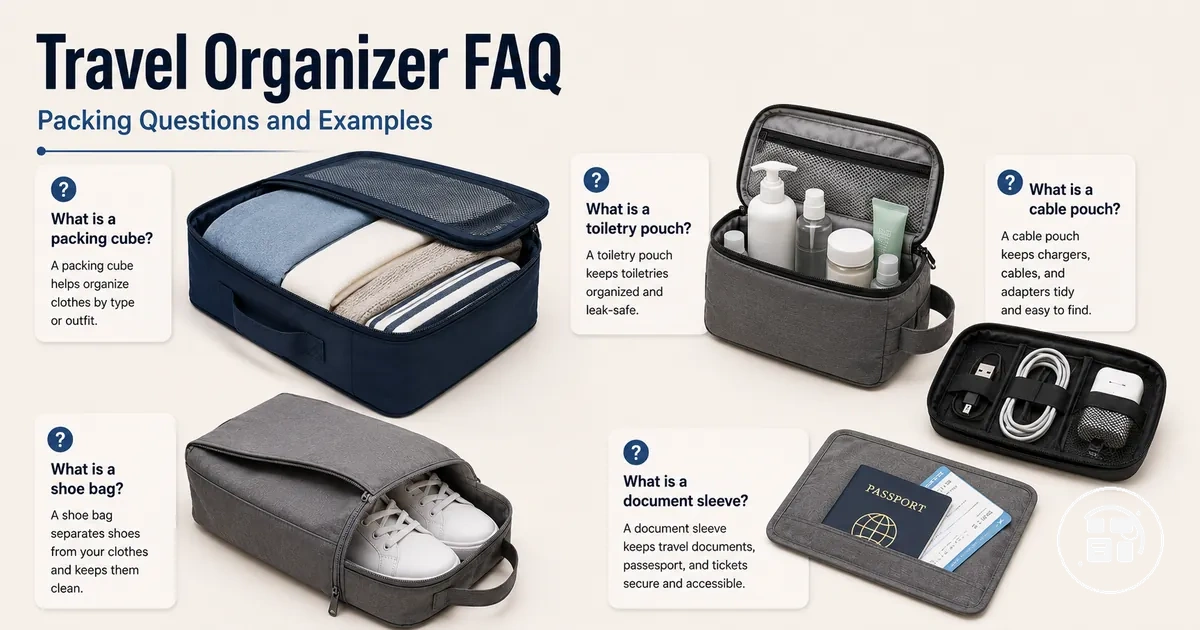
Travel Organization Accessories Questions and Answers
Travel organization accessories are packing organizers that help separate, protect, and arrange belongings inside luggage. This FAQ frames travel organizers as a category that includes packing cubes, a toiletry bag, a document pouch, an electronics organizer, and related travel pouches. The answers focus on understanding, choosing, using, cleaning, and avoiding mistakes around organizer accessories without turning the page into a buying catalog.
Use these answers to match organizer choice with packing style, luggage space, belongings, material, and use case. For the broader category context, start with the travel organization accessories overview before comparing narrower questions. Packing cubes can help with clothes and suitcase separation, while a toiletry bag may help manage liquids, leak risk, and cleaning needs. A document pouch or electronics organizer can support access when the trip context makes those belongings harder to retrieve or protect.
Travel organizer basics
Yes, travel organizers can be useful when belongings need better grouping, protection, or access during a trip. Travel organization accessories include items such as packing cubes, pouches, and other luggage organizers that help separate categories of belongings inside luggage. Their usefulness often depends on packing friction, trip context, and the type of items being packed. The basic purpose of travel organizers is to keep belongings organized and easier to access.
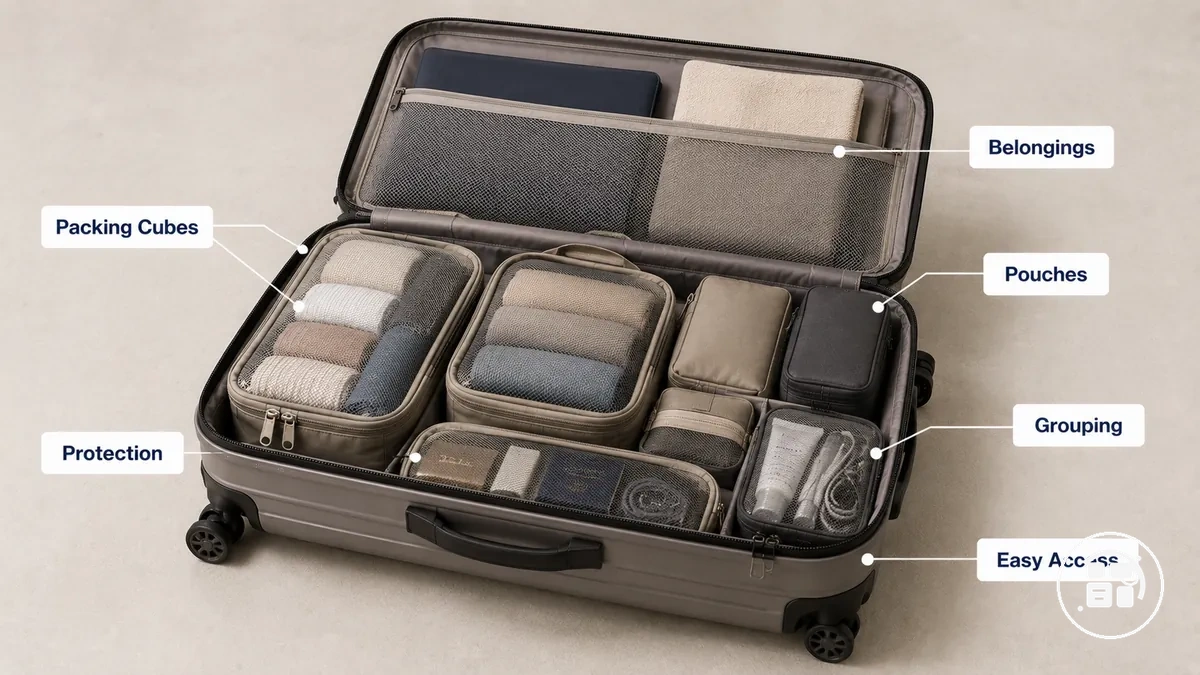
The meaning of travel organization accessories covers the broader category. Packing cubes are commonly used to keep clothes in order inside a suitcase, while pouches may help separate smaller items for better visibility and access. These distinctions provide a starting point for understanding how travel organizers can reduce packing friction in different travel situations.
What are travel organization accessories used for?
Travel organization accessories are used to separate, protect, compress, and make belongings easier to access during travel. They help organize belongings within luggage so items can be retrieved more efficiently and kept in designated spaces. Travel organizers can help reduce spills when liquids are stored in a protective pouch, while packing organizers may improve clothing arrangement through compression and separation. Their main benefit is improved organization and access when packing friction makes belongings harder to manage.
What are travel organization accessories used for in practice? The image below shows belongings separated inside luggage with a protective pouch and a clothing cube, helping clarify common organizer functions.
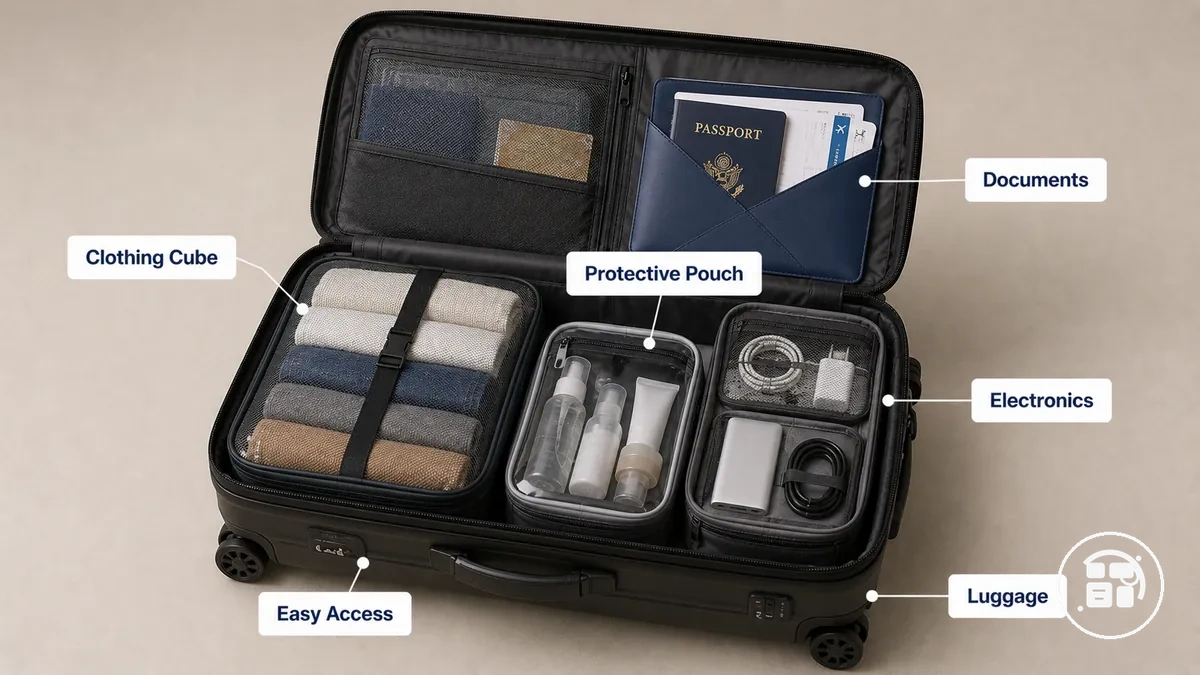
- Clothing can be grouped and compressed inside a packing cube to improve suitcase order.
- Toiletries may be stored in organizer pouches to help separate liquids and reduce spill risk.
- Documents can be kept together for faster access when retrieval is needed during travel.
- Electronics can be separated from other belongings to improve organization within luggage.
Travel organization accessories can improve arrangement and retrieval, but they do not automatically reduce baggage weight.
Are travel organizers worth using?
Yes, travel organizers are worth using when they reduce clutter, improve protection for certain items, or make unpacking easier during a trip. Their value depends on trip length, luggage size, item variety, access frequency, and cleaning needs rather than on a universal need for every traveler. Travel organizers are often most useful when belongings become harder to organize or retrieve without a dedicated system.
Are travel organizers worth using for your situation? The comparison below highlights how organized luggage can improve access compared with loose belongings, helping clarify when organizer accessories add value.
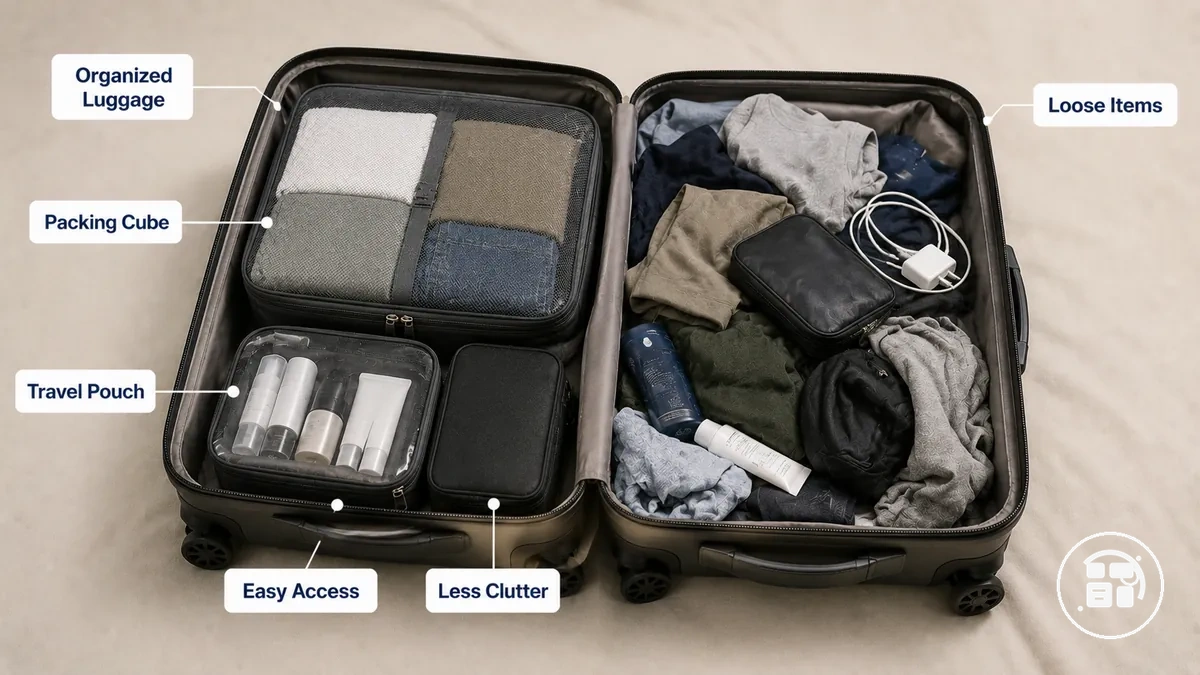
- Frequent access to items during travel can increase the usefulness of packing organizers and travel pouches.
- Longer trip length or greater item variety can make clutter harder to manage without luggage organizers.
- Luggage size affects the trade-off between organization benefits and the space taken by organizers.
- Cleaning needs, especially around toiletries, can make a dedicated pouch more useful for managing spill risk.
For light packing with few belongings, organizer accessories may provide limited additional value. For trips with more items, mixed categories, or repeated unpacking, they can make access and arrangement easier.
Which travel organizers are usually needed first?
Many travelers start with clothing cubes, a toiletry bag, a document pouch, and a small electronics organizer because these first organizers cover common item groups that are often harder to manage in luggage. Clothing cubes help separate clothes inside a suitcase, while a toiletry bag can help contain liquids and simplify cleaning after minor leaks. A document pouch supports access and protection for travel documents, and an electronics organizer can keep cables and small devices easier to retrieve. These starter organizers are often most useful when item variety or packing complexity begins to increase.
First-priority organizers usually depend on the item group being carried:
- Clothes: Clothing cubes or packing cubes for separation inside a suitcase.
- Liquids: A toiletry bag when leak risk or cleaning needs are a concern.
- Documents: A document pouch for quicker access and basic protection.
- Devices: An electronics organizer for cables, chargers, and small accessories.
For a short trip or a simple carry-on setup, only one or two organizer types may be enough. Trips involving more liquids, documents, or devices may benefit from additional organizer pouches without requiring a complete set.
Packing cubes and organizer types
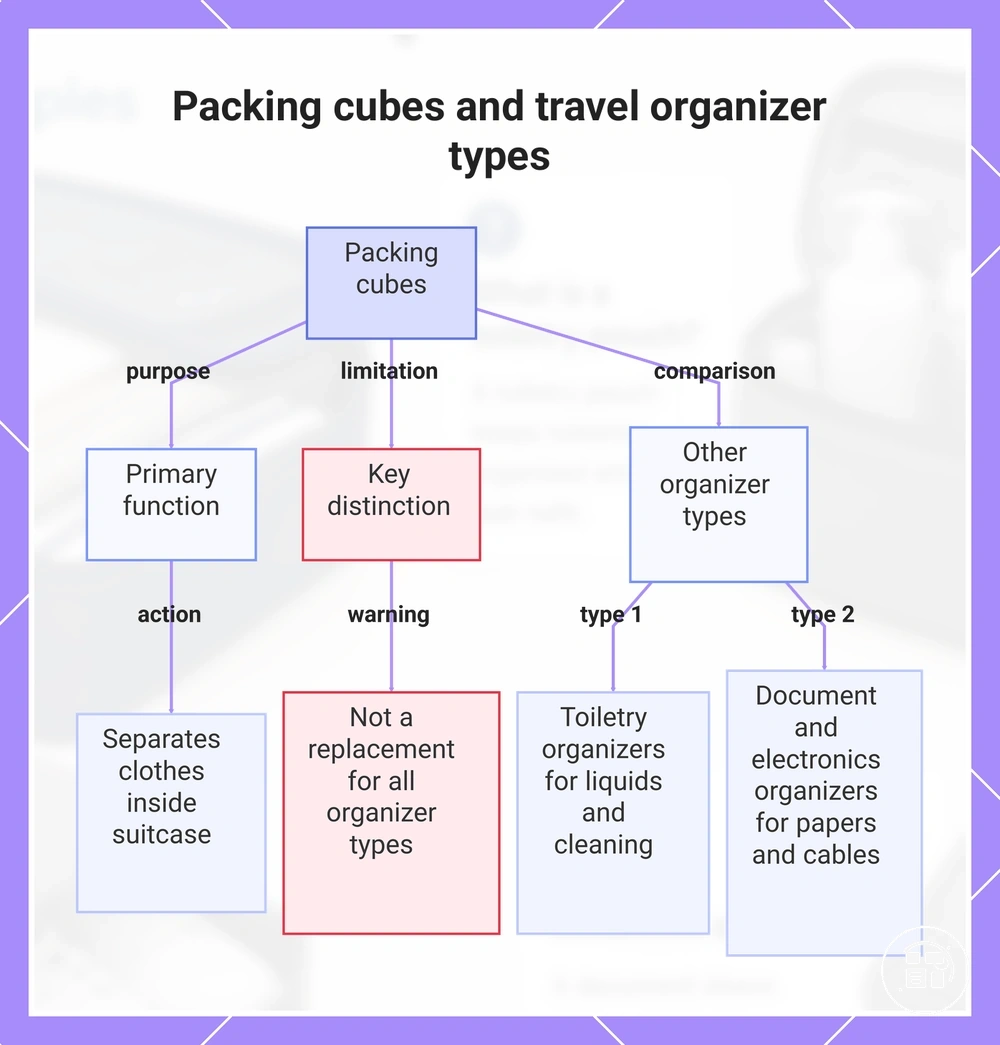
Packing cubes are one type of travel organizer, not a replacement for all organizer types. Their primary function is separating clothes inside a suitcase, while pouches, toiletry organizers, document holders, and electronics organizers are designed for different item groups and access needs. Packing cubes fit within the broader category of travel organizers alongside these other organizer types. This distinction helps place packing cubes within the category without treating them as the solution for every organizing function.
Packing cubes focus on clothes and suitcase separation, while other organizer types serve different functions. Toiletry organizers are typically used for liquids and cleaning-related needs, document holders help with access to travel documents such as a passport, and electronics organizers keep cables and accessories grouped in compartments that may improve retrieval. The following questions address these type-based distinctions without expanding into a full taxonomy of travel organizers.
This chart shows the primary function of packing cubes and how they differ from other travel organizer types.
How many packing cubes do I need?
Most travelers need only enough packing cubes to separate clothing by category, outfit, or trip segment. Cube count depends on clothing type, suitcase capacity, trip duration, and packing style rather than on a fixed rule. A carry-on setup may use fewer packing cubes than larger luggage, while more clothing volume can increase the need for separation. The right cube count depends on how much clothing needs to be organized within the available suitcase capacity.
The following factors usually influence cube count:
- Suitcase capacity: Larger luggage can provide more space for clothing cubes and category separation.
- Clothing type: Different clothing categories may be easier to organize when separated into individual packing organizers.
- Trip duration: Longer trips or more outfit changes can increase the need for organized separation.
- Packing style: Packing style affects whether fewer or more travel cubes are useful for access and organization.
For a carry-on, cube size and remaining closure space may affect how many packing cubes fit comfortably. Checked luggage often provides more flexibility for category separation. For family packing, multiple travelers may benefit from separate clothing cubes to improve access and identification.
Do packing cubes replace other travel organizers?
No, packing cubes replace only some clothing organization needs and do not replace travel organizers used for toiletries, documents, electronics, leak-control, or item protection. Packing cubes are designed for clothing separation inside luggage, while other organizer accessories serve different functions based on item type and storage requirements. Whether an organizer can be replaced depends on what is being packed and the level of access, containment, or protection needed. Packing cubes are one organizer type within a larger packing system rather than a replacement for every organizer function.
| Organizer Type | Primary Function | Limitation | Best-Use Condition |
|---|---|---|---|
| Packing cubes | Clothing separation and organization | Limited suitability for toiletries, documents, or electronics | Organizing clothes inside luggage |
| Toiletry bag | Managing toiletries and liquids | Not intended for clothing separation | When liquid containment or cleaning concerns exist |
| Document pouch | Document access and flat storage | Not designed for clothing organization | When documents need organized storage and easier access |
| Electronics organizer | Organizing cables and accessories | May not organize clothing effectively | When electronics benefit from compartments or added protection |
A common misconception is that clothing cubes can handle every packing need. In practice, clothing organization and item protection are different functions, so toiletries, documents, and electronics often benefit from organizer types designed for those specific uses.
What are the main types of travel organizers?
The main types of travel organizers are packing cubes, toiletry bags, document organizers, electronics organizers, shoe bags, laundry pouches, and accessory pouches. Each type is designed for a specific item group and function rather than for every packing need. The most useful organizer depends on the belongings being packed and how they need to be separated, stored, or accessed. These types are commonly grouped by the belongings they manage inside luggage.
- Packing cubes: Clothing item groups; used for clothes separation and suitcase organization.
- Toiletry bags: Toiletries and liquids; used to organize personal care items and help manage spill risk.
- Document organizers: Documents and travel papers; used for flat storage and easier access.
- Electronics organizers: Cables, chargers, and small devices; used to keep electronics organized within compartments.
- Shoe bags: Footwear; used to separate shoes from clothing and other packed items.
- Laundry pouches: Worn clothing; used to separate used items from clean clothing during travel.
- Accessory pouches: Small accessories; used to group smaller belongings for easier retrieval.
When the item group changes, the most useful organizer type may change as well. Travelers carrying more electronics may rely more on electronics organizers, while longer trips can make laundry pouches and additional packing organizers more useful for separation and access.
Which organizers work for toiletries, documents, and electronics?
Toiletries usually work best in a toiletry organizer with leak resistance or a hanging design, documents are typically easier to manage in a flat document pouch, and electronics often benefit from an electronics organizer with padding or compartments. Different belongings have different access, storage, and risk considerations. Organizer choice should match the item group being carried and the conditions of travel. The most suitable organizer depends on the specific needs of the belongings rather than a single pouch for every item type.
| Item type | Useful organizer attribute | Condition to check | Risk reduced |
|---|---|---|---|
| Toiletries | Leak-resistant lining or hanging toiletry organizer | When liquids are carried or cleaning concerns exist | Liquid-related mess and contact with other belongings |
| Documents | Flat document pouch | When passports or travel papers need quick access | Misplacement and disorganized storage |
| Electronics | Padding and compartments | When carrying cables, chargers, or fragile devices | Tangling, impact exposure, and access difficulty |
When liquids are packed, a toiletry bag with leak resistance may help separate moisture-sensitive items. Passports often benefit from a passport pouch that supports easier access, while chargers and cables are usually easier to organize in a cable organizer with dedicated compartments.
Choosing the right organizer setup
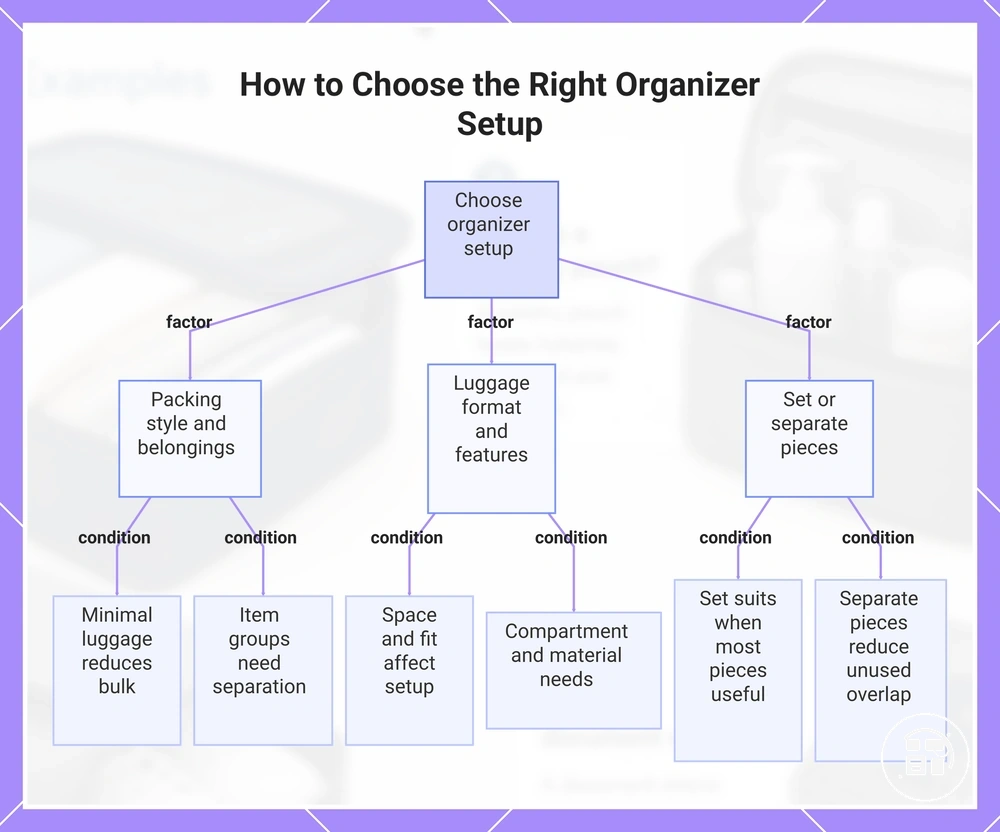
The right organizer setup depends on packing style, belongings, luggage format, and the features needed for a specific trip. A simple packing setup may be enough when item groups are limited, while a broader organizer system can be useful when clothing, toiletries, documents, and electronics need separate storage. The choice between a set and separate pieces depends on how closely the organizers match the belongings being carried. These decision variables provide the main framework for selecting an organizer setup.
When packing style favors minimal luggage, fewer luggage organizers may reduce bulk and simplify access. When belongings span multiple item groups, separate pieces can provide more targeted organization with less overlap between functions. For criteria-based selection logic tied to luggage format, feature needs, and item-specific conditions, see choosing travel organizers.
- Packing style: Match organizer type and quantity to the level of item separation needed.
- Belongings: Different item groups may benefit from different organizer types.
- Luggage format: Available space, fit, access, and bulk can influence the packing setup.
- Features: Compartments, materials, and access needs may affect practical value.
- Set or separate pieces: A set may suit situations where most included organizers are useful, while separate pieces can reduce unused overlap.
This chart shows the main decision variables for selecting a travel organizer setup, including packing style, belongings, luggage format, features, and the choice between sets and separate pieces.
How do I choose the right travel organizer accessories?
Choose the right travel organizer accessories by matching item groups, luggage space, access needs, and cleaning requirements. Organizer choice depends on criteria rather than quantity because different belongings benefit from different organizer features and fit conditions. The goal is to select an organizer setup that supports the intended use without adding unnecessary bulk. The main decision is whether the organizer feature matches the item group and travel condition.
- Item category: Match packing organizers to the belongings that need separation, protection, or easier access.
- Organizer feature: Consider compartments, padding, washability, or leak-resistant materials when those features address a specific need.
- Fit condition: Check whether organizer size works with available luggage space and supports practical access.
- Access needs: Frequently used items may benefit from travel pouches that are easier to reach during travel.
- Cleaning requirements: Materials that are easier to clean may be useful when liquids or spill risk are part of the organizer setup.
When liquids are carried, cleaning requirements and material choice may influence the decision more than the number of organizers. When devices or frequent-access documents are involved, organizer features that support protection and access can become a more important selection factor than adding extra packing organizers.
Should I buy a travel organizer set or separate pieces?
An organizer set is usually more suitable when broad starter coverage is needed, while separate pieces are often a better choice for specific packing problems. The decision depends on overlap between included organizer types, luggage fit, item-specific needs, and the likelihood of unused pieces. Neither option is automatically better because different travel situations create different organization requirements. The most suitable choice depends on whether starter coverage or a targeted solution better matches the packing condition.
| Organizer set | Separate pieces |
|---|---|
| Provides starter coverage across multiple included organizer types | Focuses on item-specific needs and individual packing problems |
| May include overlap with organizers already owned | Allows selection based on fit and intended use |
| Can result in unused pieces when all included types are not needed | Can reduce unused pieces by addressing a specific requirement |
| Often suits a first-time buyer exploring organizer functions | Often suits replacing one missing organizer or refining an existing setup |
| Luggage fit depends on the included organizer types and available space | Luggage fit can be matched more closely to a specific travel condition |
A common myth is that a travel organizer set automatically solves every organization need. In practice, unused pieces may reduce relevance when item-specific needs are limited. Minimal packers may prefer fewer organizers to reduce bulk, while travelers addressing a single packing problem may find separate pieces more appropriate.
What features matter most in travel organizer accessories?
The features that matter most in travel organizer accessories are size, durable zippers, washable materials, compartments, visibility, and protection where needed. The right combination depends on luggage fit, access needs, cleaning requirements, and the belongings being organized. Useful features are the ones that improve organization without adding unnecessary bulk. The most relevant organizer details depend on whether the feature improves access, durability, cleaning, or protection for the intended use.
- Size: When size matches luggage fit, it can improve organization while limiting unnecessary bulk.
- Zippers: Durable zippers may reduce closure-related risk when organizers are opened and closed frequently.
- Washable materials: When cleaning is a concern, washable materials can simplify maintenance and help manage odors.
- Compartments: Separate compartments can improve item separation and make access easier.
- Visibility: Better visibility can help locate items more quickly when frequent access is needed.
- Protection: Added protection may be useful for belongings that are more sensitive to pressure or contact inside luggage.
When carrying liquids, washable materials and protection may influence the decision more than extra compartments. When organizing electronics, protection and access can become more important quality signals. Compression features may be useful when luggage space is limited, but their value depends on packing style and available space.
Luggage fit and packing rules
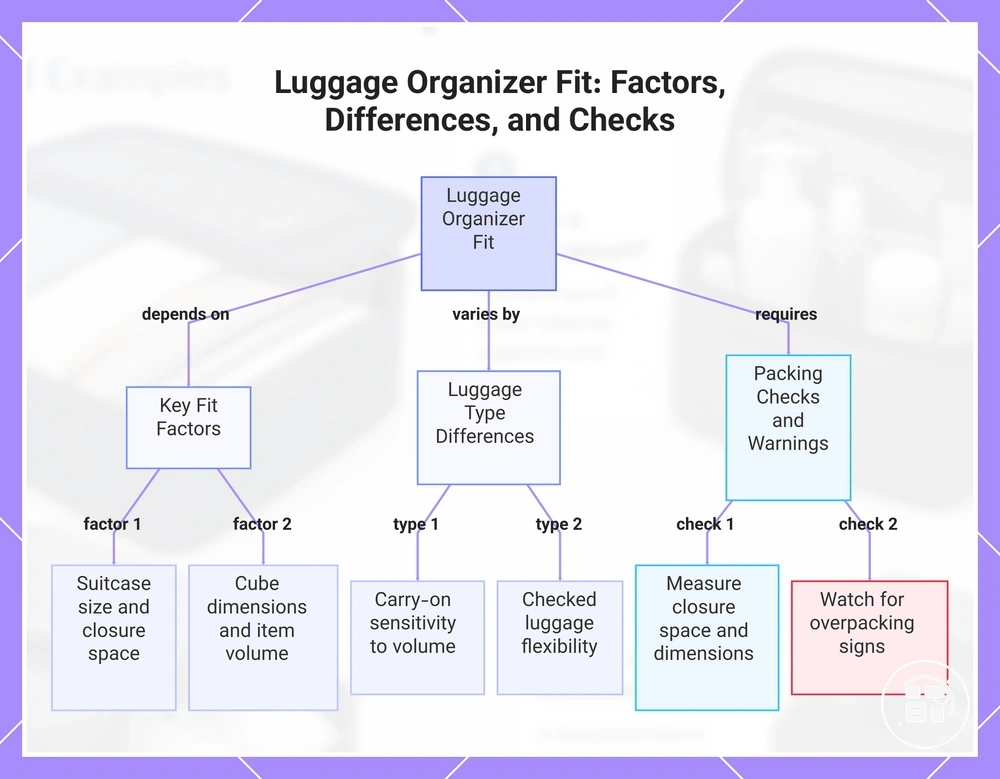
Yes, luggage fit and packing rules matter because organizers should fit within available suitcase space without competing with luggage capacity. Luggage fit depends on suitcase size, cube dimensions, item volume, access frequency, and the amount of closure space remaining after packing. When organizer size exceeds practical suitcase space, retrieval can become less convenient and overpacking risk may increase. Rules of thumb can support packing decisions, but they do not replace measuring and testing organizer fit in the intended luggage.
For carry-on luggage, limited closure space can make organizer fit more sensitive to item volume and placement. For checked luggage, extra suitcase space may provide more flexibility, but overpacking can still affect access and retrieval. For practical usage examples, packing with travel organizers can help show how packing fit influences access decisions.
- Check whether organizer size leaves enough closure space after packing.
- Compare cube dimensions with usable suitcase size rather than overall luggage dimensions.
- Estimate item volume before adding additional organizers.
- Consider access frequency when deciding item placement and retrieval priority.
- Watch for overpacking signs such as reduced closure space, added bulk, or restricted access.
- Use compression features carefully when increased density may affect organizer fit or retrieval.
This chart shows the key factors affecting luggage organizer fit, how carry-on and checked luggage differ, and practical checks to avoid overpacking.
How should travel organizers fit inside luggage?
Travel organizers should sit flat inside luggage, leave enough closure space, and keep accessible items easy to reach. Organizer fit depends on organizer size, fullness level, and the available luggage compartment rather than on a universal packing rule. When travel organizers become overfilled or bulky, closure may become more difficult and usable suitcase space may be reduced. The most reliable fit condition is whether the organizer fits within available luggage space without creating unnecessary pressure during closure.
- Check whether the organizer size fits the intended luggage compartment without limiting closure space.
- Leave enough closure space so packed items do not create excessive pressure when the luggage is closed.
- Keep accessible items near the top layer when frequent retrieval is expected.
- Monitor fullness level to reduce bulk and maintain a flatter cube shape.
- Confirm that the closure outcome remains comfortable rather than forced after packing.
Overfilled cubes can increase bulk and change shape, which may reduce packing fit inside a suitcase compartment. Bulky toiletry bags can create localized pressure, especially when suitcase space is already limited. In hard-sided cases, lower flexibility may make organizer size and fullness level more important to luggage fit.
Do packing rules like 3-3-3 or 5-4-3-2-1 change which organizers I need?
Yes, packing rules such as 3-3-3 or 5-4-3-2-1 can reduce the number of organizers needed by limiting clothing count and supporting outfit planning, but they do not determine the exact organizer type by themselves. Packing rules mainly provide a volume estimate that can influence organizer capacity and suitcase space decisions. Travel organizer choice still depends on item separation needs, item type, and whether protection is needed for specific belongings. As a boundary, a packing formula helps estimate volume, but item type determines whether cubes, pouches, or protective organizers may be needed.
- A lower clothing count may reduce the number of packing cubes needed.
- Outfit planning can help estimate organizer capacity before packing.
- Electronics, documents, or toiletries may still require a different organizer type regardless of the packing method.
- Item separation needs can change even when the same packing rules are used.
For example, a packing rule may reduce clothing volume enough for fewer cubes, but it does not determine whether a toiletry pouch or electronics organizer is necessary. Organizer type depends more on the item being packed than on the rule of thumb used to estimate travel volume.
Can too many organizers make packing harder?
Yes, too many organizers can make packing harder when they add bulk, create hidden items, or lead to unnecessary sorting. A higher organizer count can increase unused space, create access friction, and make repacking difficulty more noticeable during travel. The problem is usually a mismatch between organizer use and packing needs rather than the use of organizers themselves. The main risk appears when organizer count exceeds what the available luggage space and item separation needs require.
The following warning signs can help identify organizer overload:
- Duplicate pouches store similar items and make hidden items harder to locate.
- Unused space remains trapped inside multiple organizers while luggage space becomes more limited.
- Access friction increases because retrieving one item requires opening multiple organizers.
- Overfilled cubes add bulk and can increase repacking difficulty when adjustments are needed.
- Rigid bags in small luggage can create pressure that reduces packing flexibility.
Duplicate pouches and over-sorting can slow item retrieval even when packing volume stays similar. When organizer count is aligned with actual packing needs, packing clutter and repacking difficulty may become easier to manage.
Cleaning and care questions
Yes, most travel organizers can be cleaned, washed, disinfected, and stored, but the appropriate method depends on the material, washability, lining, zippers, and overall construction. Cleaning needs may differ when organizers use coated fabrics, padding, mesh sections, or water-resistant treatments. A hygiene issue such as liquid residue, odor, or toiletry contamination can change the safest care approach. The correct cleaning method depends on the organizer material and any care limitations that apply to that design.
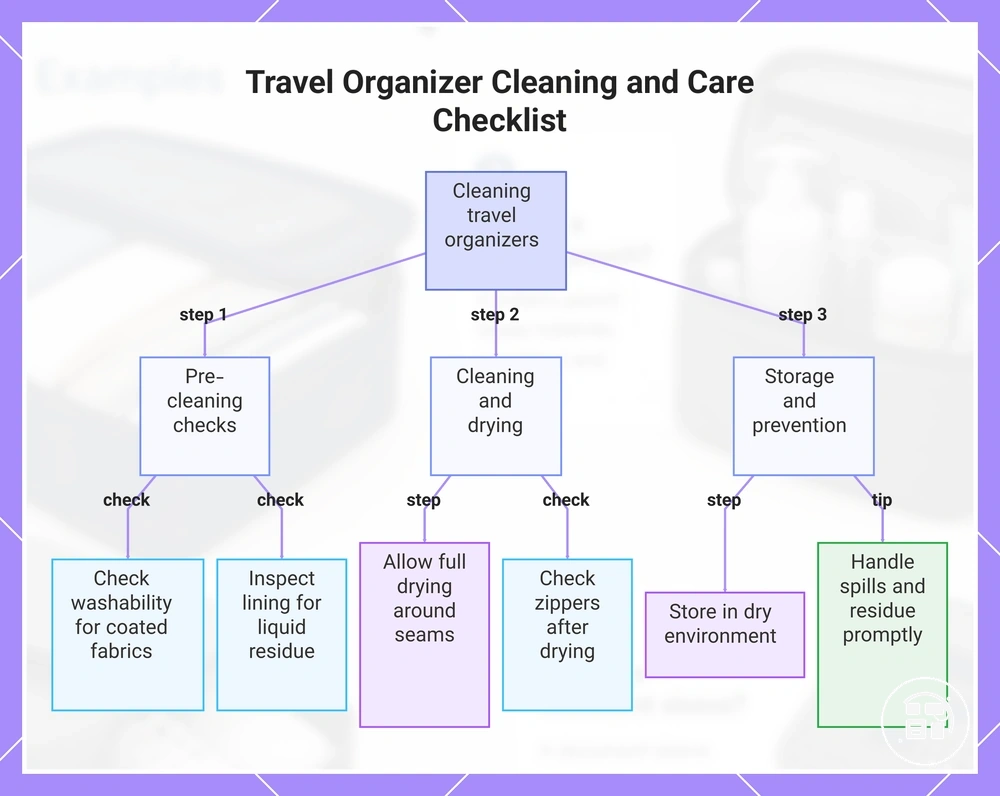
When material differences affect safe handling, the following checklist can help guide cleaning and maintenance decisions:
- Check washability before washing, especially when coated fabrics, padding, or structured panels are present.
- Inspect the lining for liquid residue that may contribute to odor when cleaning is delayed.
- Allow full drying after cleaning or disinfecting, particularly around seams, folds, and enclosed areas.
- Check zippers after drying because trapped moisture may affect function over time.
- Store organizers in a dry storage environment and avoid prolonged moisture or unnecessary compression when possible.
A cleaning issue is often easier to address when residue, spills, or contaminated toiletry items are handled promptly. For broader care and storage guidance, see cleaning and storing organizers. The appropriate washing, disinfecting, drying, and storage routine depends on the material and care condition rather than a single method for every organizer.
This chart shows the key steps and checks for cleaning travel organizers based on material and design.
How do I clean travel organization accessories?
Most travel organization accessories should be emptied, shaken out, spot-cleaned, and dried fully before storage. The safest cleaning method depends on the material, dirt type, washability, and any coating, padding, or hardware used in the organizer. Moisture left after cleaning can increase odor risk, especially when liquid residue is present. Before cleaning, check the material and washability condition to determine the appropriate care method.
When cleaning sequence matters, the following steps can help:
- Empty the organizer and shake out loose dirt, dust, or residue.
- Spot-clean affected areas using a cleaning method that matches the material and washability condition.
- Wipe down the lining when liquid residue, dirt, or odor risk is concentrated inside the organizer.
- Clean around zippers, coatings, and seams gently when those components may be sensitive to abrasion or moisture.
- Dry fully before storage so remaining moisture has less opportunity to contribute to odor risk.
A padded electronics organizer may require a different cleaning method than a mesh cube or a coated toiletry bag. When dirt, odor, or liquid residue remains, the appropriate care approach depends on the material, washability limits, and the condition being addressed rather than a single routine for every organizer.
Can packing cubes and travel bags be washed?
Yes, some packing cubes and travel bags can be washed if their material and care label allow it. The appropriate washing method depends on fabric type, mesh panels, coatings, padding, zipper hardware, and drying requirements. Water exposure may be suitable for certain washable organizers, while other materials may require a more limited cleaning approach. Before washing, check the care label and material condition to determine whether the method is appropriate.
The following checklist can help verify whether washing may be suitable:
- The care label allows a washing method compatible with the fabric and material condition.
- Mesh panels do not have care limitations that require gentler cleaning or drying.
- Coatings or waterproof linings do not include restrictions related to water exposure.
- Padding, leather details, or structured panels do not require a different cleaning approach.
- Zipper hardware and compression zippers can be cleaned without creating unnecessary stress on their function.
Mesh cubes may respond differently to cleaning than coated travel bags or padded organizers. When waterproof linings, coatings, structured panels, or compression zippers are present, washing and drying decisions depend on the material and care label rather than a single method for all packing cubes and travel bags.
How do I disinfect travel organizers safely?
Safe disinfection usually means using mild surface cleaning that is compatible with the organizer material and then drying it completely. The appropriate approach depends on material sensitivity, liquid exposure, contact time, ventilation, and residue risk. Organizers used for toiletries, shoes, laundry, documents, or electronics may require different levels of caution because moisture and cleaning products can affect materials differently. Before attempting to disinfect, confirm that the cleaning method is compatible with the organizer material and care condition.
When safe disinfection depends on material compatibility, the following process can help:
- Remove loose dirt or residue and wipe clean using a mild surface cleaning method suitable for the organizer material.
- Allow the cleaner to remain only for the contact time appropriate to the product and material condition.
- Limit liquid exposure around linings, coatings, padding, and zipper areas when excess moisture may increase residue risk.
- Provide adequate ventilation during drying so moisture has less chance of contributing to odor or material-related issues.
- Check for remaining residue before storage, especially when the organizer is used for documents, electronics, toiletries, shoes, or laundry items.
When contamination, odor, or residue is present, mild surface care may be more suitable than soaking or heat treatment. Electronics organizers with padding and organizers with coatings or moisture-sensitive linings may require additional caution because moisture exposure can affect their condition depending on the material.
How should travel organizers be stored between trips?
Travel organizers should be stored clean, dry, loosely packed, and protected from moisture or compression damage between trips. Storage conditions depend on the organizer material, structure, and care condition because trapped moisture or prolonged pressure can affect shape and usability. A dry organizer may have less moisture-related odor risk during storage when it is fully dry before being stored.
When storage conditions need verification, use the following checklist:
- Confirm the organizer is clean and dry before storage.
- Fold loosely when the organizer is designed to collapse without creating unnecessary compression.
- Keep the zipper position relaxed when pressure on seams, fabric, or hardware may affect condition.
- Allow the organizer to air out when odor control is a concern and residual moisture may still be present.
- Store toiletry bags and shoe bags separately when residue or hygiene concerns could transfer to other organizers.
Foldable cubes may benefit from limited compression when preserving shape is a concern. Structured toiletry bags may require separation when residue remains a possibility. Padded electronics organizers may need protection from sustained pressure because compression damage can depend on padding condition and storage environment.
Mistakes and replacement questions
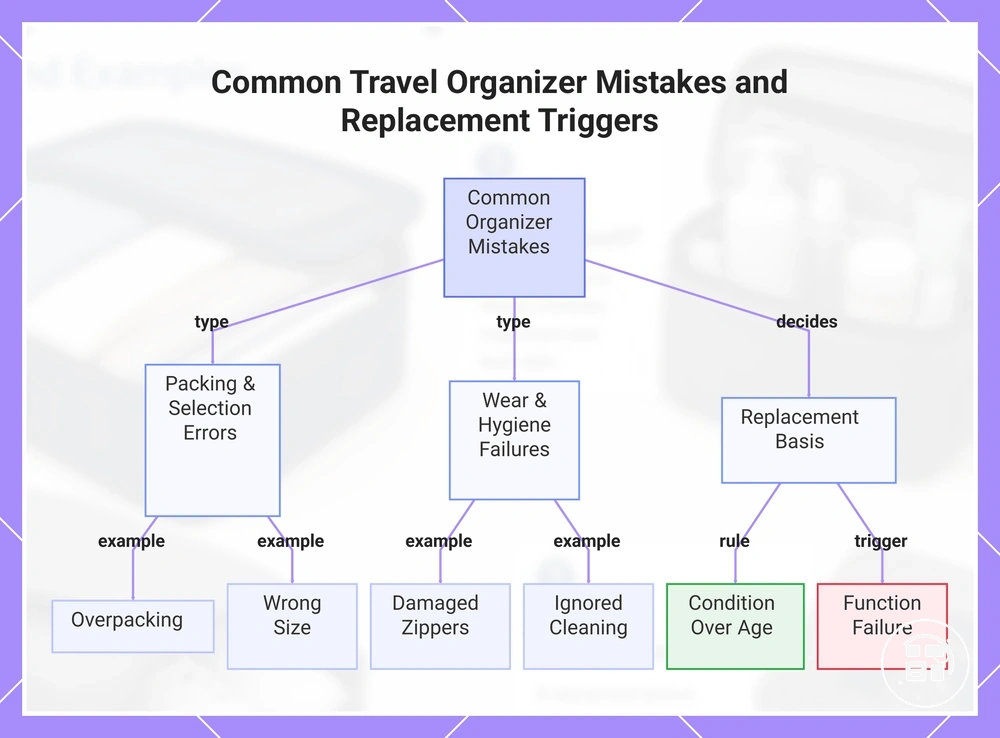
Yes, common organizer mistakes can often be recognized before replacement becomes necessary. Overpacking, wrong size selection, poor item separation, ignored cleaning needs, damaged zippers, and lost structure can create fit problems, access difficulties, hygiene concerns, or closure issues. A replacement decision usually depends on the condition causing the problem rather than on age alone. Travel organizers can support better packing, but they cannot fix unrealistic packing volume, poor luggage choice, or unsafe item placement.
When symptoms and failure signs need to be grouped, the following checklist can help identify mistakes and replacement signals:
- Overpacking creates organizer bulk that may increase fit problem risk and reduce access.
- Wrong size organizers can leave unused space or make packing less effective for the intended luggage.
- Poor item separation may lead to hidden items, slower retrieval, and packing errors.
- Damaged zippers or closure failure can become replacement signals when reliable closure is no longer maintained.
- Lost structure, unsafe contamination, persistent residue, or odor concerns may indicate organizer wear that requires closer evaluation.
Yes, replacement questions usually begin with organizer condition rather than the desire for a different option. When failure signs affect access, closure, hygiene, or structure, replacement may be more practical than continued use. For a closer look at mistakes and fit problems, review how packing conditions and organizer selection can contribute to recurring issues.
This chart shows the main organizer mistakes that can lead to replacement and the key condition that determines when replacement is needed.
What are common travel organizer mistakes?
Yes, common travel organizer mistakes include choosing the wrong size, using too many pouches, overfilled cubes, mixing wet and dry items, and ignoring access needs. These travel organizer mistakes can create luggage fit issues, retrieval delays, cleaning concerns, or closure problems when packing conditions are not considered. The cause and effect differ by mistake, but prevention usually depends on matching the organizer setup to the intended use and packing condition. Prevention is most effective when organizer choices reflect actual packing needs rather than adding complexity.
The following points separate each mistake by cause, effect, and prevention:
- Wrong size: A wrong size organizer can create bulk or unused space; prevention depends on checking luggage fit before packing.
- Too many pouches: Too many pouches can hide items and increase access friction; prevention involves limiting unnecessary item separation.
- Overfilled cubes: Overfilled cubes can contribute to closure problems and added bulk; prevention depends on leaving enough space for comfortable closure.
- Wet and dry items: Mixing wet and dry items can increase contamination and cleaning concerns; prevention involves keeping moisture-sensitive items separated.
- Ignoring access needs: Frequently used items stored inside multiple organizers can slow retrieval; prevention depends on organizing items according to expected access needs.
A fit mistake may occur when a large organizer occupies more luggage space than needed. An access problem may develop when hidden items are distributed across too many pouches. A cleaning concern may arise when wet and dry items are packed together without separation.
What packing mistakes do organizers not solve?
Yes, there are packing mistakes organizers do not solve by themselves. Excessive volume, overweight luggage, prohibited items, poor weight distribution, and fragile items can remain problems even when belongings are neatly organized. Travel organizer limitations appear when the issue relates to quantity, weight, compliance, or protection rather than organization. The key boundary is that organizers can improve organization, but they do not remove packing limits or the remaining risk created by those limits.
| Issue Type | Organizer Effect | Remaining Risk | Better Corrective Action |
|---|---|---|---|
| Organization problem | Can improve item separation and access | May remain if packing errors continue | Adjust organization based on item type and access needs |
| Packing-limit problem | Limited effect on quantity, weight, or compliance | Excessive volume, overweight luggage, prohibited items, or fragile-item damage risk may still remain | Reduce volume, improve weight distribution, review item suitability, or use more appropriate protection when needed |
A packing cube may organize bulky clothing, but excessive volume can still create luggage space limitations. A pouch may separate liquids, electronics, or documents, yet prohibited items and compliance concerns remain outside the organizer effect. Fragile items may be easier to organize, but protection and placement still require caution because the remaining risk depends on packing conditions.
When should a travel organizer be replaced?
A travel organizer should be replaced when damage, odor, poor closure, lost structure, or contamination begins to affect its function. Visible wear does not always require replacement, but failure signs become more important when they reduce reliable storage, protection, or hygiene. The checklist below focuses on observable conditions that may indicate function loss. A travel organizer is usually replaced because of condition and performance concerns rather than a fixed replacement date.
- Zipper condition: Poor closure, repeated snagging, or closure failure can become a replacement signal when secure storage is no longer maintained.
- Fabric tears: Fabric tears can increase the risk of item loss, contamination, or reduced usability, depending on their location and severity.
- Coating failure: Peeling, cracking, or worn coatings may reduce the organizer's ability to contain moisture or residue.
- Padding collapse: Padding collapse in an electronics organizer may reduce protection and may require closer evaluation.
- Odor, staining, and contamination: Persistent odor, staining, or contamination can become a hygiene concern when cleaning no longer restores acceptable condition.
- Lost structure: Lost structure can affect packing stability, item separation, or access when the organizer no longer maintains its intended shape.
A toiletry bag with repeated leak-related contamination may present a higher hygiene risk than a lightly worn organizer. A shoe bag with persistent odor or an electronics organizer with padding collapse may justify being replaced when failure signs affect function. A document pouch may also warrant replacement when damage affects secure storage or reliable closure.