
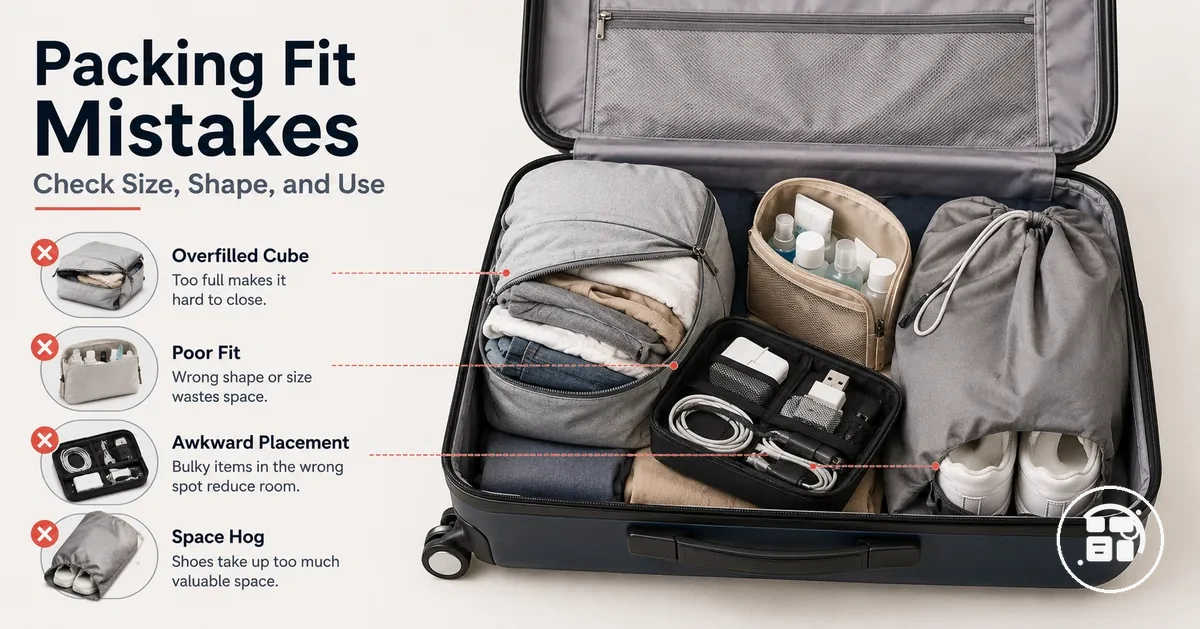
Travel Organization Accessories Fit Problems and Packing Mistakes
Travel organization accessories usually create fit problems when organizer size, packing volume, compression, or access needs do not match the suitcase space available. Packing cubes, pouches, and compression packing cubes can organize items, but they do not create unlimited capacity when luggage dimensions, clothing volume, or compartment shape are already restrictive.
This page focuses on packing mistakes and visible fit symptoms involving travel organizers, not general luggage buying or a full packing workflow. The main problem is often a mismatch between the organizer setup and the suitcase: too many pieces, overfilled cubes, bulky pouches, or poor item separation can make access harder and increase zipper pressure. For broader category context, use the travel organization accessories hub as the main reference point. The next diagnostic layer is to identify what the suitcase is showing before deciding what to adjust.
A suitcase may look organized at first but still close poorly if packing cubes are rounded, compression packing cubes push volume into the middle, or frequently needed items are buried under rigid pouches. In many cases, the correction depends on whether the issue comes from overpacking, organizer depth, luggage dimensions, or the way items are grouped for access.
The page-level diagnosis is simple:
- Bulging layers may suggest overfilled packing cubes, mismatched organizer size, or limited suitcase space.
- Tight zippers can point to excess volume, poor cube shape, or pressure from stacked organizers.
- Buried essentials often come from item separation mistakes and weak access planning.
- Compression can reduce soft-item puffiness, but compression packing cubes do not reduce weight or remove realistic limits.
Why Travel Organizers Fail to Improve Packing
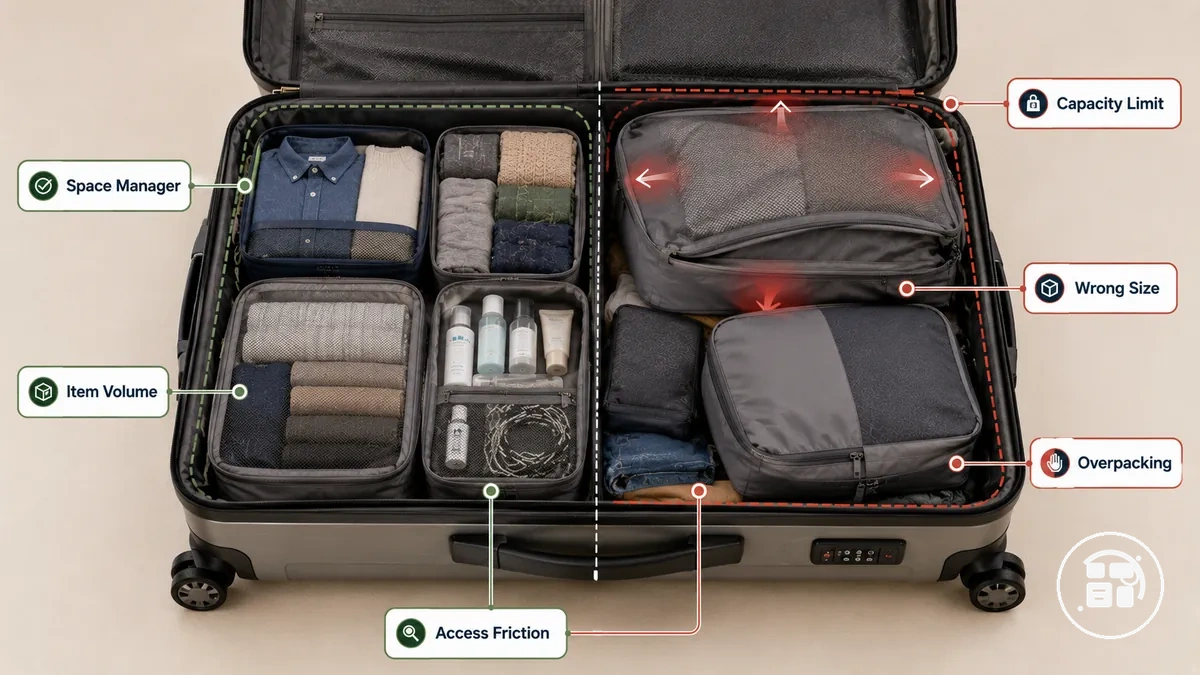
Travel organizers fail to improve packing when expectations exceed suitcase capacity, item volume, or compartment shape. They can separate and stabilize belongings, but they work as space managers rather than extra suitcase capacity.
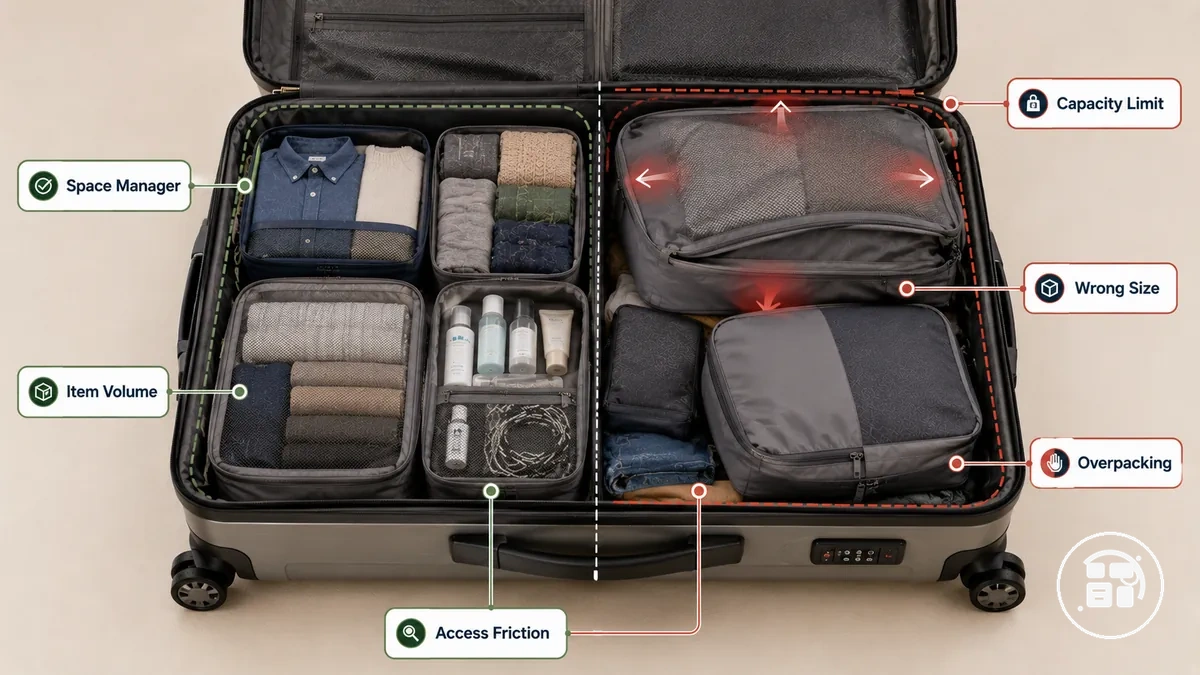
Space management means using organizers to group items, control movement, and make access more predictable inside the luggage space that already exists. If the organizer setup ignores compartment shape, rigid edges, or remaining usable space, the same items may create more zipper pressure or access friction. Fit and access need to be checked together because a neat layer can still block essentials or press against the suitcase closure.
Why Travel Organizers Fail to Improve Packing becomes clearer when the mistake is separated from the tool itself. The common failure patterns usually come from wrong expectations, wrong size, wrong quantity, wrong grouping, wrong compression use, or poor access planning.
- Wrong expectation: Travel organizers can improve separation and usability, but they may not improve packing when the suitcase is already near its practical capacity.
- Wrong size: An organizer that conflicts with compartment shape can waste usable space even when the item volume seems reasonable.
- Wrong quantity: Too many storage pouches can create air gaps, rigid edges, and overlap that reduce flexible packing space.
- Wrong grouping: Mixed item groups can make access slower when essentials are buried under clothing or bulky pouches.
- Wrong compression use: Compression expectations can cause overpacking if compressed volume is treated as reduced weight or unlimited capacity.
- Poor selection criteria: Organizer setup should match luggage constraints, item volume, and access needs when users choose travel organizers correctly.
Fit Symptoms That Show the Organizer Setup Is Wrong
When fit symptoms appear, the organizer setup may be contributing to the problem, but the symptom alone does not identify one guaranteed cause. Bulging, tight zippers, shifting clothes, wrinkles, and buried essentials are useful warning signs because they can point toward setup issues when viewed alongside suitcase shape, overpacking, and item distribution. Symptoms suggest likely causes rather than proving an exact diagnosis, which is why symptom-based evaluation is more reliable.
In carry-on luggage, limited space may make bulging or zipper resistance easier to notice, while checked luggage can hide uneven layers until contents move during handling. Soft organizers, rigid pouches, and compression cubes may create different packing symptoms depending on how they interact with suitcase shape and item distribution. The table below connects visible problems to likely organizer issues and practical checks before any changes are made.
| Symptom | Likely organizer issue | Check | What it means |
|---|---|---|---|
| Bulging | Overfilled cube or oversized organizer | Compare organizer size to available suitcase space | Item volume may exceed what the compartment can hold comfortably |
| Tight zippers | Excess pressure from packed layers | Check for compression, stacking, or overpacking | Zipper resistance may indicate concentrated pressure inside the suitcase |
| Uneven layers | Mismatched organizer sizes | Look for gaps, overlaps, or rigid pouch edges | Uneven item distribution may reduce usable packing space |
| Shifting clothes | Loose organizer setup | Check whether cubes fit securely in the compartment | Movement may increase disorder and reduce packing stability |
| Wrinkles | Compression or crowding in limited space | Inspect folded items for pressure points | Fabric may crease when item distribution concentrates pressure |
| Buried essentials | Poor access planning | Check whether frequently used items sit beneath bulky organizers | Access can become slower even when the suitcase appears organized |
Bulging cubes, tight zippers, and uneven suitcase layers
When bulging cubes, tight zippers, or uneven suitcase layers appear, the likely cause is often excess volume, a shape mismatch, or a depth mismatch within the organizer setup. These visible signs usually indicate pressure points inside the luggage rather than a product problem. The cause may depend on cube fill level, organizer height, and suitcase shell depth.
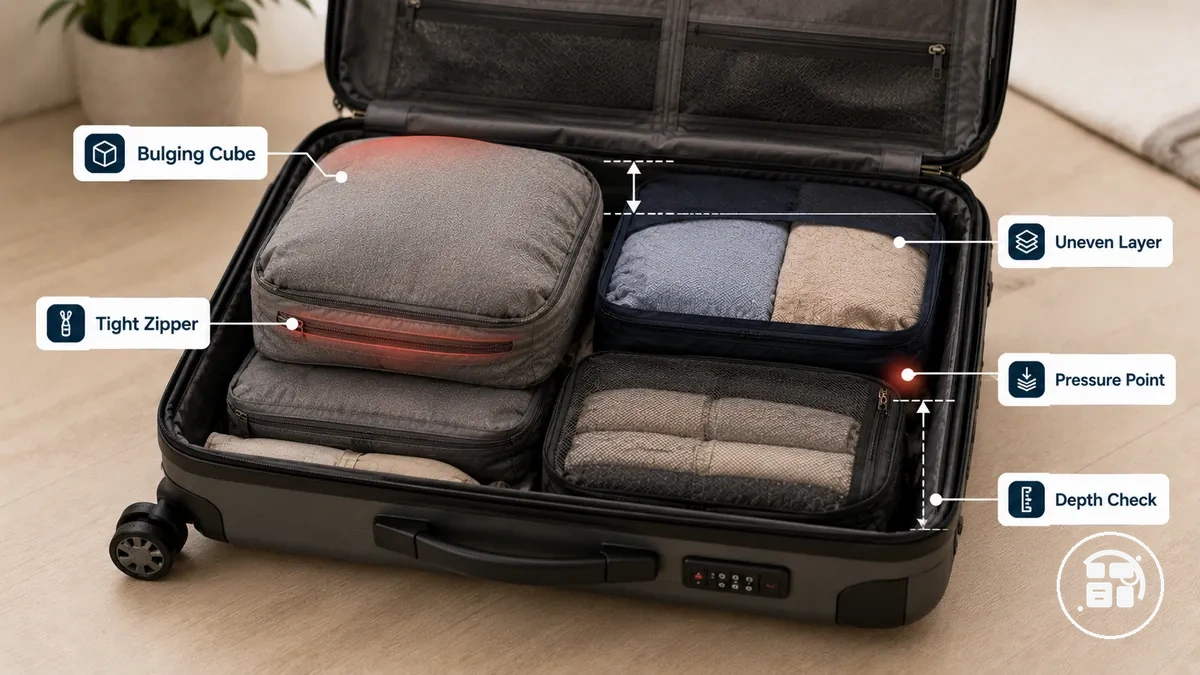
Bulging cubes can result from excess fill, while tight zippers may indicate zipper strain when the packed height exceeds the available depth. Checking local pressure points helps distinguish excess volume from a shape mismatch. Use this checklist to inspect the symptom cluster:
- Check cube shape: Rounded edges or bulging cubes may suggest that the cube fill level exceeds the available space.
- Check zipper resistance: Tight zippers may indicate zipper strain when closure pressure builds between packed layers.
- Check layer height: Uneven suitcase layers can appear when organizer height does not align with suitcase shell depth.
- Check pressure location: Concentrated pressure points in one area may suggest a local fit issue rather than overall overpacking.
- Check suitcase shell depth: A soft cube inside a shallow or rigid suitcase may create a visible bulge even when items remain organized.
Shifting clothes, wrinkles, and buried essentials
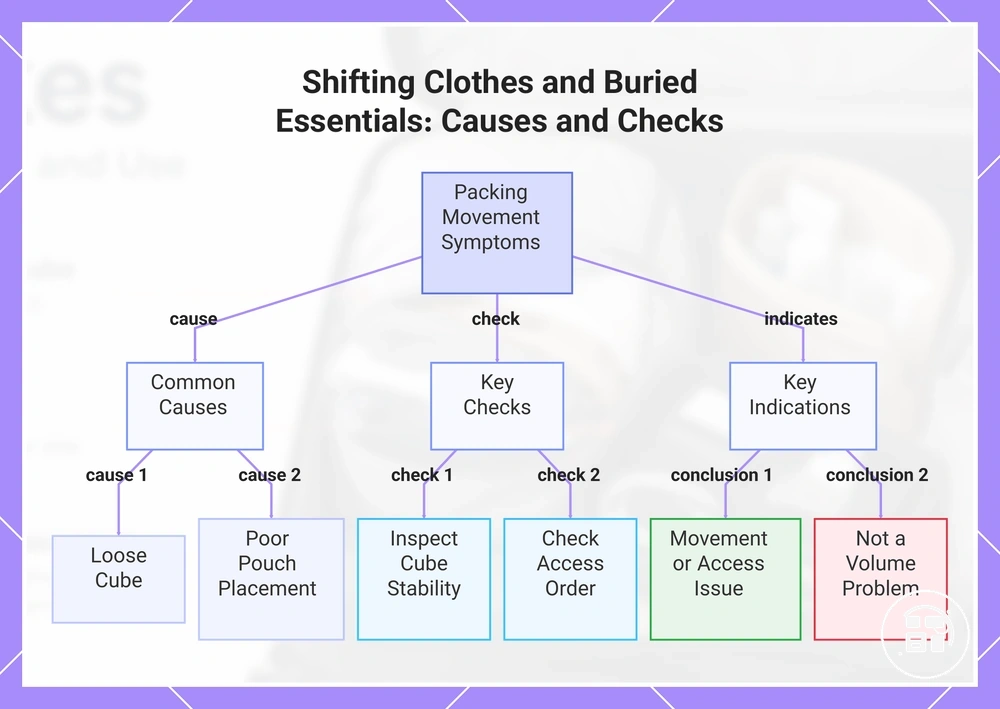
When shifting clothes, wrinkles, or buried essentials appear, the likely cause is often a loose cube, weak separation, or poor organizer placement. These symptoms suggest that items are moving more than intended or becoming difficult to access during transit. The local cause usually relates to movement, item grouping, or access order.
During transit, clothes movement can occur when a loose cube leaves space around packed items. Buried essentials often become harder to reach when pouch placement and access order do not match how frequently items are needed. Inspect cube stability, item grouping, and pouch placement to identify the source of poor access.
- Loose fill: A loose cube can allow shifting clothes and increase movement between item layers.
- Mixed item groups: Weak separation between different item types can make buried essentials harder to locate and increase repacking.
- Poor pouch placement: Frequently used items may become hidden essentials when larger organizers block access.
Shifting clothes and buried essentials usually indicate movement or access issues rather than a volume problem. Wrinkles may also develop when movement continues during transport, although the result can vary by fabric and travel conditions.
This chart shows the common causes of shifting clothes and buried essentials in travel bags, along with key checks and what the symptoms indicate.
Size and Luggage Compatibility Mistakes
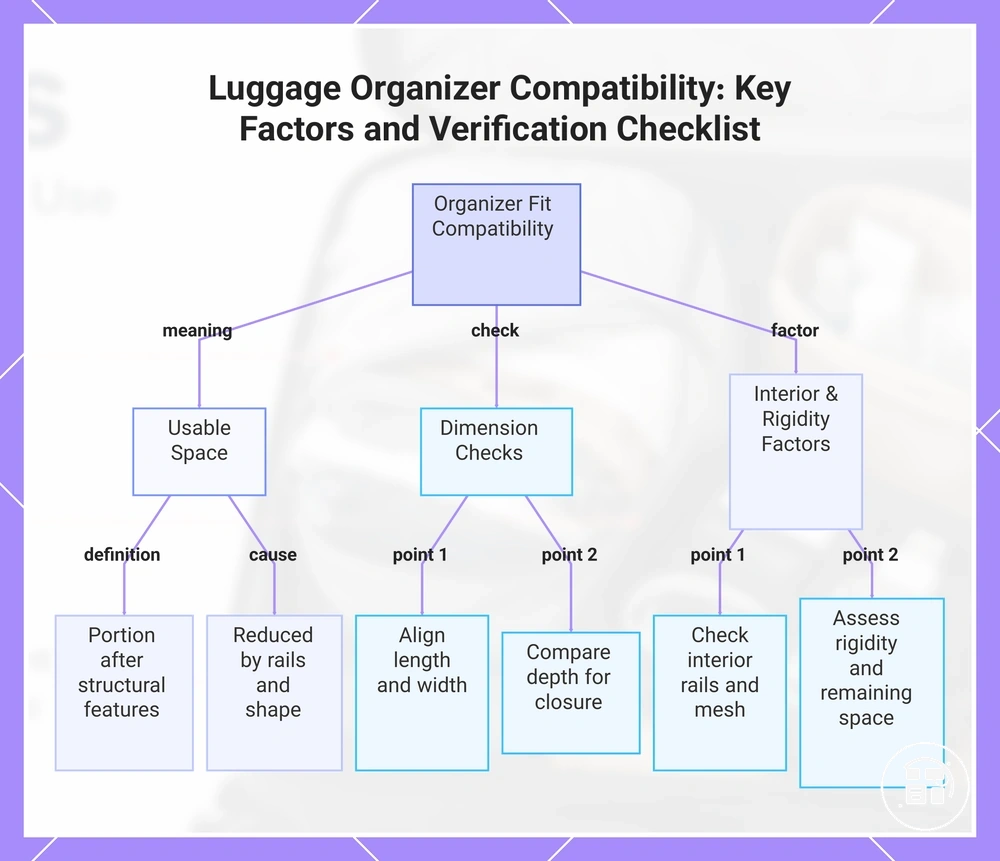
Organizer size depends on usable space inside the suitcase rather than the labeled size alone. Luggage dimensions, compartment shape, and interior features can affect luggage fit even when an organizer appears compact. Compatibility depends on how organizer size relates to the available interior space.
Usable space is the portion of the suitcase interior that remains available after structural features and packing constraints are considered. Internal rails, mesh pockets, and compartment shape can reduce the interior space available for placement. Organizer depth and rigidity may affect closure when stacked height approaches the available space. These conditions create different compatibility constraints across carry-on luggage and checked luggage through dimensions and shape limitations.
A compact organizer can still fit poorly if its shape conflicts with the suitcase interior, such as when a rigid rectangular organizer meets a curved compartment edge. The checklist below helps verify key compatibility conditions without replacing deeper fit evaluation. For broader fit scenarios across luggage types, see luggage fit guidance. Fit outcomes may vary depending on measured conditions.
- Length: Verify that organizer size aligns with the available interior length rather than exterior luggage dimensions.
- Width: Check whether organizer width matches the usable space between compartment boundaries and interior features.
- Depth: Compare organizer depth with available interior depth to identify possible closure conflicts.
- Rigidity: If rigidity is high and usable space is limited, compartment fit may become more restrictive.
- Internal rails: Confirm whether internal rails reduce the usable space needed for placement.
- Mesh pockets: Check whether mesh pockets occupy interior space that may affect organizer placement.
- Remaining space: Verify that enough usable space remains around the organizer to reduce fit conflicts with surrounding items.
This chart explains how usable space and interior features affect organizer fit, and lists the essential dimensions and factors to verify for compatibility.
Choosing organizers that do not match suitcase dimensions
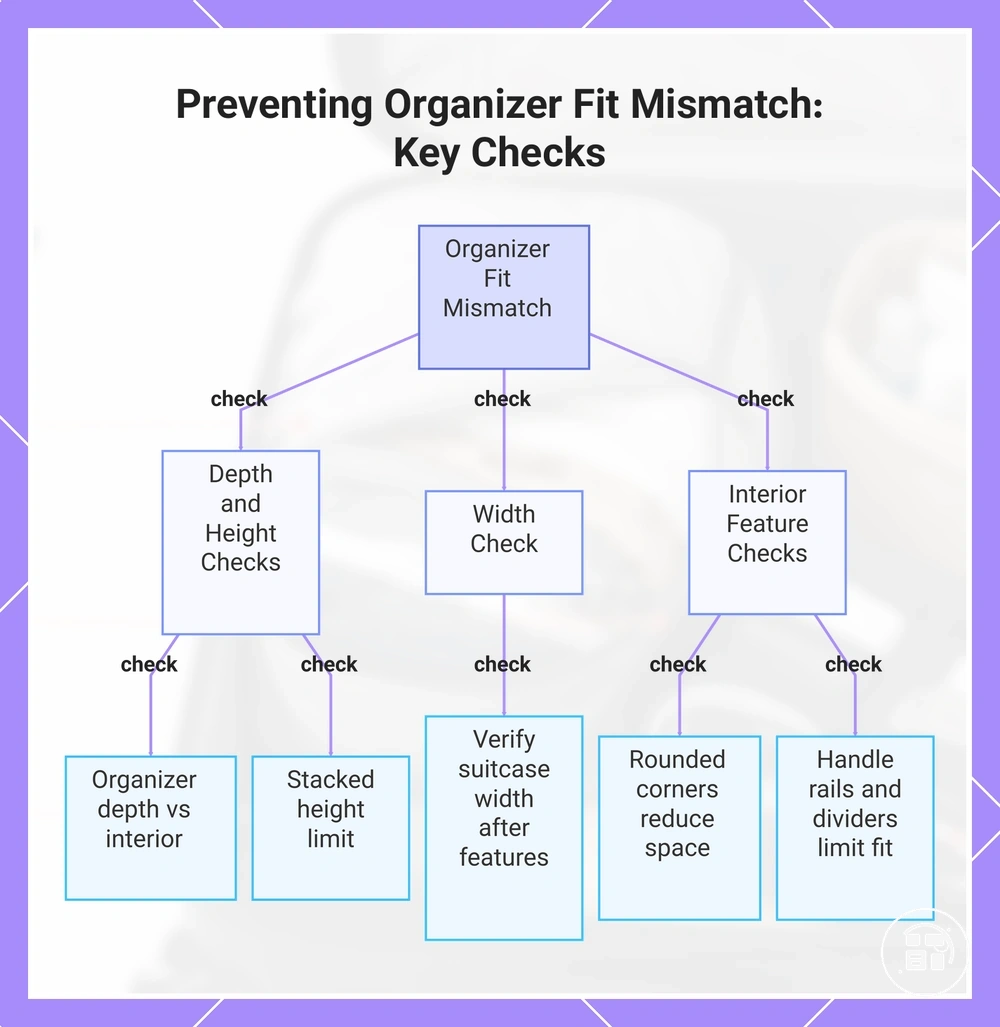
Organizer measurements can fail when the usable suitcase interior is smaller than the stated suitcase dimensions. A fit mismatch may occur when rounded corners, handle rails, divider panels, or reduced interior depth change the space available for the organizer. The measurement focus should be the usable suitcase interior, not the labeled size alone.
Use the checklist below to compare the dimensions that most often affect compartment fit. Check each condition before assuming the organizer will fit, with stacked height and organizer depth as the final verification points.
- Organizer depth: Compare organizer depth with the available interior depth because a depth mismatch may reduce usable packing space.
- Suitcase width: Verify that suitcase width supports the organizer measurements after accounting for interior features.
- Rounded corners: If rounded corners reduce interior dimensions, part of the stated space may become unusable for rectangular organizers.
- Handle rails: When handle rails extend into the luggage interior, they may create lost space that affects placement.
- Divider panels: Check whether divider panels reduce the usable suitcase interior or limit compartment fit.
- Stacked height: If multiple organizers increase stacked height beyond available interior depth, a fit mismatch may occur even when individual measurements appear suitable.
This chart outlines the three main areas to inspect—depth and height checks, width verification, and interior features—to avoid organizer fit mismatch.
Using too many organizers for the available compartment space
When fit problems appear, too many organizers may be reducing usable compartment space rather than improving organization. Excessive organizer count can consume flexible space by creating extra separation between items, which may lead to pressure points and unused air gaps. The local issue is often related to organizer quantity, pressure, and gaps.
In a suitcase compartment filled with many small pouches, available space may become fragmented instead of being shared efficiently. Air gaps between organizers and compartment overlap can make the layout less adaptable even when item volume remains similar. The checklist below helps identify whether organizer count is contributing to the fit problem.
- Excess pouches: If the number of pouches increases without a clear purpose, flexible space may become divided into smaller unusable areas.
- Trapped air gaps: Check for air gaps between organizers that remain inaccessible because pouch placement blocks effective use of the space.
- Rigid edges: When rigid edges meet inside a tight suitcase compartment, they may create localized pressure points.
- Compartment overlap: If organizers overlap each other, available compartment space may be reduced by duplicated storage zones.
- Zipper pressure: When pouch count increases bulk near the closure area, zipper pressure may indicate that organizer quantity is affecting fit.
Packing Cube Mistakes That Reduce Organization
Packing cubes reduce organization when fill level or grouping logic is wrong. Packing cube mistakes such as underfilled, overfilled, or misgrouped cubes can weaken category separation, make access sequence less predictable, and disrupt suitcase organization. The core mistake is usually a mismatch between fill level, clothing type, cube size, and grouping logic.
Packing cubes work best when clothing type, category separation, and access sequence support the intended organization system. A useful packing cube setup keeps related items together and helps maintain a stable suitcase layer without relying on compression. Organization depends on grouping logic and stack order, while compression serves a different purpose.
When packing cube setup creates organization loss, the cause is often visible in the cube condition rather than the suitcase itself. The table below connects common packing cube mistakes to organization outcomes and correction cues.
| Mistake | Cube condition | Organization effect | Correction cue |
|---|---|---|---|
| Underfilled cubes | Loose shape with shifting contents | Category separation may become less stable during travel | Group similar items more consistently within the cube |
| Overfilled cubes | Distorted shape and reduced flexibility | Organization can become harder to maintain within the suitcase layer | Reduce contents if shape interferes with organization |
| Mixed categories | Different clothing types stored together | Poor grouping can reduce category separation and retrieval clarity | Use grouping logic based on item type or purpose |
| Wrong cube size | Cube size does not match the clothing type | Access sequence may become less efficient and organization may suffer | Match cube size to the item group being stored |
| Poor stack order | Frequently needed cubes placed beneath less-used cubes | Access sequence may require repeated unpacking | Arrange cubes according to expected access order |
Leaving cubes too loose to hold clothing in place
Loose cubes reduce organization when clothing can move inside them during travel. Loose cubes and partial fill may allow clothing movement, which can weaken category separation and make items harder to locate. The main issue is often the extra movement created by empty internal space.
In a cube with partial fill or slippery fabrics, items may shift as the suitcase changes position. Wrinkles may also develop in some fabrics when movement continues, although the outcome depends on clothing type and travel conditions. The most common local causes are listed below.
- Partial fill: When a cube is only partly filled, clothing movement may increase because items are not held in place consistently.
- Slippery fabrics: If slippery fabrics are stored together, shifting clothes may occur more easily when empty internal space is present.
- Large cube size: A large cube size can create a weak hold when the clothing volume does not match the available cube space.
- Mixed item types: Mixed item types may reduce category separation when smaller items move between larger garments.
- Empty internal space: If empty internal space remains inside a loose packing cube, shifting and access disruption may become more noticeable.
Tighter is not always better because overfilling creates a different packing cube mistake. The goal is to limit unnecessary movement without creating a rigid or overcrowded cube.
Overfilling cubes until they lose their useful shape
Overfilled cubes can lose their useful shape and create bulky pressure points inside the suitcase. When clothing compression pushes the sides outward, overfilled cubes may stop functioning as stable rectangular organizers. Rounded cube edges and visible shape loss are common signs of this problem.
Before closing the suitcase, check whether the cube still maintains a stable shape and stacks evenly with surrounding organizers. If shape loss is already visible, additional closure pressure may reduce fit and make access less convenient. The warning signs below can help identify overfilling cubes before they affect organization.
Warning checklist:
- Seam strain: When fabric pulls tightly along seams, seam strain may indicate that the cube is holding more volume than its shape can support comfortably.
- Zipper resistance: If zipper resistance increases during closure, overfilled cubes may be creating compression pressure that affects suitcase fit.
- Rounded cube edges: Rounded cube edges often indicate shape loss because the cube is no longer maintaining a stable rectangular form.
- Uneven stacking: When cubes stack unevenly, bulky pressure points may develop and reduce packing stability inside the suitcase.
- Access loss: Clothing compression and excess bulk may make items harder to reach when overfilled cubes disrupt the surrounding layout.
Compression Packing Cube Problems and Limits
Compression packing cubes can help reduce soft-item puffiness, but they do not fix every fit issue in a travel organizer setup. When excess bulk comes mainly from fabric volume, compression packing cubes may improve packing efficiency, yet results still depend on fill level, luggage shape, and item type. The main limit is that compression can change volume and shape without solving every overpacking or fit problem.
Compression packing cubes use a compression zipper to reduce fabric volume by tightening the packed contents. When the compression zipper closes, cube thickness may decrease in one area while pressure transfer increases in another area. Bulge location can shift, and suitcase closure may still depend on how the compressed cube interacts with surrounding items and luggage shape. Compression affects volume and shape, but the item weight remains unchanged because compression does not remove item mass.
When compression helps, the benefit usually comes from controlling puffiness in soft items rather than correcting every packing constraint. The contrast below shows what compression packing cubes may improve and what they do not reliably fix, which can help set realistic expectations.
| Compression can help with | Compression does not reliably fix |
|---|---|
| Reducing puffiness through fabric volume reduction | Item weight, which remains unchanged after compression |
| Reducing cube thickness when fabrics compress effectively | Every luggage shape or fit limitation |
| Managing soft-item bulk in a compressed cube | Overpacking when total packed volume remains excessive |
| Changing bulge location through pressure transfer | All suitcase closure challenges |
| Improving organization when puffiness is the main issue | Local pressure buildup that may still affect fit |
Uneven compression, stuck zippers, and middle bulging
When uneven compression, stuck zippers, or middle bulging occur, the cause is often an uneven load, poor folding, or excessive fill within the compressed cube. These symptoms may indicate that compression pressure is concentrating in specific areas instead of being distributed evenly. This pattern is usually linked to compression mechanics rather than a general packing issue.
Inspect the zipper path, fabric distribution, and cube corners before assuming a stuck zipper indicates product failure. If pressure gathers around one section of the cube, a center bulge may develop and increase resistance along the closure path. The checklist below helps identify the most common compression-specific causes.
Diagnostic checklist:
- Zipper path: If zipper resistance increases at one point along the zipper path, compression pressure may be concentrating in that area.
- Fabric distribution: When fabric distribution is uneven, one side of the cube may compress differently and contribute to middle bulging.
- Cube corners: If cube corners appear noticeably fuller than surrounding areas, load imbalance may be affecting compression performance.
- Middle bulge: A center bulge may form when soft items collect in the middle instead of remaining evenly distributed across the cube.
- Seam strain: When seam strain appears together with uneven compression, excessive fill or localized pressure may be creating stress within suitcase pressure zones.
Expecting compression to fix overpacking or reduce weight
Myth: Compression can fix overpacking or reduce weight. Truth: Compression may reduce puffiness by reducing fabric air volume, but it does not reduce item mass or luggage weight. The key distinction is that compression changes space and shape differently from weight.
Compression affects fabric air volume because compressed fabric occupies less space when excess air is removed. Item mass remains the same, so baggage weight limits are not reduced by compression even when the packed load appears smaller. If overpacking still creates suitcase closure pressure, compression may alter the shape of the load without removing the underlying space limit.
When user expectation is that compression will overcome packing volume limits, the result may be frustration if the suitcase is already near its practical capacity. A more useful approach is to view compression as a way to manage puffiness while recognizing that fit still depends on available space and closure pressure.
Item Separation Mistakes That Create Access Problems
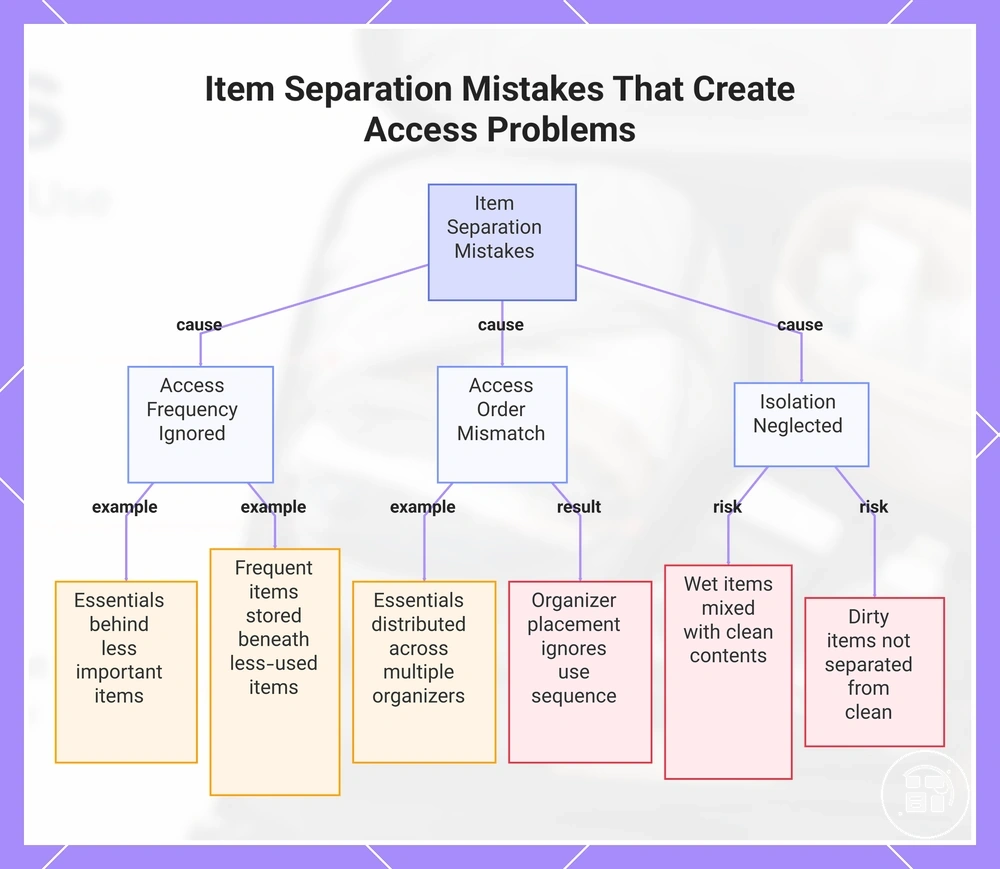
Item separation mistakes can create access problems even when a suitcase looks neat and organized. Poor item grouping may place essentials behind less important items, making them harder to reach when access needs change during a trip. The problem is often not the appearance of organization but the mismatch between item grouping and access order.
At airport access points, frequently needed items may be harder to reach if documents, electronics, or toiletries are buried beneath clothes. At hotel arrival, a neatly packed suitcase can still slow access when essentials are distributed across multiple organizers. During mid-trip repacking, weak item separation may lead to unnecessary searching because organizer placement does not follow a clear separation logic.
The checklist below organizes common item types by access need, organizer placement, and access risk. Placement choices may vary by trip context, but access often improves when item grouping reflects expected use frequency.
- Documents: Quick access need → accessible organizer placement → risk of delayed access if buried beneath clothes or larger organizers.
- Electronics: Frequent retrieval need → dedicated organizer placement → risk of repeated unpacking if mixed with unrelated items.
- Toiletries: Routine access need → separate organizer placement → risk of affecting nearby contents when wet items or leakage-prone items are grouped together.
- Clothes: Regular use need → grouped organizer placement → risk of buried items when mixed with unrelated categories.
- Small accessories: Easy identification need → compact organizer placement → risk of slow retrieval when scattered between larger items.
- Dirty items and wet items: Separation need → isolated organizer placement → risk of affecting clean contents when grouped together.
- Frequently needed items: Priority access need → top-layer organizer placement → risk of repeated searching when stored beneath less-used items.
These access-priority mistakes often become more noticeable as a trip progresses. The same separation logic can support a broader packing workflow with organizers when organizer placement is based on expected access needs rather than appearance alone.
This chart shows the main causes of access problems from poor item separation, highlighting how ignoring access frequency, access order, and isolation needs leads to delayed retrieval and contamination risks.
How to Correct Travel Organizer Fit Problems
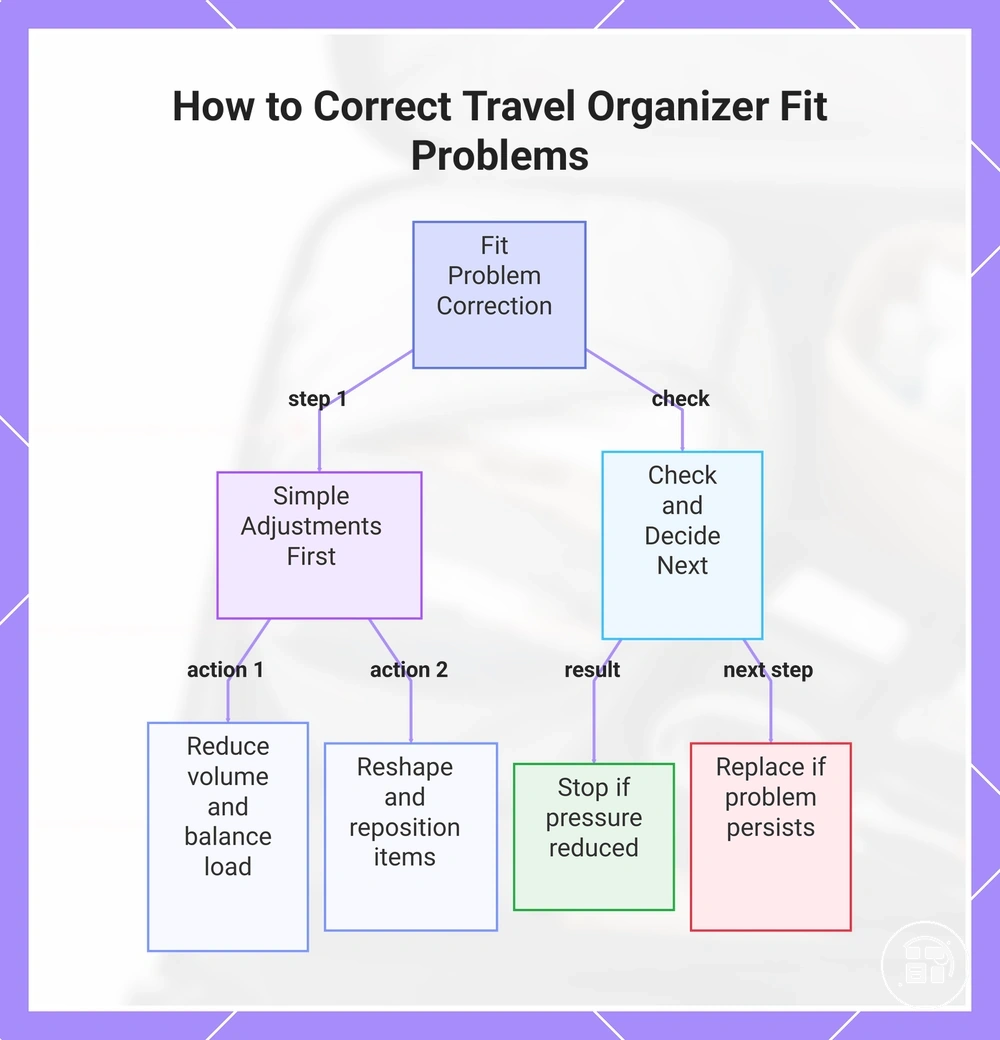
Correct fit problems by starting with low-disruption adjustments before considering replacement. Small changes to packing volume, item distribution, and organizer placement may improve fit without changing the entire organizer setup. The correction method should move from simple adjustments to more decisive changes only when the problem continues.
The steps below follow a condition → action → expected effect sequence designed to correct fit problems systematically. Outcomes may vary because suitcase shape, item volume, and organizer rigidity can influence how much improvement an adjustment provides.
- Condition: If pressure, bulging, or difficult zipper closure is present, action: remove excess items from the most crowded organizer, expected effect: pressure may decrease and available space may become easier to manage.
- Condition: If an organizer appears too large or too small for the contents, action: consider resizing cubes to better match the item group, expected effect: fit may improve through more efficient use of available space.
- Condition: If one section of the suitcase is crowded while another has unused capacity, action: redistribute items across organizers, expected effect: load balance may improve and local pressure points may become less pronounced.
- Condition: If uneven layers are created by bulky clothing, action: flatten soft goods before repacking, expected effect: organizer layers may become more uniform and easier to arrange.
- Condition: If rigid pouches create concentrated bulk or shape conflicts, action: reposition pouches to a less restricted area, expected effect: localized fit issues may be reduced.
- Condition: If the same mismatch remains after repeated adjustment, action: evaluate whether mismatched organizers are causing the persistent problem, expected effect: replacement may become a more realistic solution than continued adjustment.
If adjustment reduces pressure and the organizer setup functions as intended, further changes may not be necessary. When the same fit problem persists after multiple corrections, replacement is often a stronger signal than additional rearrangement.
For related troubleshooting topics beyond this correction method, the common travel organizer questions resource can provide additional context.
This chart shows the systematic correction method for travel organizer fit problems, starting with simple adjustments and evaluating the result before considering replacement.
Downsize, remove, or redistribute organizers
When pressure reduces usable luggage space, reduce pressure before replacing organizers. Start with small adjustment steps that downsize, remove, or redistribute organizers, then check whether fit improves. Use the local sequence below before considering more disruptive changes.
- Downsize large cubes and check whether usable luggage space increases while pressure becomes less concentrated.
- Remove redundant pouches and check whether closure areas gain space with fewer air gaps or overlaps.
- Redistribute dense items across organizers and check whether weight and bulk feel more balanced.
- Separate rigid items from crowded sections and check whether local pressure points become less noticeable.
- Rebalance organizer placement and check whether the suitcase interior uses available space more evenly.
- Test closure after each change and check whether fit improves before making another adjustment.
Replace rigid or mismatched organizers when fit cannot be corrected
Replace organizers only when adjustment fails to improve a persistent fit problem. Diagnosis should come first because many fit issues can be reduced through repositioning, downsizing, or redistribution. Replacement is the final correction path when those adjustments no longer improve the result.
When the same fit issue continues after multiple adjustments, the organizer itself may be limiting improvement. A rigid organizer shape, fixed depth, or poor suitcase compatibility can create recurring conflicts that adjustment may not resolve. Use the decision checklist below as a replacement cue.
- If a fixed depth continues to create fit conflicts after adjustment, replacement may be a reasonable decision.
- If repeated bulging returns after multiple corrections, mismatched organizers may still be contributing to the problem.
- If weak zipper alignment persists despite adjustment, replacement can be considered as a diagnostic outcome.
- If poor suitcase compatibility remains after diagnosis, an unsuitable organizer may be limiting further improvement.
- If persistent access problems continue after reorganization, replacing mismatched organizers may be worth evaluating.
- If a rigid organizer shape continues to create conflicts after adjustment fails, replacement may be more practical than further modification.