
Packing With Travel Organization Accessories
Packing with travel organization accessories starts by turning loose belongings into controlled groups before those belongings go into a suitcase. Packing cubes, travel pouches, toiletry organizers, and electronics pouches help separate item types, keep access clearer, and make luggage fit easier to judge. Travel organizers work by controlling item grouping and access, not by magically reducing luggage volume.
For a short trip, a few organizer bags may be enough to separate clothes, toiletries, and electronics; for a longer trip, suitcase space, item category, and access frequency matter more. This travel organization accessories guide connects the packing method back to the broader category of organizers used for grouping, visibility, compression, and retrieval. The right packing method depends on what must stay reachable, what needs separation, and how much space the suitcase can realistically hold.
Overpacking usually starts when compression, cube size, zipper tension, and luggage fit are treated as afterthoughts. Travel organization accessories can make packing easier to inspect and adjust, but compression should still respect fabric bulk, wrinkles, suitcase depth, and weight limits. Before filling organizers, the useful starting point is to understand what travel organizers change in the packing process.
What Travel Organizers Change Before You Pack
Travel organizers change how items are controlled before they change how a suitcase is physically arranged. They create containment for loose items, improve separation between categories, increase visibility during packing, and establish a clearer access order for retrieval later. Travel organizers change control and visibility before they change the physical packing layout.
What Travel Organizers Change Before You Pack becomes easier to see when loose items are compared with grouped organizers. The image below clarifies how containment, separation, visibility, and access order shift belongings from scattered items into controlled groups before packing begins.
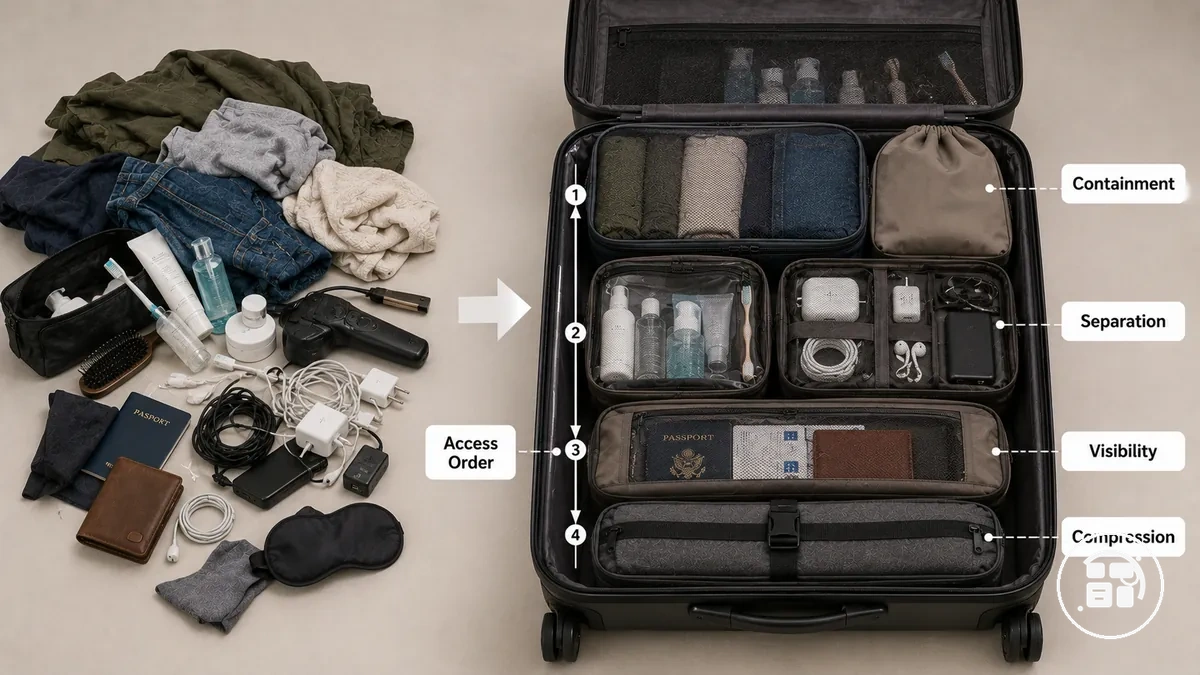
Without organization, toiletries, chargers, clothing, and other travel items can compete for space and become harder to locate. Travel organizers address this by creating containment, separation, and a planned access order, which can reduce packing errors and make retrieval more predictable during transit. Containment, separation, and access order support fewer packing mistakes by making item locations clearer before packing starts.
The organizer changes below clarify the main controls introduced before the packing load is built:
- Containment: Keeps loose items together so belongings are easier to track and manage.
- Separation: Divides item categories to reduce mixing between clothing, toiletries, electronics, and other travel items.
- Visibility: Makes grouped contents easier to identify without searching through the entire suitcase.
- Compression control: Can help manage fabric bulk, but results depend on item quantity, luggage dimensions, suitcase shape, packing discipline, and available suitcase depth.
- Access order: Places frequently needed items, such as toiletries or chargers, where they may be easier to reach during transit.
Compression and packing results can vary with item quantity, cube size, luggage dimensions, and suitcase shape. Travel organizers improve control and retrieval, but they do not guarantee space savings and do not replace thoughtful packing discipline.
Build the Packing Load Before Filling Organizers
Build the Packing Load Before Filling Organizers by identifying what needs to travel before deciding how items should be grouped. The packing load determines organizer choice because item groups, access needs, and separation requirements vary by trip. The packing load should be known before organizers are filled.
Build the Packing Load Before Filling Organizers depends on knowing what item groups must be controlled. The image below shows how clothing groups, liquids, electronics, shoes, laundry, and documents can be identified before organizers are filled.
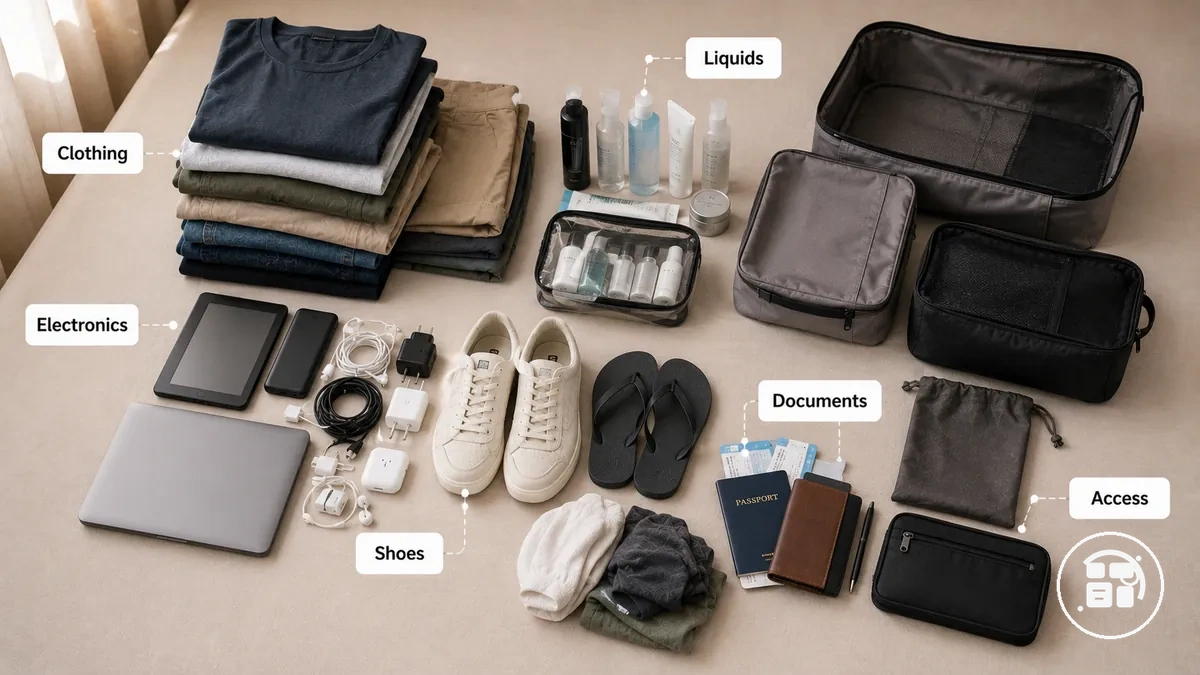
Short trips may require fewer clothing groups, while family packing or carry-on-only travel can change how belongings are separated and prioritized. Trip length and access frequency influence which item groups stay together and which items may need quicker retrieval during transit.
Use this checklist to verify the packing load before assigning items to organizers:
- Clothing groups: Check which clothing categories need separation and how grouping affects organizer choice.
- Liquids and toiletries: Identify items with leak risk and consider whether separate containment improves organization.
- Electronics: Review devices, cables, and chargers to determine grouping based on protection and access frequency.
- Shoes: Decide whether shoes should remain separate from clothing to support cleanliness.
- Laundry: Consider whether used clothing will require separate grouping during the trip.
- Documents: Verify which documents need quick access and clear visibility during transit.
- Trip length: Confirm how the overall travel load affects item quantity and grouping priorities.
- Access frequency: Identify items needed during travel so grouping reflects retrieval needs rather than packing order alone.
Mixed belongings can lead to organizer choices that do not match actual travel needs. Reviewing the criteria behind packing problems organizers solve can help explain why unmanaged item groups often create avoidable packing issues.
Choose clothing groups before choosing cube sizes
Choose clothing groups before choosing cube sizes by sorting garments into categories before assigning storage space. Clothing groups determine cube sizes because volume, access, and separation needs differ between garment types. Cube size follows clothing group volume and access need.
Choose clothing groups before choosing cube sizes by matching clothing groups to cube sizes based on volume and access needs. The image below shows how clothing groups can be organized by cube-size need before packing decisions are made.
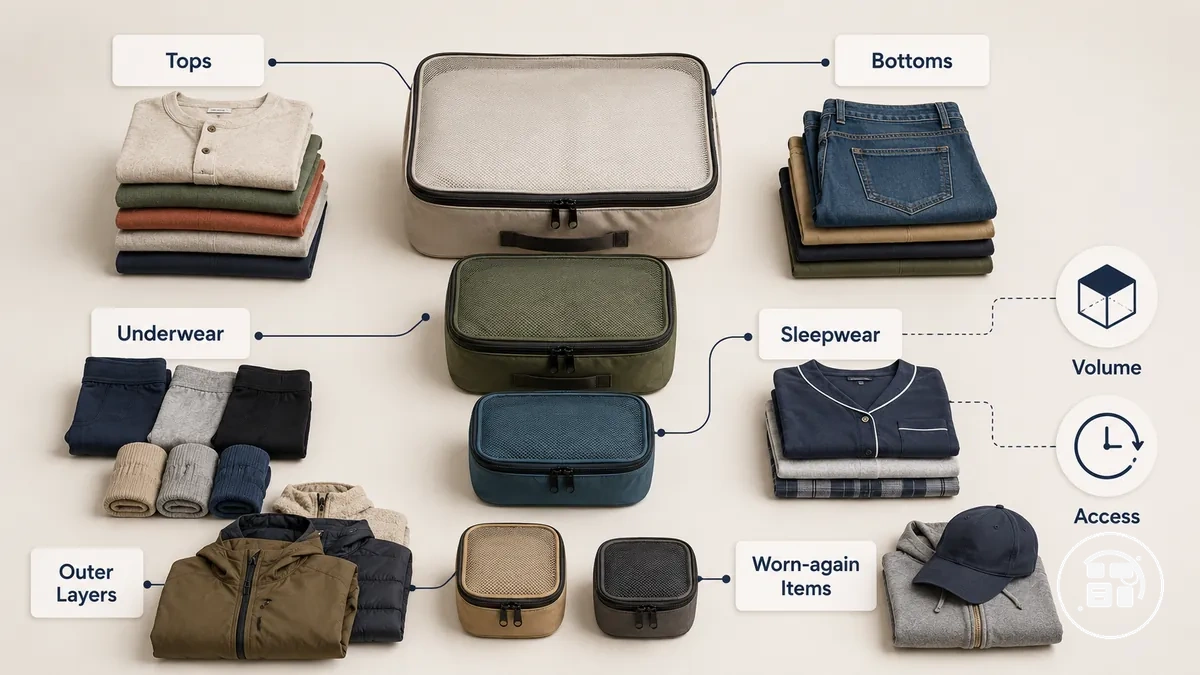
- Tops: Volume and access needs may influence whether a larger or more accessible cube size is useful.
- Bottoms: Greater garment volume can influence the cube size assigned to this clothing group.
- Underwear: Separation and visibility often support the use of smaller cube sizes.
- Sleepwear: Keeping sleepwear separate can improve access without mixing it with other clothing groups.
- Outer layers: Bulkier garments may require larger cube sizes when volume becomes a factor.
- Worn-again items: Separation from clean clothing can help maintain clearer clothing groups during a trip.
If daily outfits or worn-again items need separate handling, cube count may depend on volume and access requirements. Clothing groups should guide cube sizes first, while trip duration may influence how much separation is useful.
Separate liquids, devices, shoes, and laundry early
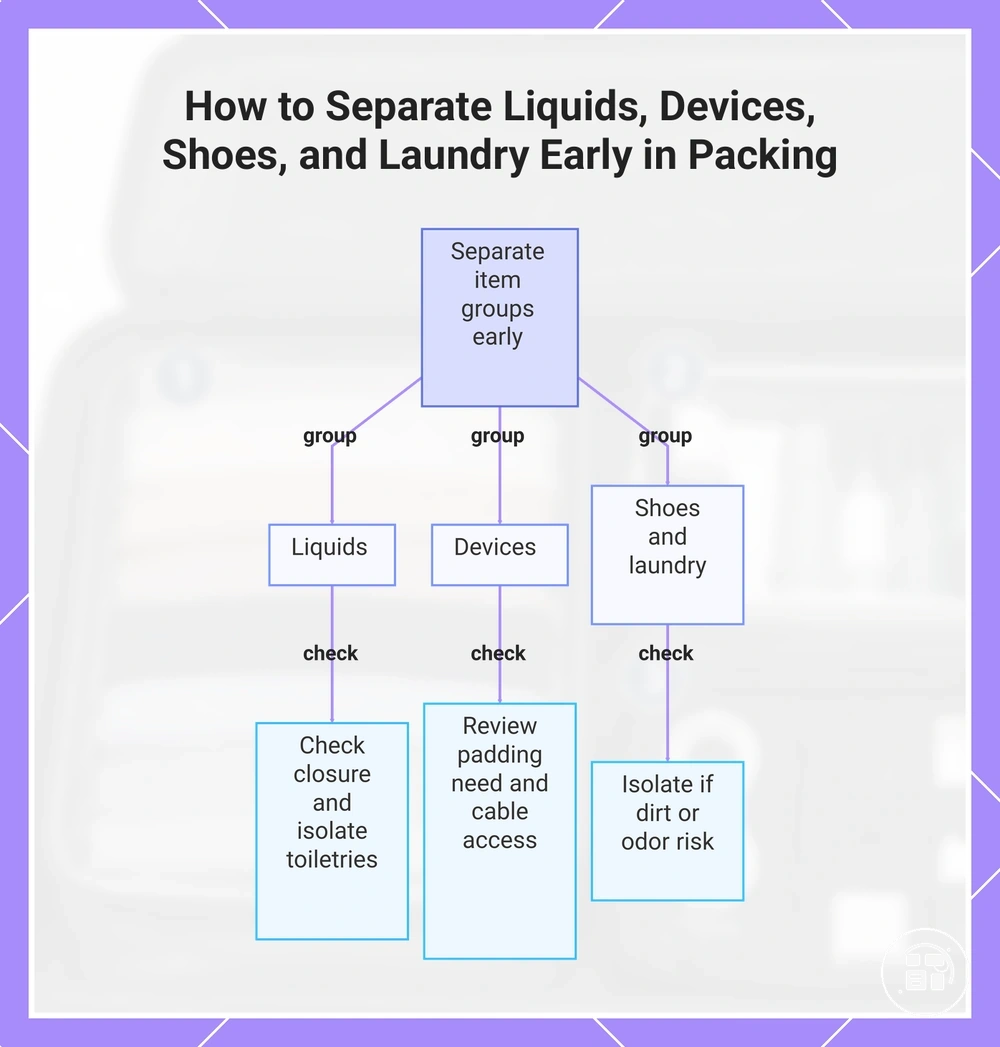
Separate liquids, devices, shoes, and laundry early because each item group creates different packing conditions before organizers are filled. Liquids carry leakage risk, devices may have a padding need, and shoes or laundry can affect cleanliness and odor control when mixed with other belongings. Early separation helps reduce spill, odor, and quick access problems during travel.
Use a quick verification check before grouping these items:
- Liquids: Check bottle closure and leakage risk, then keep toiletries separate from other item groups.
- Devices: Review padding need and cable access so electronics remain easier to locate when needed.
- Shoes: Isolate footwear when dirt or odor could affect surrounding belongings.
- Laundry: Separate dirty clothes or wet items when cleanliness and odor control may become concerns.
This chart shows the main item categories to separate early during packing and the quick checks for each group.
Match Organizer Types to the Items They Control
Match organizer types to the item category they control, not to a product list or ranking. Packing cubes, toiletry organizers, electronics pouches, travel pouch sets, shoe bags, and laundry bags each serve a different packing purpose. Organizer type should follow the item it controls.
Functional matching means the item category, key attribute, and packing effect work together. Compartments, protection, visibility, and access can support better grouping when the organizer matches the item condition. The table below shows functional matching, not product selection.
| Organizer type | Items it controls | Key attribute | Packing effect |
|---|---|---|---|
| Packing cubes | Clothes | Volume and visibility | Groups garments so clothing is easier to identify and retrieve. |
| Toiletry organizers | Liquids and toiletries | Compartments | Helps separate leak-prone items and may support upright placement. |
| Electronics pouches | Cables, chargers, and small devices | Padding and small pockets | Can improve access while keeping electronics grouped together. |
| Travel pouch sets | Small mixed accessories | Visibility and separation | Keeps small item groups easier to sort without mixing them into clothing. |
| Shoe bags | Shoes | Separation | Helps keep dirt and odor away from cleaner belongings. |
| Laundry bags | Used clothes | Moisture and separation control | Keeps worn items apart during the trip and return packing. |
For deeper item-category planning, use the same matching logic to organize clothes toiletries documents and devices before assigning each group to an organizer.
Packing cubes for clothes
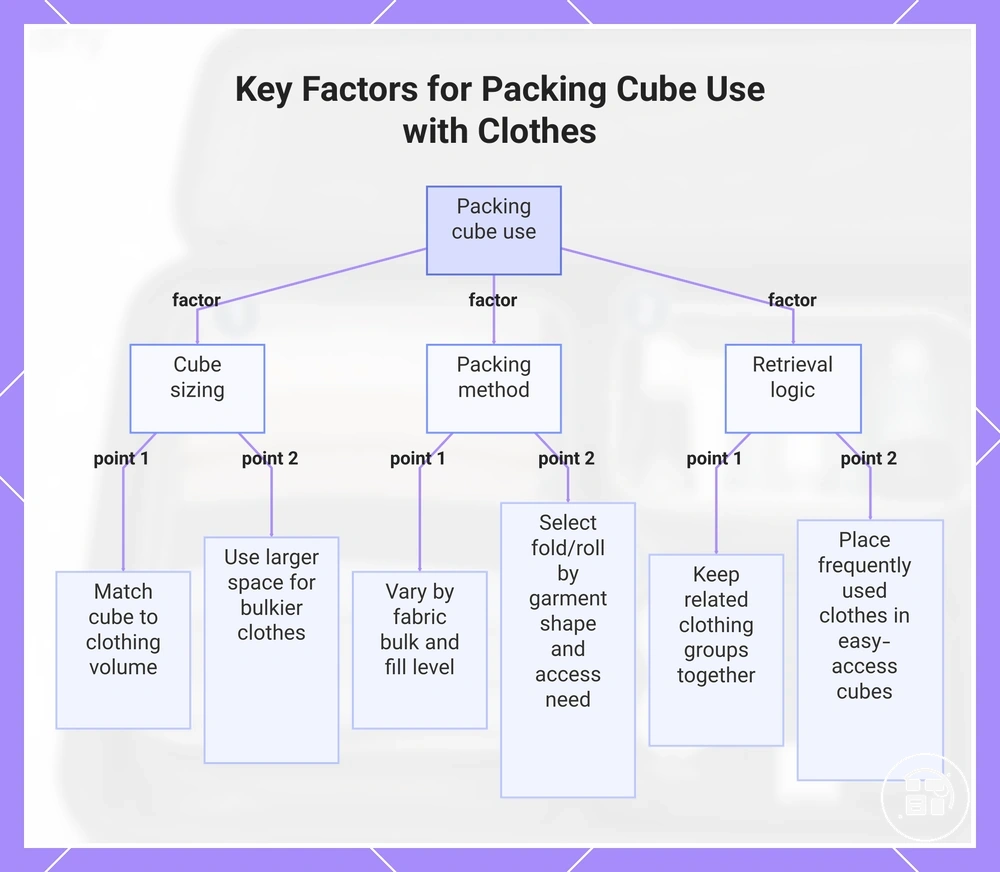
Packing cubes are suited for clothes because they hold garment groups in a controlled space while keeping visibility and access clearer. Cube size should follow clothing volume, fabric bulk, and how often the clothes need to be retrieved. Fold or roll choices can vary by fabric bulk and cube fill level, so packing cube use should stay tied to clothing volume and access frequency.
- Cube size: Match the cube to the clothing volume without forcing zipper tension.
- Fabric bulk: Use larger space for bulkier clothes when shape and fit become harder to control.
- Fold or roll: Choose the method that suits the garment shape and access need without treating either method as universal.
- Visibility: Keep related clothing groups together so retrieval is easier during the trip.
- Access frequency: Place frequently used clothes in cubes that are easier to identify and open.
This chart shows the main factors to consider when using packing cubes for clothes: cube sizing, packing method, and retrieval logic.
Toiletry organizers for liquids and leak-prone items
Toiletry organizers help contain liquids and leak-prone items before they are placed inside luggage. Leakage can become harder to manage when liquids mix with clothing or electronics, so toiletry organizers use compartment separation to keep liquid items grouped and easier to access. Effective liquid control depends on bottle closure, compartment separation, and upright placement.
Use these leak-control checks before packing liquids into a toiletry organizer:
- Bottle closure: Confirm caps and closures are secure to reduce leak risk during movement.
- Upright placement: Position liquids upright when organizer shape and packing conditions allow.
- Wipeable lining: A wipeable lining may make spill cleanup easier if leakage occurs.
- Compartment separation: Keep leak-prone items separate from other bathroom items to help limit spill spread.
- Access timing: Place frequently used liquids where retrieval is easier without disturbing the rest of the packing load.
Electronics pouches for cables and small devices
Electronics pouches keep cables and small devices grouped so they are easier to find and less likely to scatter inside luggage. They improve visibility and may provide limited cushioning when padding and pouch structure suit the items being carried. Electronics pouch choice should follow access and protection needs during transit and hotel use.
- Cables: Use small pockets to keep cable types separated and easier to identify during retrieval.
- Chargers: Match charger size to pouch space so chargers remain organized without crowding smaller items.
- Adapters: Group items by adapter count to improve visibility and reduce retrieval time.
- Small devices: Padding may help cushion small devices when luggage movement or pressure occurs.
- Transit access: Keep frequently used cables or chargers in locations that support quicker retrieval during travel.
- Hotel access: Organize commonly used electronics together so daily setup and access remain simpler after arrival.
Pack Packing Cubes Without Losing Shape or Access
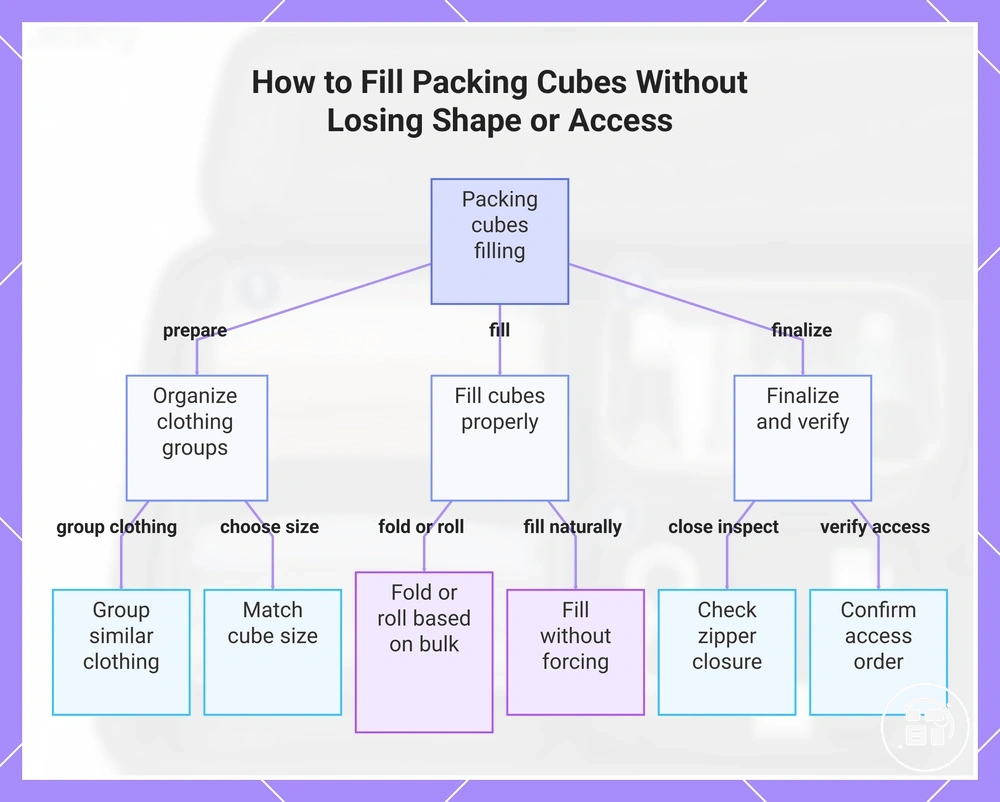
Pack packing cubes by matching clothing groups to the right cube size and filling each cube without forcing items into unused space. Folding and rolling can both work, depending on fabric bulk, clothing shape, and retrieval needs. A packing cube should close cleanly without becoming a rigid block.
Overfilled packing cubes can reduce shape, visibility, and retrieval because zipper tension increases and clothing groups become compressed together. Lightweight clothes and bulky clothes may benefit from different folding or rolling approaches because fabric bulk affects cube fit. Use the steps below to fill packing cubes while preserving shape, grouping, and access.
- Group clothing first: Place similar clothing categories together and check that each group has a clear purpose. This improves visibility and retrieval.
- Choose the cube size: Match cube size to clothing volume and check that the packing cube is neither overcrowded nor mostly empty. Better cube fit helps maintain shape.
- Fold or roll based on fabric bulk: Use folding or rolling according to garment thickness and access needs. Lightweight clothes and bulky clothes may benefit from different methods.
- Fill without forcing: Arrange clothing evenly and check that items sit naturally inside the packing cube. This helps reduce unnecessary zipper tension.
- Close and inspect: Check that the zipper closes smoothly without resistance. A clean closure helps preserve shape and supports easier retrieval.
- Verify access order: Place frequently needed clothing where it is easier to reach and confirm that opening the cube does not disturb the entire clothing group.
This chart shows the main steps to pack packing cubes while preserving shape, grouping, and access.
Rolling, folding, and grouping clothes inside cubes
Rolling, folding, and grouping clothes inside cubes starts with creating stable clothing groups that stay organized when the cube is opened. Rolling and folding can both work inside cubes, but the better method often depends on fabric bulk, wrinkle sensitivity, and retrieval needs. Method choice should support both clothing organization and access.
- Rolling: Rolled clothes may suit softer garments when reducing bulk and keeping individual items visible is useful.
- Folding: Folded clothes may suit more structured garments or clothes with higher wrinkle sensitivity when a flatter stack is preferred.
- Outfit grouping: Place complete outfit sets together when daily retrieval is more important than separating clothing categories.
- Category grouping: Keep similar clothes together when visibility and item tracking matter more than outfit-based organization.
- Method selection: Choose rolling, folding, or grouping based on fabric bulk, wrinkle sensitivity, and access needs rather than following a universal rule.
Using cube sizes without forcing the fit
Using cube sizes without forcing the fit starts with choosing a cube size that supports clothing organization without creating unnecessary pressure on the contents. When cube dimensions, fabric compression, and suitcase height are overlooked, closure and item retrieval can become more difficult. A good cube fit preserves closure, shape, and retrieval without creating a rigid block.
- Cube dimensions: If clothes extend beyond the natural shape of the cube, choose a different cube size rather than forcing additional items inside.
- Zipper strain: When closure requires noticeable pressure, treat zipper strain as a signal to reduce the load or adjust the cube fit.
- Fabric compression: If clothing becomes tightly compressed, item retrieval may become less convenient and the cube shape may be harder to maintain.
- Suitcase height: When a filled cube presses against available suitcase height, reassess the packing cube size or packing arrangement.
- Item retrieval: If retrieving one item disrupts the entire clothing group, the cube fit may benefit from a lower fill level or revised organization.
Arrange Organizers Inside the Suitcase
Arrange organizers inside the suitcase by placing filled organizers according to weight, shape, and access needs rather than packing order alone. Heavy organizers provide stability when positioned lower, while lighter organizers may remain easier to retrieve when placed higher. Suitcase layout should follow weight, shape, and access.
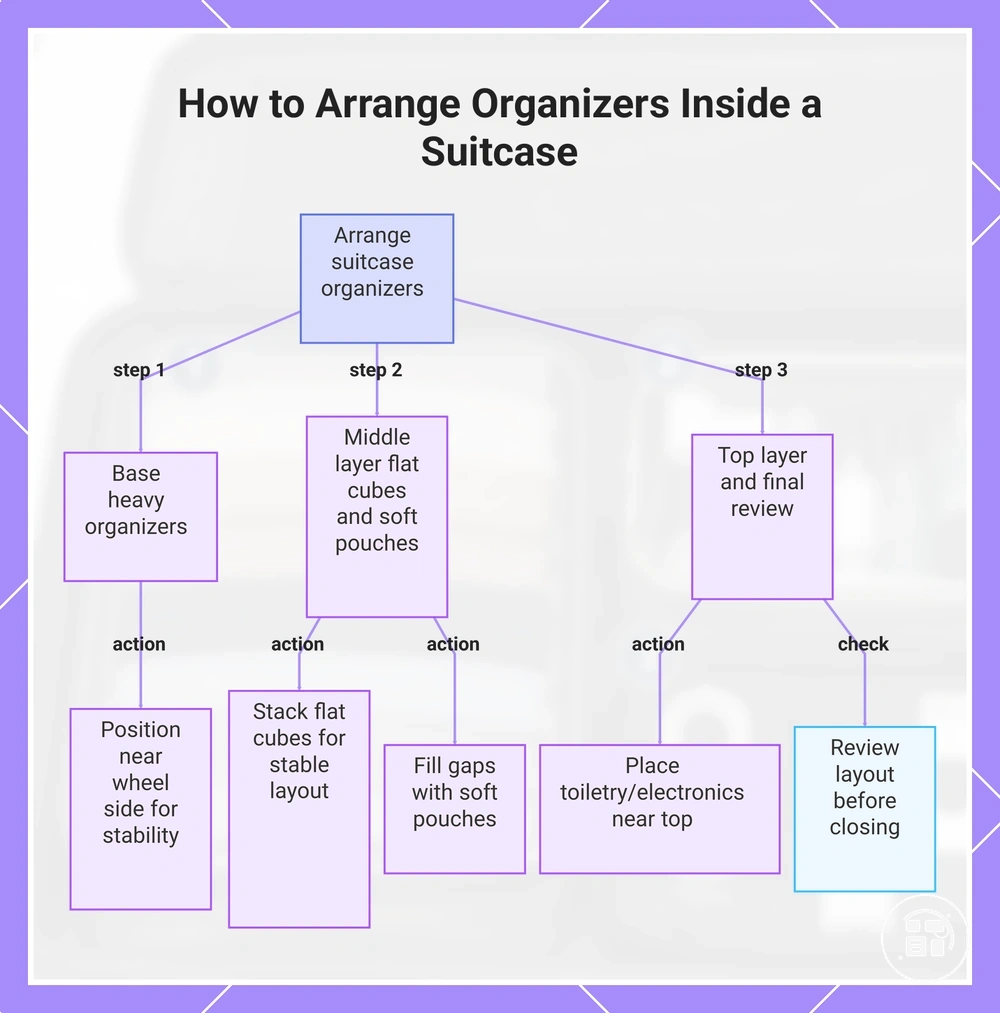
If a suitcase contains heavy organizers, flat cubes, soft pouches, toiletry bags, and electronics pouches, organizer placement can be staged by stability and retrieval priorities. A practical example places heavy organizers at the base, flat cubes through the middle layer, and frequently needed items closer to the top. The steps below follow a sequence for base, middle, top, and remaining gaps.
- Place heavy organizers at the base: Position heavy organizers near the wheel side or lower section of the suitcase to improve stability and help reduce shifting during movement.
- Arrange flat cubes in the middle layer: Stack flat cubes when their shape supports a stable packing layout and allows clothing groups to remain organized.
- Fill remaining gaps with soft pouches: Use soft pouches around structured organizers when small spaces remain, helping limit movement and reduce clutter.
- Position toiletry bags and electronics pouches near the top: Place these organizers where access may be easier during transit or after arrival without disturbing lower layers.
- Review layout before closing: If organizer placement restricts space or retrieval, consider how to fit organizers inside luggage before making adjustments. This helps preserve retrieval while respecting suitcase shape and available space.
This chart shows the step-by-step process for placing organizers inside a suitcase based on weight, shape, and access needs.
Place heavier organizers near the base
Place heavier organizers near the base because heavier organizers usually provide better stability when their weight sits in the lower layer of the suitcase. Wheel-side placement often supports this arrangement when suitcase orientation keeps the weight closer to the base during movement. If soft items are packed nearby, keeping heavier organizers lower may help reduce crushing risk and protect those items from pressure. For example, a heavy cube can be placed at the suitcase base while softer pouches remain above it, helping support stability without assuming a universal layout.
Stack cubes and pouches by access priority
Access priority determines how to stack cubes and pouches so frequently needed items remain more reachable than less-used items. Access order can vary by trip timing, suitcase opening direction, and retrieval needs during transit or arrival. Access priority determines top, side, or lower placement.
- Airport access: Use top placement for cubes or pouches that may need quick access during transit.
- Overnight access: Keep overnight-access items in a side placement when retrieval without unpacking the full suitcase is preferred.
- Hotel-first items: Place hotel-first items near the upper packing layers so they remain easier to reach after arrival.
- Daily clothing: Position daily clothing where access stays practical throughout the trip without disturbing lower packing layers.
- Backup items: Reserve lower placement for backup items that are less likely to be needed during routine access.
Use soft pouches to fill open spaces
Use soft pouches to fill open spaces when leftover spaces remain after the main organizers are positioned and the layout is stable. Soft pouches can fit irregular gap shape areas because pouch flexibility allows small accessories to stay organized without creating clutter. For example, a flexible pouch may fit a narrow side gap or lid gap while preserving inspection and keeping items easier to locate. If fragile items are packed inside, any cushioning benefit may depend on pouch contents, gap shape, and pressure from nearby organizers. Soft pouches should fill gaps only after main organizers are stable to help limit overfilling risk and preserve inspection.
Use Compression Organizers Without Overpacking
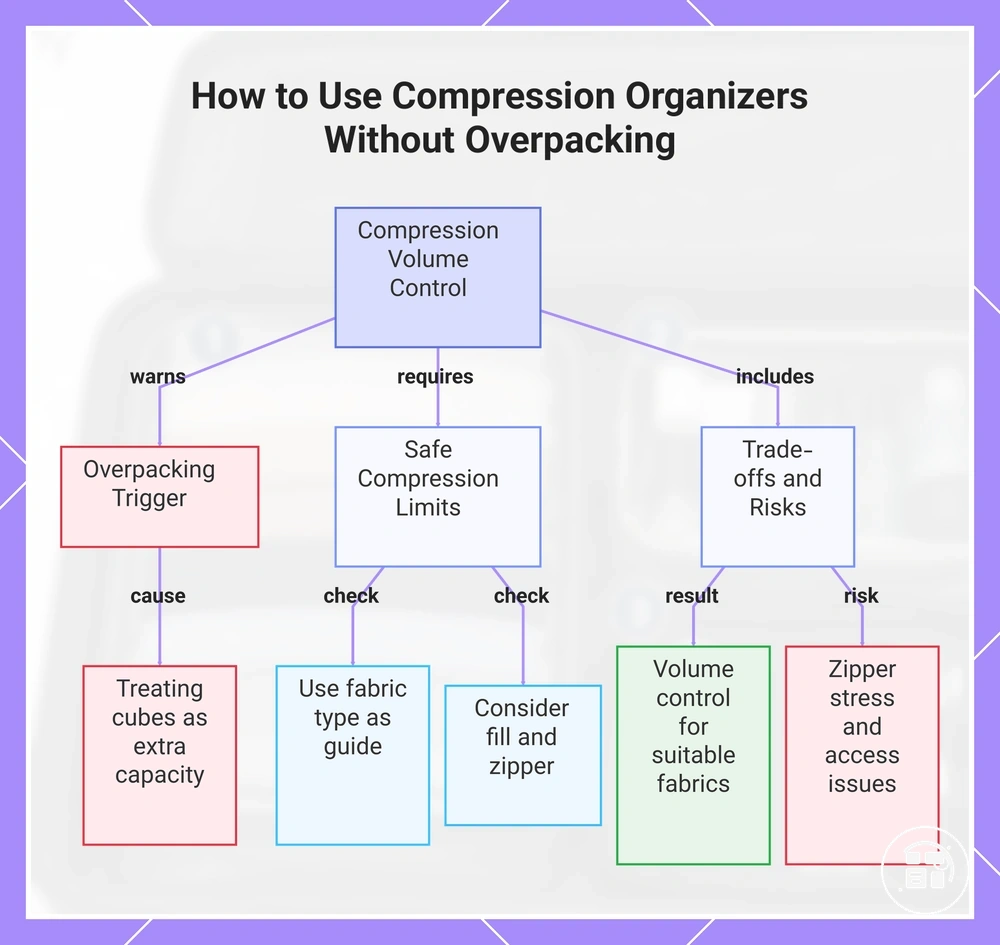
Use compression organizers to control clothing volume, not to justify overpacking. Compression amount should stay within what the fabric type, cube closure, and suitcase depth can handle without creating excess pressure. Compression is a packing-control tool, not permission to pack more.
Overpacking starts when compression cubes are treated as extra luggage capacity instead of a way to manage bulk. Too much compression can increase zipper stress, make wrinkles more likely on sensitive fabrics, and make reopening access harder when items need to be retrieved or repacked. Fabric type, fill level, and zipper behavior should guide how much compression is sensible. Safe use means stopping before the organizer becomes difficult to close or hard to reopen.
Check compression amount against the weight limit, suitcase depth, and reopening access before closing the suitcase. The trade-offs are clear: compression organizers may improve volume control for suitable fabrics, but they can also add zipper stress, restrict retrieval, and make repacking harder when the cube is overfilled.
Here are product examples that may make comparison easier. Before buying, always review the compatibility criteria, essential features, and product details.
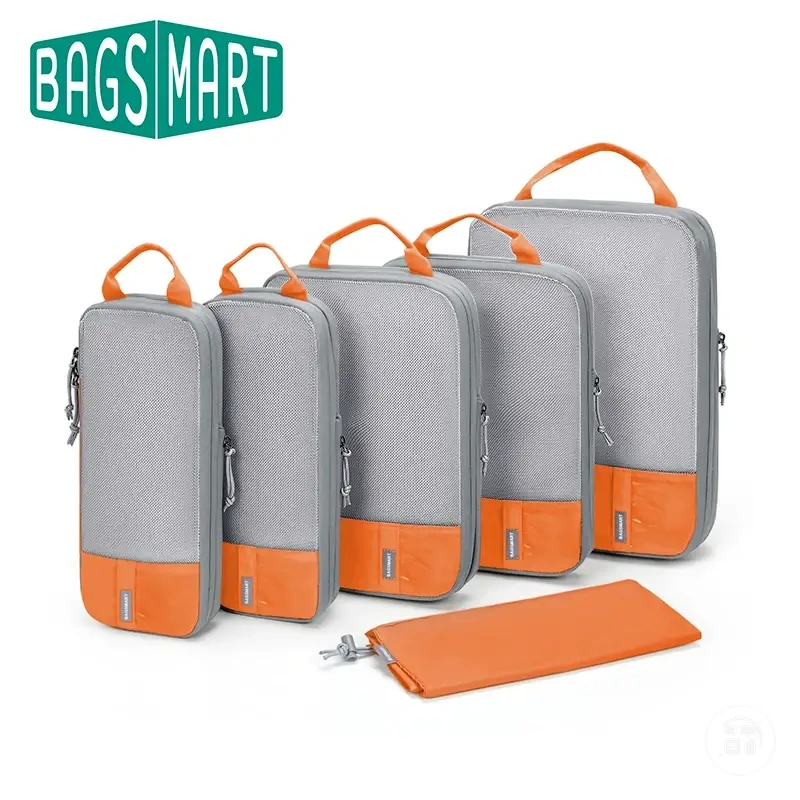
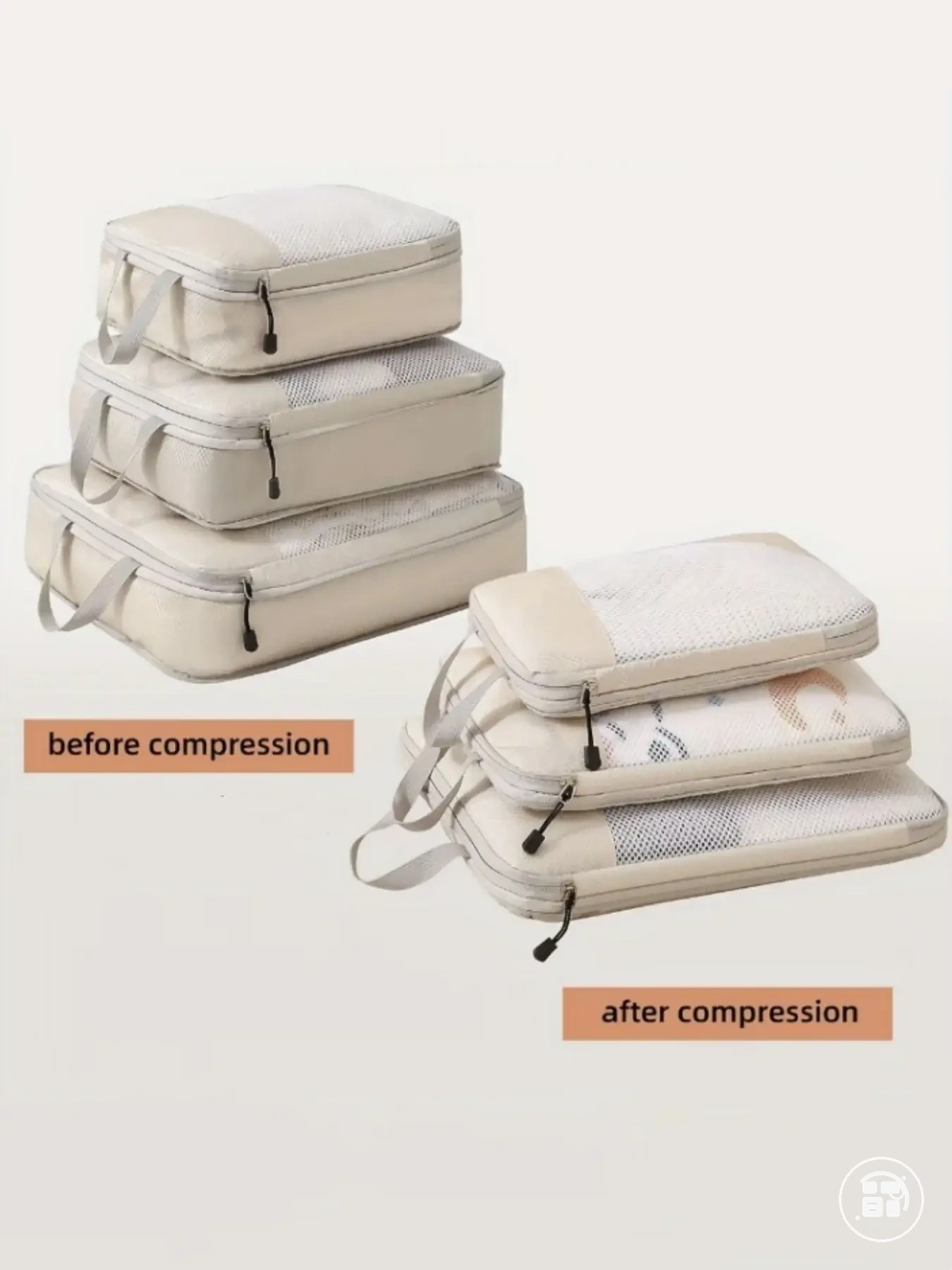
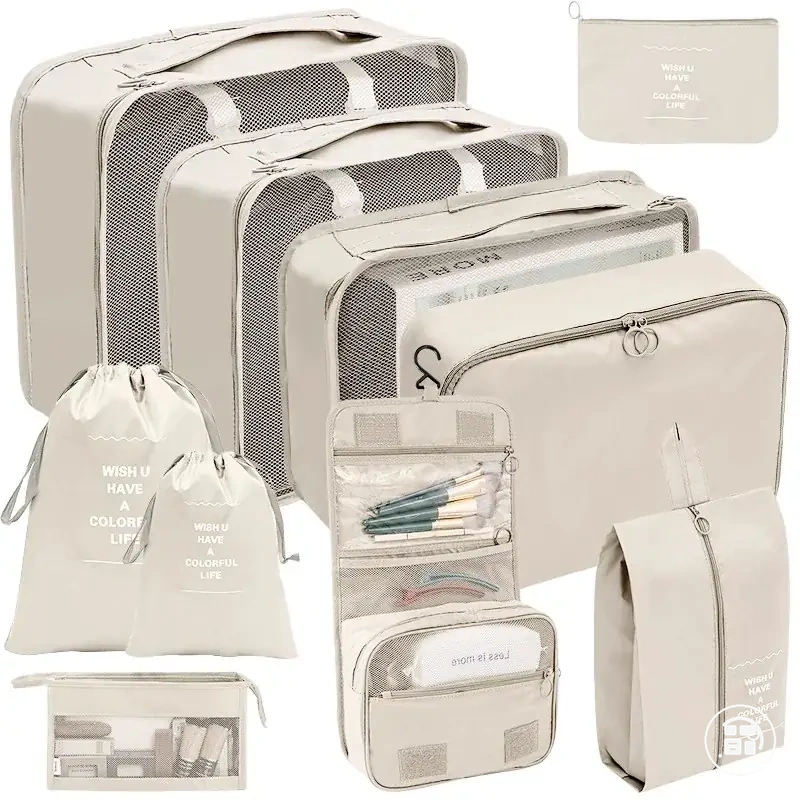
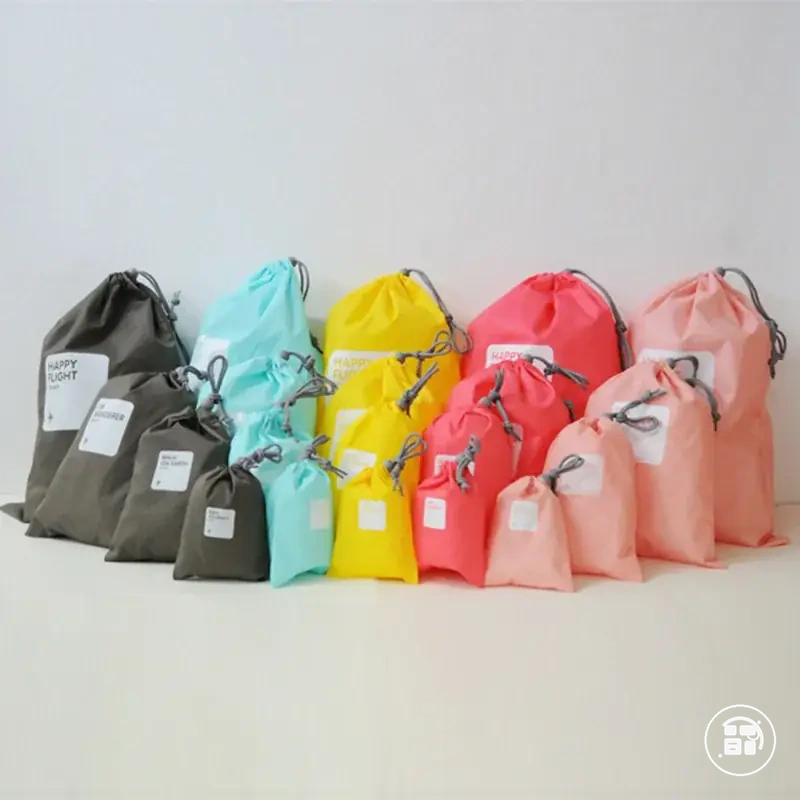
This chart shows the core principle, safe usage limits, and trade-offs when using compression organizers to avoid overpacking.
Adapt the Packing Setup for Carry-On and Checked Luggage
Adapting the packing setup depends on luggage size, weight limit, access during transit, and movement inside the bag. Carry-on packing favors reachability, while checked luggage favors stability and protection from shifting. The same packing method changes by access needs and checked-bag movement risk.
Carry-on decisions depend on access during transit, security checks, and organizer retrieval. Toiletry placement, electronics pouches, and other frequently used organizers are often easier to manage when they remain reachable without disturbing the entire luggage layout. Carry-on packing setup should prioritize practical access while avoiding rigid overpacking.
| Carry-on packing setup | Checked luggage packing setup |
|---|---|
| Keep transit-use organizers closer to the top layer for easier retrieval. | Place less-used organizers deeper to improve stability during checked-bag movement. |
| Arrange pouch placement so security checks may require less disruption to the packing setup. | Distribute weight to help limit shifting and support a more stable luggage layout. |
| Keep fragile items accessible only when transit access is important. | Protect fragile items by avoiding pressure from tightly packed organizer layers. |
| Use toiletry placement that supports practical access when needed. | Keep toiletry placement controlled so liquids remain separated during movement. |
Checked luggage decisions depend more on stability, weight distribution, fragile items, and luggage movement. Organizers should support a balanced layout that respects luggage size and weight limit without forcing a rigid fit. Checked luggage setup should focus on reducing movement and preserving organization throughout handling.
Keep organizers reachable when access during transit is likely to matter. Prioritize weight distribution and stability when checked luggage may experience more movement. If reopening access becomes difficult or the luggage layout feels forced, adjust the load rather than compressing more items into the packing setup.
Here are product examples that may make comparison easier. Before buying, always review the compatibility criteria, essential features, and product details.
Common Packing Mistakes With Travel Organizers
When travel organizers create retrieval problems, wasted space, or poor visibility, packing mistakes are often the underlying cause. Most packing mistakes come from using organizers in ways that do not match the contents, available space, or access needs. Mismatch, overfilling, and poor placement are the main causes.
Common Packing Mistakes With Travel Organizers are easier to diagnose when each problem is reviewed through mistake-effect-fix logic. The checklist below identifies common organizer mistakes, what they can cause, and safer correction options using a clear mistake-effect-fix approach.
| Mistake | What it causes | Safer correction |
|---|---|---|
| Overpacking cubes | Zipper strain, a rigid block, and a potential fit problem | Reduce the load and keep the cube easier to close and access |
| Mixing wet and dry items | Possible leakage or moisture transfer depending on contents | Separate wet and dry items into different organizers |
| Burying access items | Slower retrieval and repeated unpacking | Keep access items nearer to the top layer or a reachable location |
| Using too many pouches | Clutter, reduced visibility, and more difficult inspection | Combine related items where practical to reduce unnecessary pouch layers |
| Ignoring luggage shape | Unused space and organizer fit problems | Adjust organizer placement to the available luggage shape |
| Compressing the wrong items | Possible wrinkles, restricted access, or concentrated weight | Use compression selectively based on item type and retrieval needs |
Safer correction depends on matching the fix to the specific cause rather than treating every issue as an organizer problem. Overpacking cubes, burying access items, and relying on too many pouches are common signals that the packing setup may need adjustment. For broader troubleshooting related to fit problems and organizer use, review packing mistakes to avoid.
Small correction checks can often improve visibility, retrieval, and organization without rebuilding the packing setup. After troubleshooting is complete, it may help to clean and store organizers so they remain easier to use on future trips.