Travel Organization Accessories Feature Guide
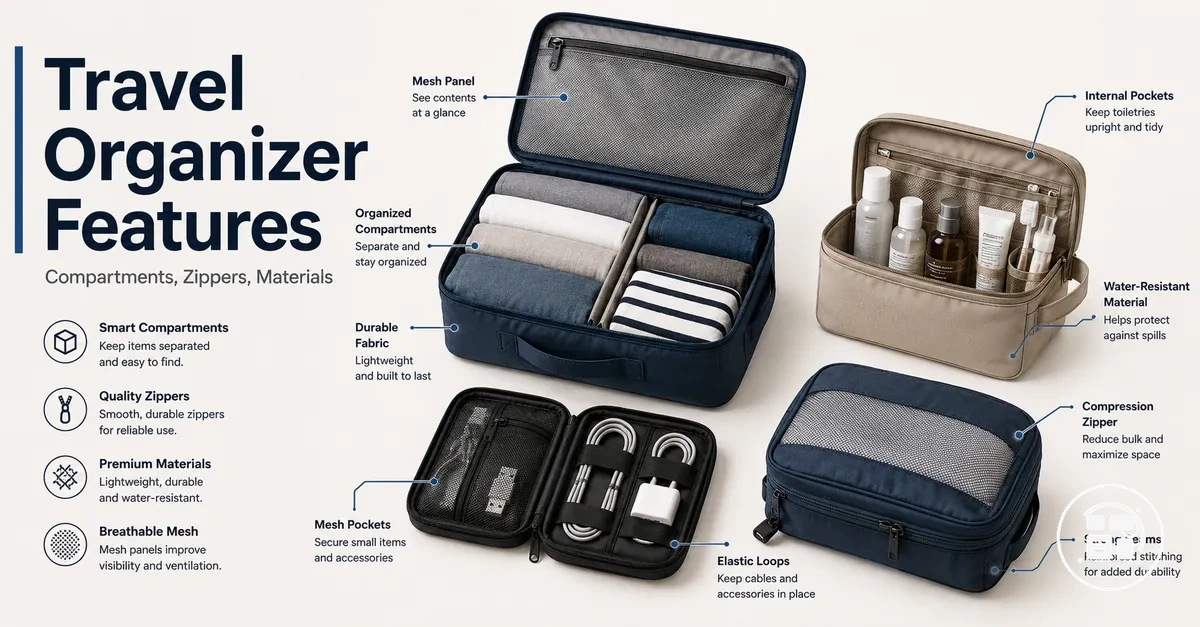
Travel organization accessories are packing accessories whose features shape how belongings are separated, accessed, protected, and fitted inside luggage. Similar organizer types can perform differently because compartments, zippers, materials, visibility, and protective construction change the way each organizer handles contents. These features are the main performance variables.
Features matter because the same organizer type may support different packing outcomes depending on luggage size, item type, trip length, material, and packing behavior. Compartments can improve separation, zippers can affect access and containment, materials can change weight and packability, and visibility can make contents easier to identify without unpacking. This page focuses on organizer features rather than the full category; for the broader category context, see the travel organization accessories guide.
A toiletry pouch, cable case, packing cube, or travel pouch may look similar at first, but its practical value depends on the attributes built into it. A soft pouch may pack flatter, while a structured organizer may offer more protection for delicate items when the size and construction match the packed contents. The sections below explain feature behavior before moving into narrower criteria.
What Features Change in Travel Organization Accessories
Travel organization accessories are defined by the features that influence how a travel organizer separates, protects, stores, and presents packed items. Organizer features do not change the purpose of an organizer, but they can change the conditions under which it performs. Compartments, materials, closures, visibility elements, and cleaning-related attributes affect how items are grouped, accessed, and maintained during travel. The main feature effect is the relationship between organizer attributes, conditions, and packing outcomes.
What Features Change in Travel Organization Accessories becomes clearer when feature effects are viewed as connections between an attribute and its result. The image below highlights common organizer features and the packing outcomes they may influence under different conditions.
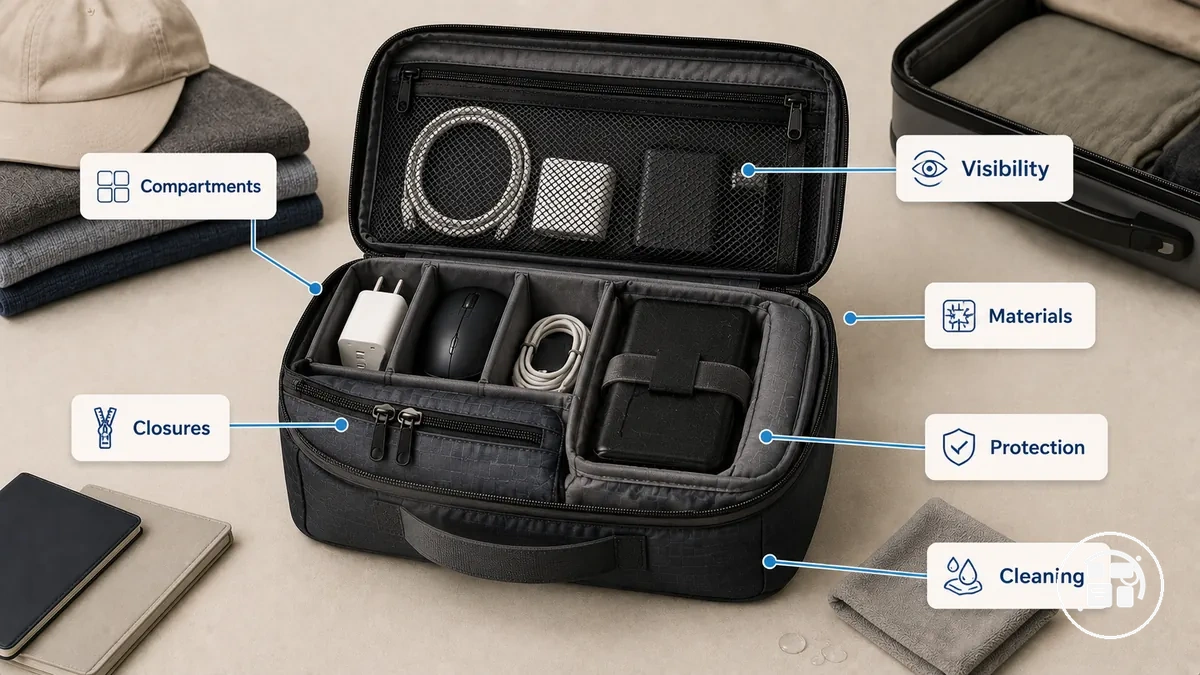
A travel organizer with multiple compartments may improve separation when small items need dedicated spaces, while fewer compartments may suit larger items or simpler layouts. Materials can influence weight, protection, and cleaning effort, but the outcome depends on the packed items and travel conditions. Closures can affect access and containment, while visibility features may make contents easier to identify without opening every section.
The feature-to-effect relationship can be summarized through common organizer attributes:
- Compartments → separation and item grouping.
- Visibility elements → identification and access to contents.
- Materials → weight, protection, and cleaning considerations.
- Closures → access control and containment.
- Protective construction → additional protection when the packed items require it.
Features support decisions by explaining possible trade-offs between access, protection, visibility, weight, and cleaning needs. However, a feature set does not replace fit, packing style, or item-type judgment because outcomes can vary by use case.
Compartments, Dividers, and Separation Features
Compartments, dividers, and separation features are the internal layout components that create distinct spaces for belongings inside travel organization accessories. These features separate items by type, size, or use, which can reduce mixing and make contents easier to locate under certain packing conditions. Compartments create dedicated zones, while dividers, pockets, elastic loops, and segmented sections refine how items are contained. The value of separation features depends on the balance between organization needs and available packing space.
Compartments, Dividers, and Separation Features become easier to evaluate when viewed through the relationship between layout parts and separation outcomes. The image below highlights common internal layout elements and the different ways they can separate belongings.
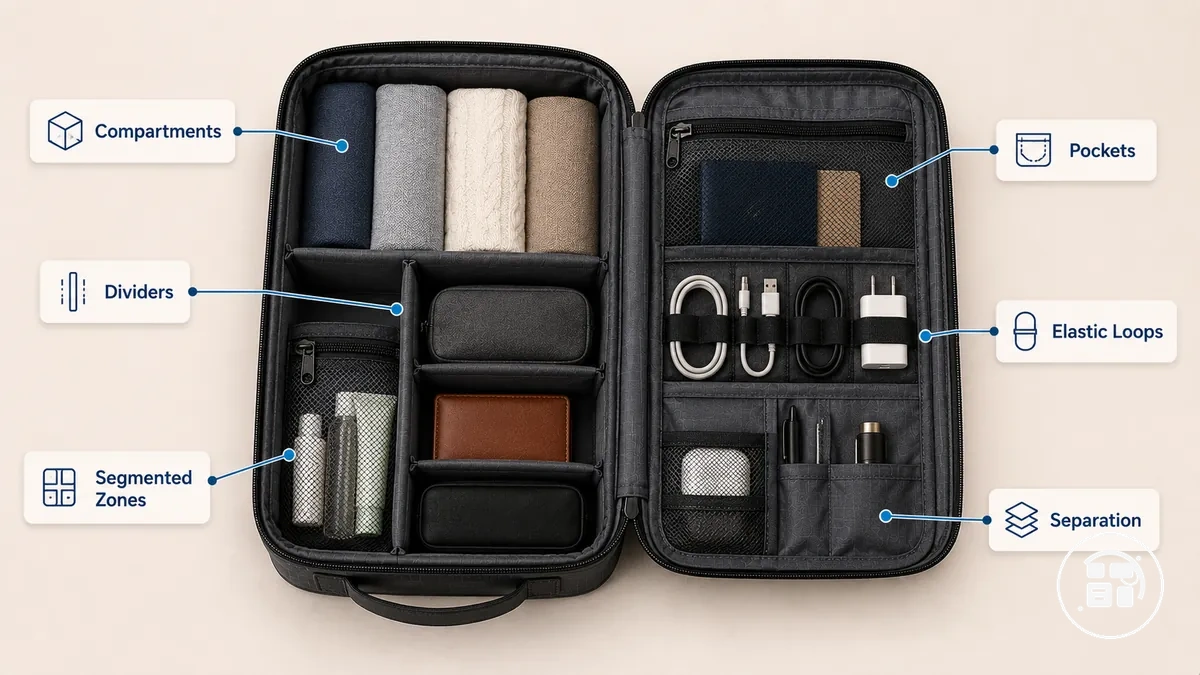
Compartments often help keep clothes separate from toiletries, while smaller pockets may isolate accessories such as cables, adapters, or other small items. Dividers create boundaries between groups of belongings, and elastic loops can hold individual items in place. Segmented zones may improve organization when multiple item types share the same organizer, although additional sections can also reduce flexibility when carrying larger objects.
Separation features differ by item type and access needs. The table below shows how common layout parts relate to organization effects and possible packing trade-offs.
| Layout Part | Attribute | Condition | Possible Effect |
|---|---|---|---|
| Compartments | Dedicated sections | Mixed item categories | Can improve separation between item groups |
| Dividers | Internal boundaries | Shared storage space | May reduce item mixing |
| Elastic Loops | Individual retention | Cables or small accessories | Can keep items positioned and separated |
| Pockets | Quick-access storage | Frequently used items | May simplify retrieval |
| Segmented Zones | Multiple storage areas | Different item types in one organizer | Can increase organization but may limit space for larger items |
More compartments are not automatically better. The most useful separation features depend on the item types being carried, how often access is needed, and the packing density inside the organizer.
Fixed Compartments, Open Pockets, and Slip Sections
Fixed compartments, open pockets, and slip sections differ in how much structure they impose on storage space. Fixed compartments create defined boundaries with dedicated locations, while open pockets and slip sections provide more flexible areas that can adapt to changing item sizes. Divider placement and elastic holders further influence containment and access by shaping how items are positioned within the same organizer.
Fixed Compartments, Open Pockets, and Slip Sections are easier to compare when viewed as local layout forms with different containment behaviors. The image below labels these storage structures and clarifies how each form affects access and separation conditions.
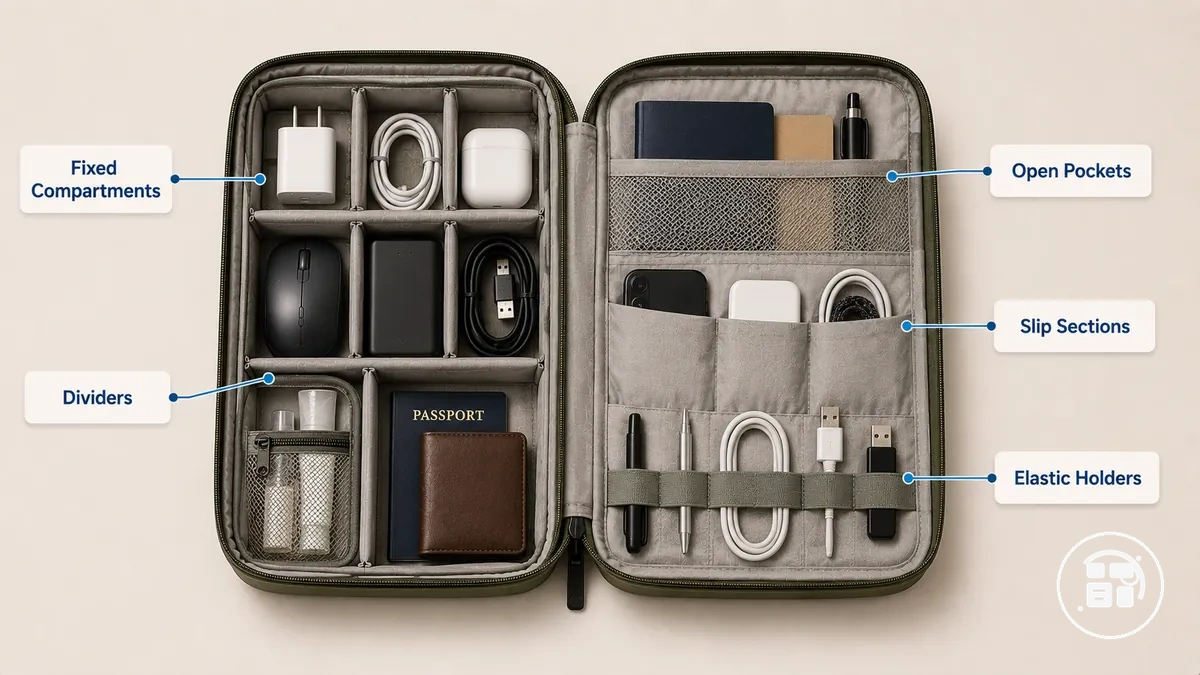
- Fixed Compartments: Defined sections that separate item groups when consistent placement is useful.
- Open Pockets: Flexible storage areas that may accommodate different item sizes when access needs vary.
- Slip Sections: Flat spaces designed to hold thin items within a compact layout.
- Elastic Holders: Retention features that can keep individual cables or small accessories positioned inside a larger section.
- Divider Placement: Internal boundaries that influence how storage space is partitioned and accessed.
A fixed compartment may help separate toiletries from clothing when clear boundaries are needed, while an open pocket may work better when accessory sizes change between trips. The usefulness of each storage form depends on item size, access frequency, and containment needs rather than on any single layout being suitable for every situation.
Mesh Panels, Windows, and Item Visibility
Mesh panels, windows, and item visibility features make contents easier to identify without unpacking the organizer. Mesh panels provide partial visual access through the material, while translucent windows allow stored items to be seen more directly. Label-friendly surfaces support identification from the outside when visual access alone is not sufficient.
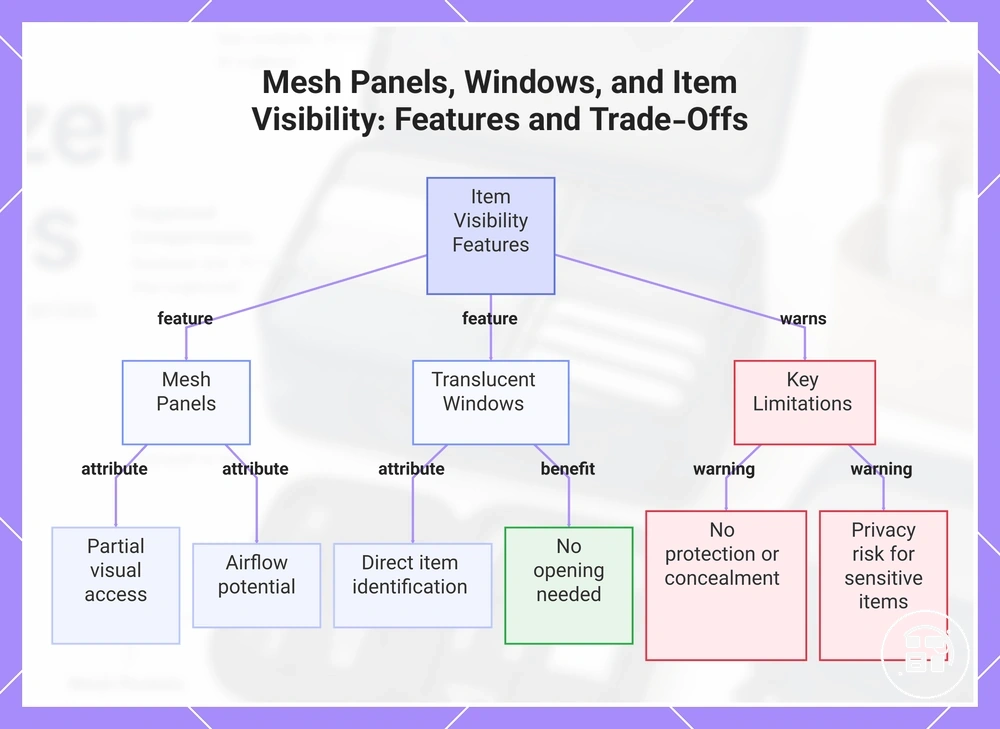
Mesh Panels, Windows, and Item Visibility help with content recognition, but visibility does not automatically provide protection, concealment, or material performance benefits. The value of a visibility feature depends on whether seeing the contents is more important than limiting exposure.
- Mesh Panels: Improve content visibility and may allow airflow depending on the material and construction.
- Translucent Windows: Make stored items easier to identify without opening the compartment.
- Breathable Panels: May support airflow, but the effect depends on material type and surrounding conditions.
- Label-Friendly Surfaces: Provide an external reference point for identifying contents.
Mesh panels and windows can simplify identification of cables, accessories, or toiletries during travel. However, privacy-sensitive items or belongings that should remain concealed may be better suited to covered storage areas. Visibility features can support recognition and condition monitoring, but visibility alone does not indicate protection, waterproofing, hygiene, or long-term storage suitability.
This chart shows the main visibility features of mesh panels and translucent windows in organizers, along with their key limitations.
Zippers, Closures, and Access Features
Zippers, closures, and access features affect how easily a travel organizer opens, how securely contents remain contained, and how reliably compartments can be accessed during travel. Closure design influences access behavior because opening direction, fastening method, and pull-point placement change how quickly a compartment can be opened and closed under different packing conditions.
Zippers, Closures, and Access Features create trade-offs between access convenience and containment. A closure that allows faster access may expose contents more easily when a compartment is overfilled, while a more restrictive closure may require additional effort during frequent opening and closing.
| Closure Feature | Attribute | Condition | Possible Outcome |
|---|---|---|---|
| Zipper Strength | Closure resistance | Frequent use or heavier contents | May support more consistent containment when properly used |
| Zipper Direction | Opening path | Frequent opening | Can affect how quickly contents are reached |
| Pull Tabs | Grip point | One-handed access | May make opening and closing easier |
| Elastic Closures | Flexible retention | Variable item sizes | Can provide quick access but may allow more item movement |
| Drawstrings | Adjustable opening | Soft or expandable contents | May simplify access while offering less containment than fully enclosed closures |
| Flaps and Buckle-Style Closures | Layered fastening | Travel movement or packed storage | Can improve containment but may require additional opening steps |
Zipper direction and pull-tab design are often most noticeable when the same compartment is accessed repeatedly during a trip. Pull tabs may improve grip during one-handed use, while zipper paths can influence whether access feels direct or requires repositioning of the organizer.
Closure choice depends on access frequency, compartment load, and containment needs. Overfilled compartments may place additional stress on closures, and no closure type is automatically suitable for every organizer layout or travel condition.
Two-Way Zippers, Pulls, and Quick-Access Openings
Two-way zippers, pulls, and quick-access openings change the speed and control of opening a travel organizer. These zipper mechanics affect access because they determine where an opening begins, how much of the compartment is exposed, and how precisely contents can be reached during use.
Quick-access behavior depends on the opening mechanism and the access situation. The following features create different convenience and containment trade-offs:
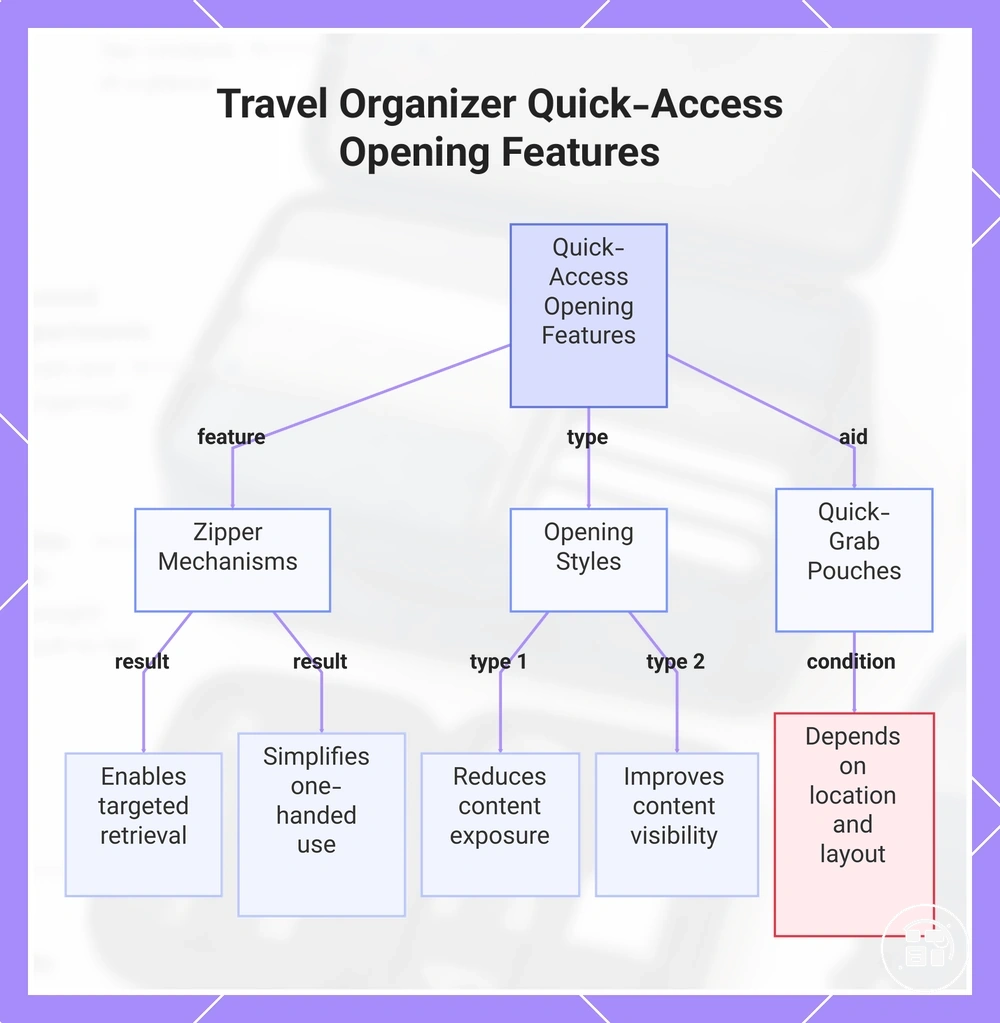
- Two-Way Zippers: Allow access from different points along the closure, which may make targeted retrieval more practical when only a small opening is needed.
- Large Pulls: Provide a larger grip area and may simplify opening when quick access or one-handed use is needed.
- Partial Openings: Expose only part of the compartment, which can reduce unnecessary exposure of other contents during retrieval.
- Clamshell Openings: Open a larger portion of the organizer and can improve content visibility, though more items may be exposed at the same time.
- Quick-Grab Pouches: Place frequently accessed items within easier reach, but usefulness depends on pouch location and organizer layout.
For example, when accessing an organizer inside a packed travel bag, a two-way zipper may allow a specific item to be reached without opening the entire compartment. The most suitable quick-access opening depends on access frequency, item placement, and containment needs rather than on any single zipper design.
This chart shows the main quick-access opening features in travel organizers and their trade-offs in convenience and containment.
Compression, Expansion, and Space Control
Compression, expansion, and space control features affect volume control by changing how an organizer occupies space and how contents are distributed within that space. Compression features can reduce bulk when contents are compressible, while expansion features can increase available volume when additional capacity is needed. The outcome depends on the contents, packing density, and how the organizer fits within surrounding luggage.
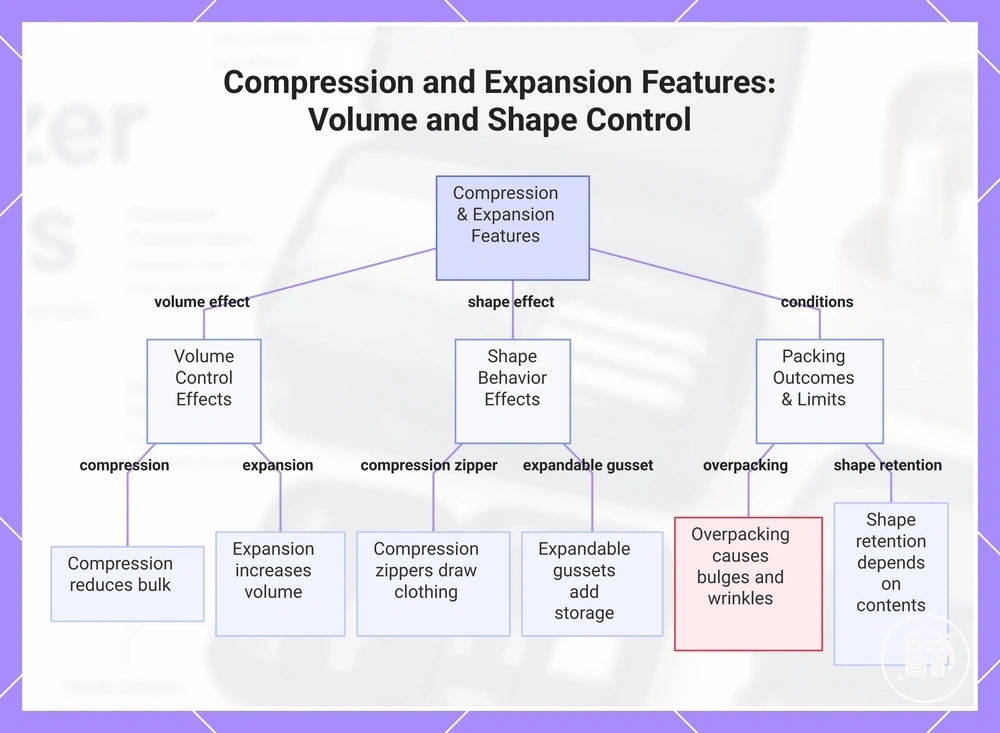
Compression, expansion, and space control also influence shape behavior. Compression zippers can draw soft clothing closer together, while expandable gussets can create additional storage room. Soft-sided construction may adapt to changing loads, but shape retention can vary when bulky items or rigid belongings place uneven pressure on the organizer.
Space-control results depend on both the organizer and its contents. The following criteria highlight common volume-control conditions and limits:
- Compression Zippers: Can reduce bulk when soft clothing or other compressible contents are packed inside.
- Expandable Gussets: Increase available volume but may create a larger external profile when fully expanded.
- Soft-Sided Construction: May adapt to changing loads, though shape retention can vary with packing density.
- Overpacking Risk: Excessive compression or expansion can create bulges and may increase the likelihood of wrinkles in compressible contents.
- Shape Retention: Often depends on the balance between soft clothing, bulky items, and rigid belongings.
Compression and expansion features can influence how an organizer may fit inside carry-on and checked luggage, but compatibility depends on the final packed size rather than on the feature alone. Space-control outcomes vary by contents and packing conditions, so no compression or expansion system produces the same result in every situation.
This chart shows how compression and expansion features affect volume control and shape behavior in organizers, and the key packing outcomes and limits.
Material, Weight, and Packability Features
Material, weight, and packability features influence how a travel organizer behaves during packing, carrying, storage, and cleaning. Material choices affect overall weight, flexibility, cleaning considerations, and shape behavior, while construction features influence how easily an organizer folds, compresses, or maintains its form under different travel conditions.
Material outcomes depend on both fabric properties and construction details. Nylon and polyester can provide lightweight storage surfaces, while mesh panels may improve visibility and reduce material weight in selected areas. Coated fabrics can add a surface layer that may simplify cleaning under certain conditions, and structured panels can help maintain shape when contents benefit from additional support.
Different material and construction features create different packability, wear, and maintenance trade-offs. The comparison below highlights common attribute-to-outcome relationships.
| Material or Construction Feature | Attribute | Possible Effect |
|---|---|---|
| Nylon | Lightweight flexible fabric | May support compact packing when low weight is a priority |
| Polyester | Synthetic woven fabric | Can balance structure and packability depending on construction |
| Mesh Panels | Open material sections | May reduce weight and improve content visibility |
| Coated Fabric | Surface-treated material | May simplify cleaning when spills or residue occur |
| Structured Panels | Shape-supporting construction | Can improve form retention but may reduce foldability |
| Seams | Material connection points | Wear characteristics can vary with construction and use conditions |
A traveler prioritizing low weight may prefer materials that fold easily when empty, while frequent washing needs may make cleaning-related surface features more relevant. Structured protection may be more useful when contents benefit from shape retention, but packability can change as structure increases. Material, weight, and packability features work together, so the most suitable choice depends on contents, travel habits, and storage priorities rather than on any single material being universally preferable.
Lightweight Fabrics and Foldable Construction
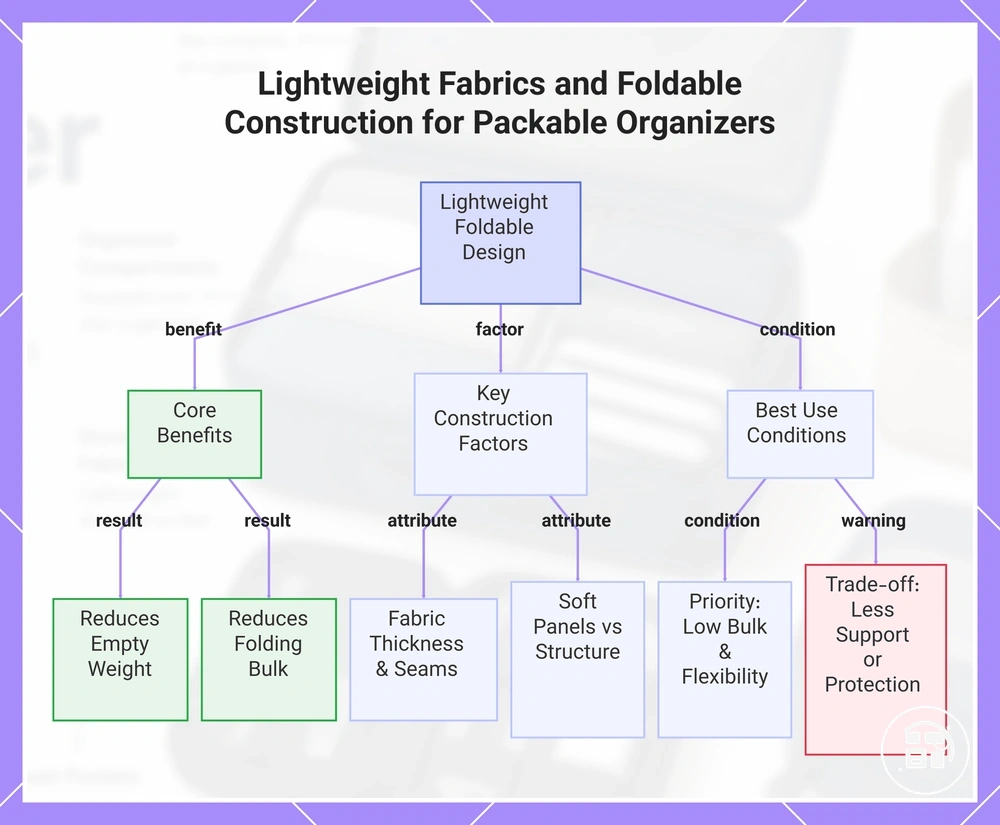
Lightweight fabrics and foldable construction reduce empty weight and folding bulk by using thinner materials, soft panels, and collapsible shapes. These attributes support packability when luggage space is limited, but the outcome depends on fabric thickness, seam construction, and the amount of structure built into the organizer.
- Fabric Thickness: Thinner fabrics can reduce bulk and make folding easier when compact storage is a priority.
- Soft Panels: Flexible panel construction can help an organizer adapt to available luggage space.
- Empty Weight: Lighter construction reduces the organizer's weight before contents are added.
- Seam Strength: Seam performance can influence wear characteristics and may vary with construction method and handling conditions.
- Folding Behavior: Collapsible shapes can store flatter or fold more easily when the organizer is empty.
- Shape Recovery: Shape retention after folding may depend on material thickness, panel structure, and packing conditions.
Very light construction can improve packability, but reduced fabric thickness or softer panels may provide less structure when contents benefit from additional support or protection. Lightweight fabrics and foldable construction are most useful when low bulk and flexible storage are priorities, while shape recovery and structural support depend on the specific material and construction combination.
This chart shows how lightweight fabrics and foldable construction reduce weight and bulk, the key material and construction factors that influence performance, and when this design is most useful despite trade-offs in support.
Washable, Water-Resistant, and Waterproof Surfaces
Washable, water-resistant, and waterproof surfaces describe different moisture-related properties. Washable surfaces focus on cleaning, water-resistant surfaces can help limit moisture penetration under certain conditions, and waterproof surfaces are intended to provide a higher level of moisture protection. However, moisture performance can still depend on seams, closures, linings, and overall construction.
These terms describe different protection levels, so they should not be treated as interchangeable surface attributes.
| Surface Attribute | Condition | Possible Outcome |
|---|---|---|
| Washable Surface | Routine cleaning needs | Can make dirt or residue easier to remove |
| Water-Resistant Coating | Light moisture exposure | May help reduce surface moisture penetration |
| Waterproof Surface | Moisture exposure with supporting construction | Can provide a higher level of moisture protection when seams and closures support the design |
| Mesh Panels | Cleaning and drying conditions | May dry more quickly because of their open structure |
| Wipe-Clean Linings | Surface spills or residue | Can simplify cleaning when residue remains on the lining surface |
| Seam Exposure | Moisture reaching stitched areas | Moisture outcomes may vary when seams or openings are exposed |
Coated surfaces, mesh washability, drying behavior, and seam construction should be evaluated together because surface claims alone do not define overall moisture performance. Cleaning procedures and long-term storage practices belong to a separate maintenance context, so this comparison is limited to surface attributes and their cleaning or moisture-related outcomes.
Protection Features for Liquids, Devices, and Delicate Items
Protection features for liquids, devices, and delicate items depend on both item sensitivity and organizer construction. Padding, lined compartments, reinforced sides, moisture barriers, and closure control can reduce certain travel risks, but outcomes vary with packing conditions, item placement, and the nature of the contents being carried.
Liquids, electronics, and fragile belongings are exposed to different travel conditions. Toiletry bottles may benefit from moisture-focused compartments and controlled bottle orientation, while cables and chargers may benefit from separation features that reduce tangling or contact with other items. Documents and delicate accessories may benefit from lined compartments or reinforced sides when additional structure helps limit movement.
Protective features work by matching a specific risk to a specific attribute. The table below highlights common relationships between item groups, protection features, and possible limitations or risk reductions.
| Item Group | Protection Attribute | Possible Risk Reduction or Limitation |
|---|---|---|
| Toiletry Bottles | Moisture Barriers and Bottle Orientation | May help limit the spread of leaks when closures remain secure |
| Cables and Chargers | Cable Separation Features | Can reduce tangling and contact between stored accessories |
| Electronic Devices | Lined Compartments and Padding | May reduce minor contact-related wear during travel |
| Documents | Structured Compartments | Can help maintain organization and reduce folding under certain conditions |
| Delicate Accessories | Reinforced Sides and Protective Linings | May provide additional separation from surrounding contents |
| Mixed Contents | Closure Control | Can help keep item groups contained when compartments are properly closed |
Protection features can reduce common travel risks, but they do not guarantee complete damage prevention, leak control, or device safety in every situation. The most suitable protection features depend on item sensitivity, packing density, closure condition, and the overall construction of the organizer.
Padding, Reinforced Areas, and Structured Cases
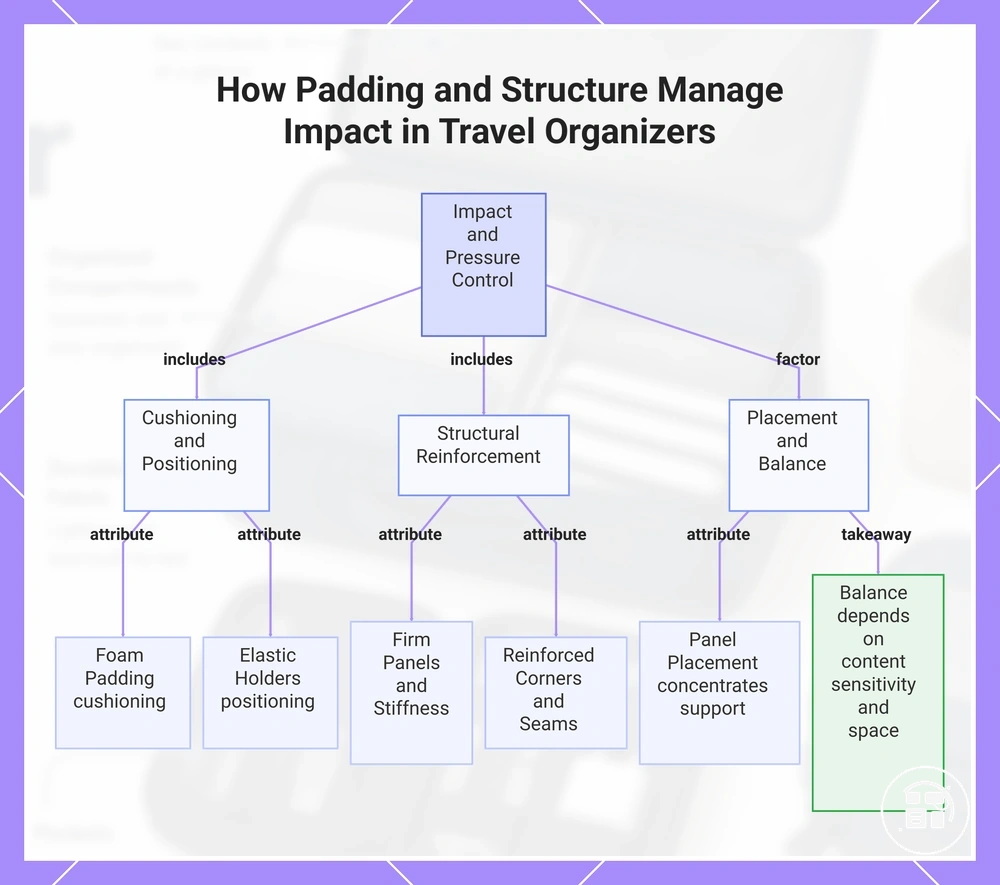
Padding, reinforced areas, and structured cases help manage pressure and impact by adding cushioning, support points, and shape retention within a travel organizer. These physical attributes can reduce direct contact between stored items and surrounding contents, but their protective effect depends on packing density, item placement, and the force applied during travel.
Impact and pressure control depend on how protective components are positioned and combined inside the organizer.
- Foam Padding: Creates a cushioning layer that may help reduce minor contact pressure when contents shift during transport.
- Firm Panels and Shell Stiffness: Add structural support and can help distribute pressure across a wider surface area.
- Reinforced Corners and Seams: Strengthen high-stress areas and may improve shape retention under load.
- Elastic Holders: Help keep individual items positioned and can reduce internal movement.
- Panel Placement: Determines where support is concentrated and can influence both pressure distribution and organization outcomes.
Structured cases provide a more defined shape, while padding focuses on cushioning and separation. Additional structure may improve support in certain conditions, but reinforced panels and stiffer construction can add bulk and reduce packability when luggage space is limited. The most suitable balance between padding and structure depends on content sensitivity, available space, and the level of organization required.
This chart shows the key components that manage pressure and impact in a travel organizer, and the trade-offs between padding and structure.
Leak Control and Moisture Separation
Leak control and moisture separation depend on construction features that help limit moisture movement between stored items. Coated linings, seam design, zipper coverage, and compartment separation can help contain minor spills or damp contents under certain conditions, but containment outcomes vary with closure condition, liquid volume, and item placement.
Leak control depends on lining, closure, seams, and item placement. The following attributes influence containment and separation behavior:
- Coated Linings: May help limit moisture transfer across interior surfaces and can support containment of minor spills.
- Sealed or Protected Seams: Can reduce potential moisture entry points, while exposed seams may allow moisture transfer more easily when liquids reach stitched areas.
- Zipper Coverage: Additional fabric coverage may help limit moisture reaching the zipper area, depending on construction and closure position.
- Separate Wet Compartments: Can help isolate damp items from surrounding contents when moisture remains contained within the compartment.
- Drying Behavior: Material choice and compartment design may influence how quickly residual moisture dissipates after exposure.
Water resistance, waterproofing, and leak control describe different conditions and should not be treated as identical features. Even when moisture-control features are present, no soft organizer should be considered fail-safe for unmanaged liquids, especially when seams, closures, or containers are compromised.
Hanging, Handle, and Attachment Features
Using hanging, handle, and attachment features changes how a travel organizer is positioned, carried, and accessed during travel. Hooks, handles, loops, straps, and removable components create additional placement options that can affect visibility, reachability, and space use depending on the travel setting and the weight of the contents.
Convenience may change when an organizer can be suspended, carried, or attached to another item. The effect depends on the feature design, the available support point, and how frequently stored items need to be accessed.
| Feature | Condition | Possible Access or Placement Outcome |
|---|---|---|
| Hooks | Available hanging point | Can suspend the organizer and may improve content visibility |
| Grab Handles | Frequent carrying or repositioning | Can make short-distance transport easier |
| Loops | Temporary attachment or hanging use | May provide additional placement flexibility |
| Straps | Attachment to luggage or support points | Can help keep the organizer positioned during travel |
| Removable Pouches | Selective item access | May allow a smaller group of items to be separated from the main organizer |
| Hanging Panels | Organizer opened while suspended | Can increase visibility of multiple compartments at once |
A hook may keep an organizer accessible when a surface is unavailable, while a removable pouch may allow frequently used items to be reached without accessing the full organizer. Straps and loops can also change placement options, but stability may depend on the available attachment point and the load being supported.
Hanging, handle, and attachment features provide different access and placement advantages rather than a universal convenience benefit. The most suitable feature set depends on travel conditions, available support locations, organizer weight, and how often the contents need to be accessed.
How Features Change by Organizer Type
How features change by organizer type depends on the storage purpose and the packed item category. The same feature can provide different value when used for clothing, toiletries, electronics, or mixed accessories because separation, protection, cleaning, and access needs are not the same across organizer types.
Organizer features should be interpreted by the job each organizer performs. The types affected by these features differ because each organizer format prioritizes different storage conditions and access requirements.
| Organizer Type | Feature or Attribute | Value or Trade-Off |
|---|---|---|
| Packing Cubes | Compression and compartment separation | May improve clothing organization, but compression value depends on the contents being packed |
| Toiletry Organizers | Moisture-control features and coated linings | Can support cleaning and separation needs, though containment depends on closures and containers |
| Electronics Organizers | Cable holders and padded sections | May improve accessory organization and reduce contact between stored items |
| Pouches | Simple compartments and lightweight construction | Can provide flexible storage but may offer less separation than compartment-focused organizers |
| Hanging Organizers | Hooks and hanging panels | Can improve access and visibility when a suitable support point is available |
Packing cubes often place greater value on volume management and clothing separation, while toiletry organizers may place greater value on cleaning-related and moisture-related attributes. Electronics organizers may benefit more from structured layouts, whereas pouches often emphasize flexible storage and compact carrying.
Feature selection becomes more meaningful when organizer type and packed item category are evaluated together. Readers who want to choose by packing style can compare which attributes align most closely with their typical travel conditions and storage priorities.
How features change by organizer type also depends on travel context, packing habits, and the items being carried. Reviewing relevant buying checklist criteria can help connect feature interpretation to a more informed selection decision.
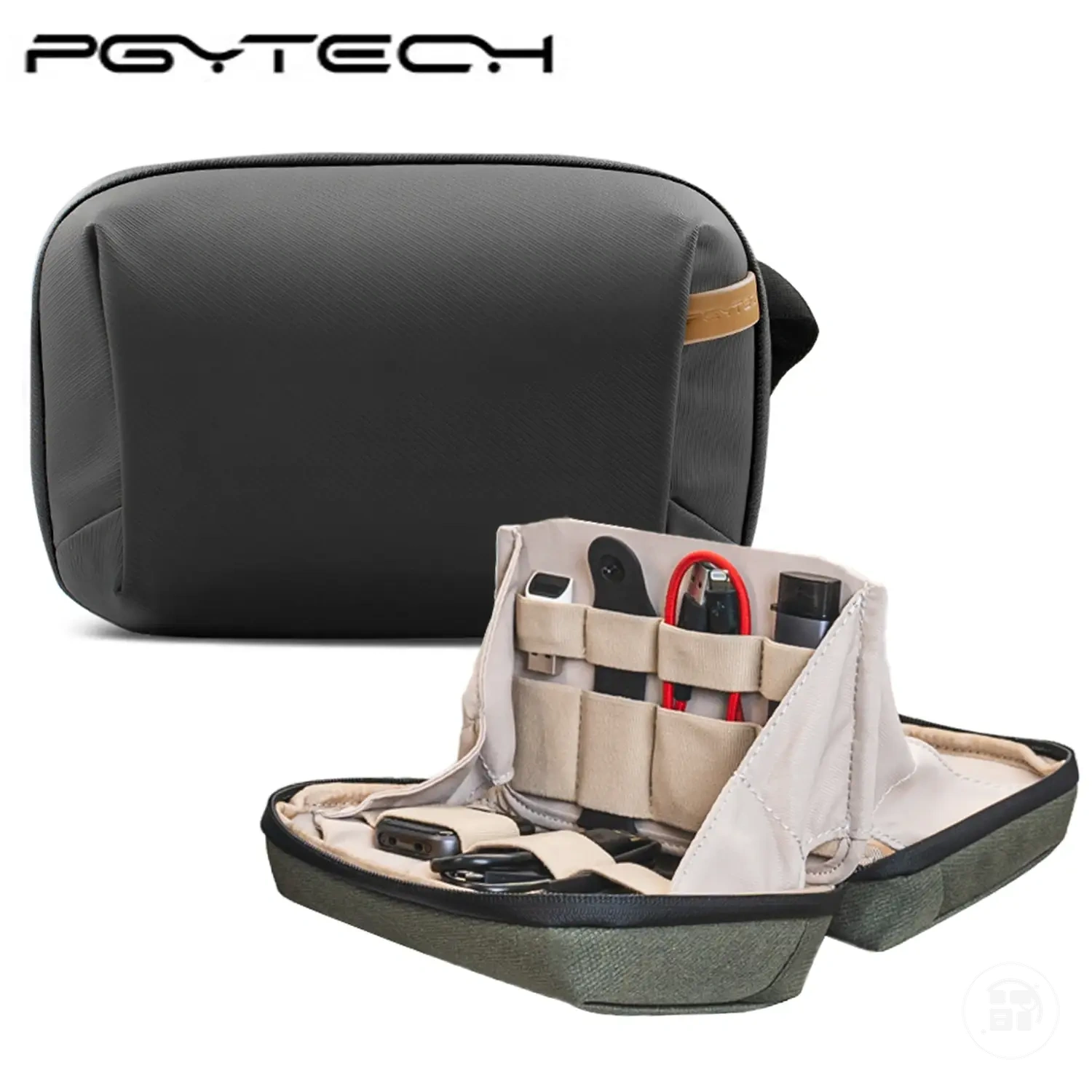
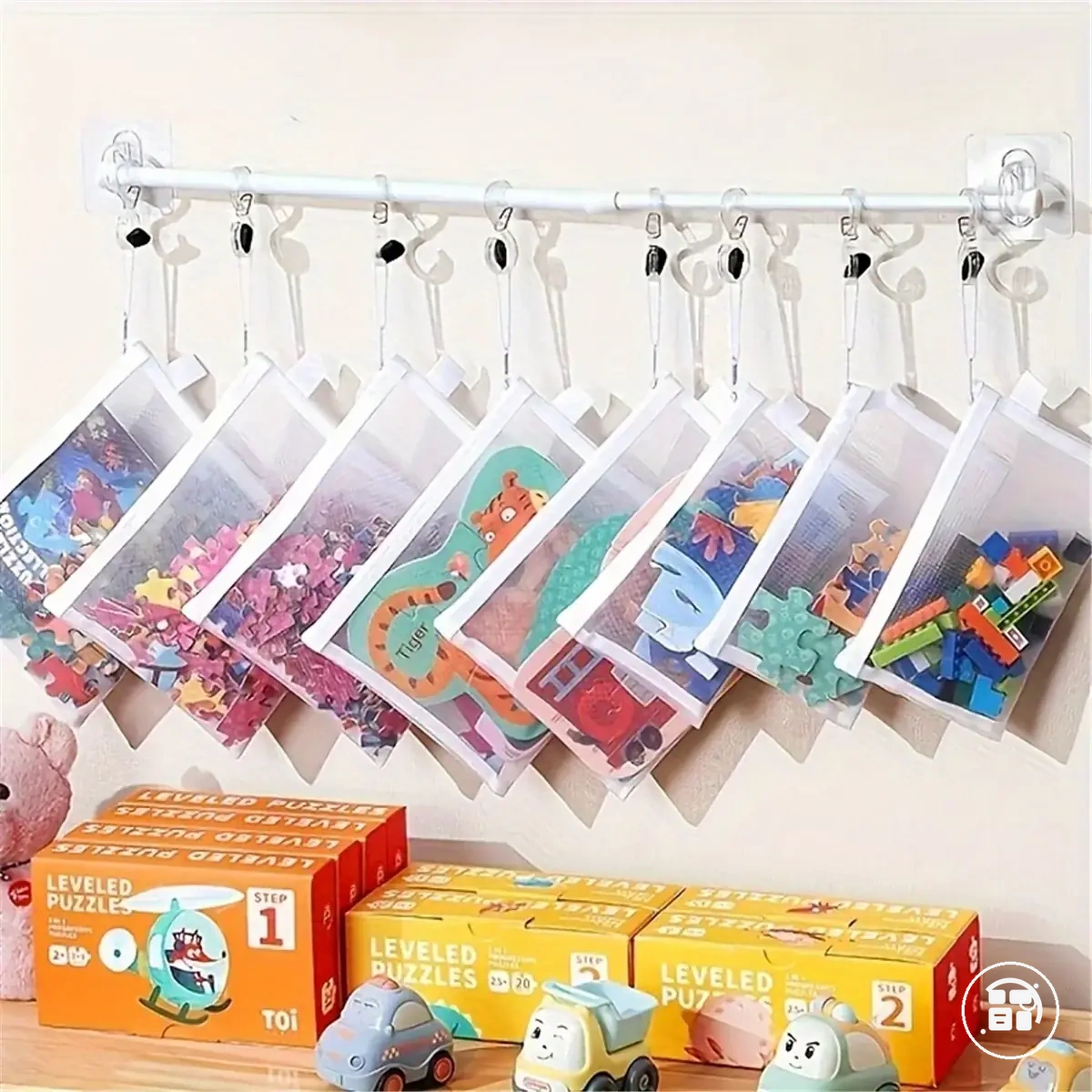
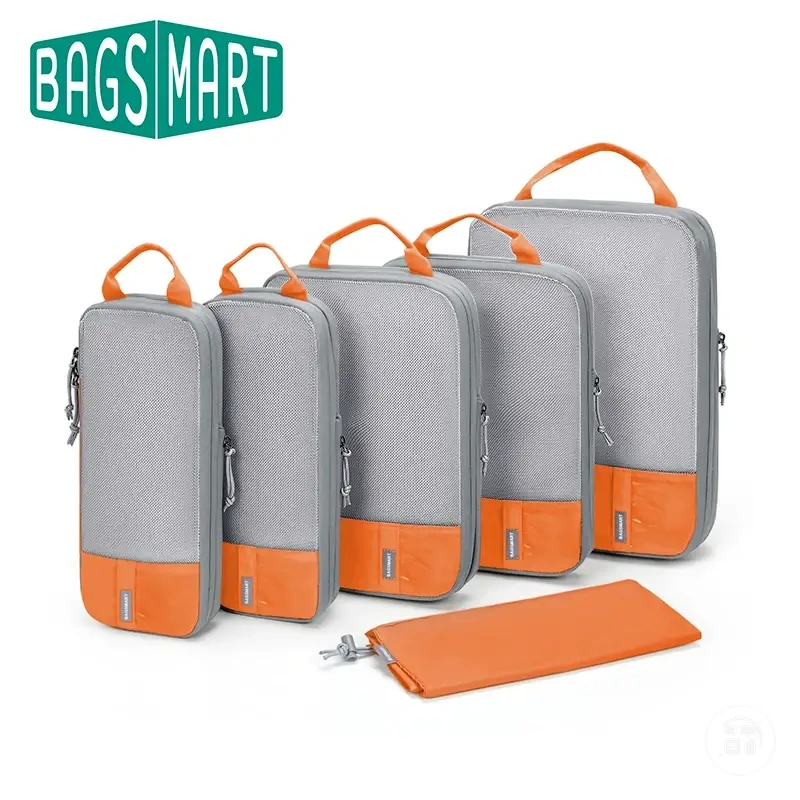
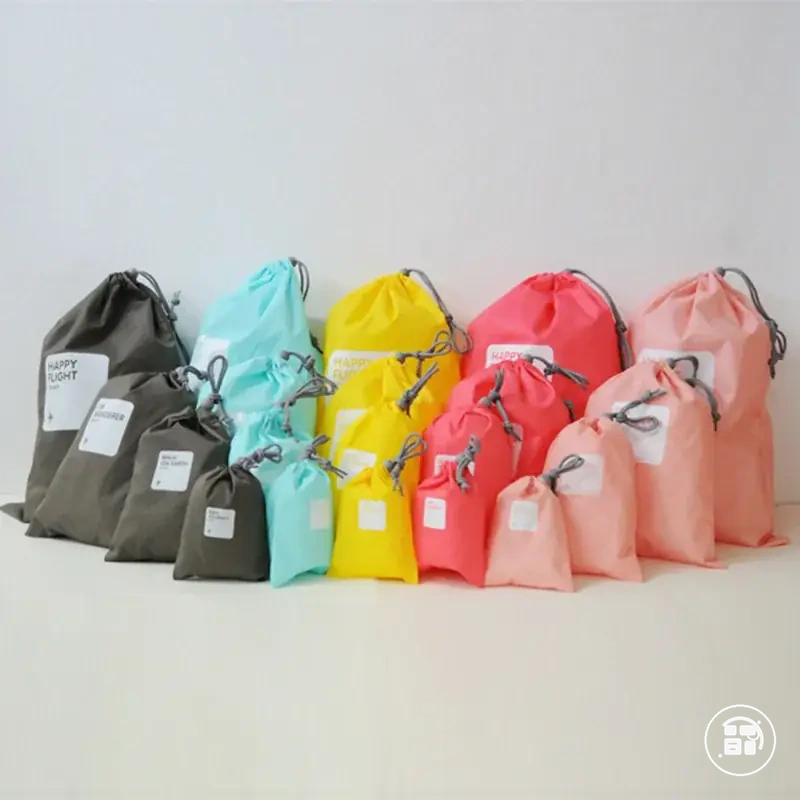
Here are product examples that may make comparison easier. Before buying, always review the compatibility criteria, essential features, and product details.