Travel Organization Accessories Buying Checklist
Travel organization accessories buying checklist criteria help verify travel organization accessories before comparison by focusing on fit, format, protection, material quality, and purchase readiness. Travel organization accessories can include a travel organizer set, packing cubes, a toiletry organizer bag, an electronics travel organizer, a document organizer travel solution, luggage organizer bags, or a waterproof travel pouch, but the goal is to evaluate selection criteria rather than rank products. The main decision frame is matching organizer attributes to packing needs and comparison readiness.
A buying checklist is a category-level review process that organizes what to check before comparing travel organizers. It helps separate coverage, compatibility, access, durability, and value signals so that different organizer accessories can be evaluated on the same basis. For broader category context, see the travel organization accessories hub. This checklist moves from purchase readiness into packing purpose.
Packing purpose and trip-context checks before choosing organizers
Packing purpose controls organizer choice because the right organizer direction depends on what needs to be packed, how often items are accessed, and which luggage style is being used. Trip context changes which selection criteria deserve priority. The main packing conditions are luggage style, item categories, access frequency, and packing constraints.
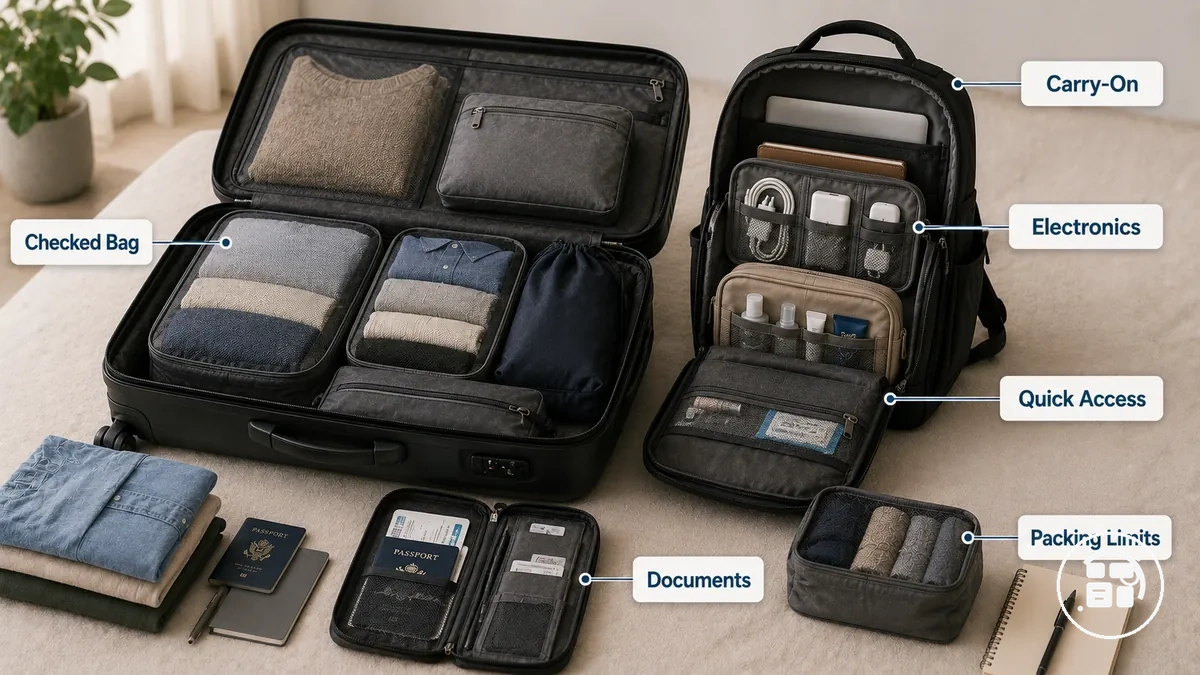
A carry-on packing situation may place more emphasis on quick access and efficient separation because space can be limited. Checked luggage may allow larger item groupings when volume is less restrictive. Work travel often involves electronics and documents, while a mixed packing load may combine clothes, toiletries, and accessories that benefit from category separation. Each travel context should be checked against organizer fit for the specific trip.
A mismatch between packing needs and organizer format can make comparison difficult because the wrong criteria may be prioritized. Packing purpose and trip-context checks before choosing organizers help identify which organizer direction aligns with the travel context. After identifying the main packing filters, the selection guide for travel organizers can support more detailed comparison decisions.
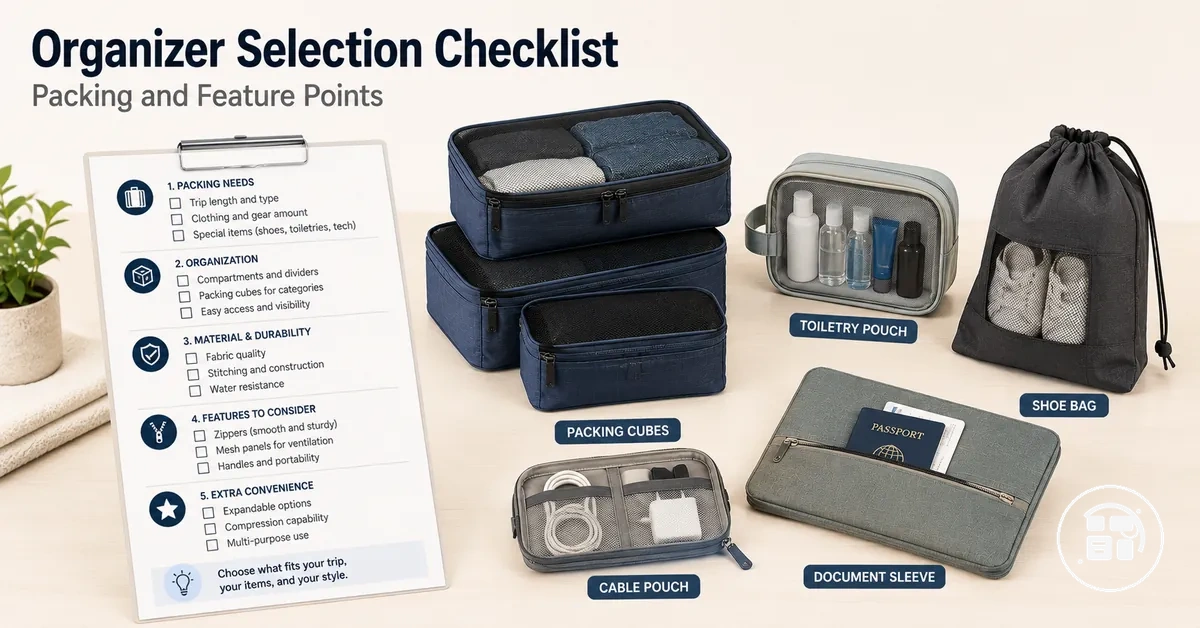
Packing purpose and trip-context checks before choosing organizers verify which organizer direction fits the trip. The checklist below focuses on the conditions that most often influence selection.
- If a carry-on is the primary luggage style, organizers that support efficient use of limited capacity may be easier to manage.
- If checked luggage is used, larger item groupings may be practical when packing volume is higher.
- If item categories include toiletries, clothes, electronics, and documents, separate organizers can improve organization depending on the packing situation.
- If access frequency is high, organizer options that support quick access may reduce the need to unpack multiple items.
- If a mixed packing load is expected, a travel organizer set may provide broader coverage when separate categories need distinct storage.
- If packing constraints involve limited volume or unusual item shapes, organizer choice may depend on available space and packing layout.
Trip length, item volume, and packing-rule limits
Trip length and item volume change organizer size and organizer quantity because larger item loads often require more separation and storage space. Smaller item loads may work with fewer organizers or more compact formats. The most suitable arrangement depends on volume needs, luggage constraints, and the intended item load.
Packing-rule limits can affect liquids, electronics, documents, and access items, especially when carry-on restrictions apply. These limits may influence how contents are separated, but this subsection highlights packing-rule effects and does not replace airline or transport rules. The checklist below verifies how limits and conditions connect to organizer decisions.
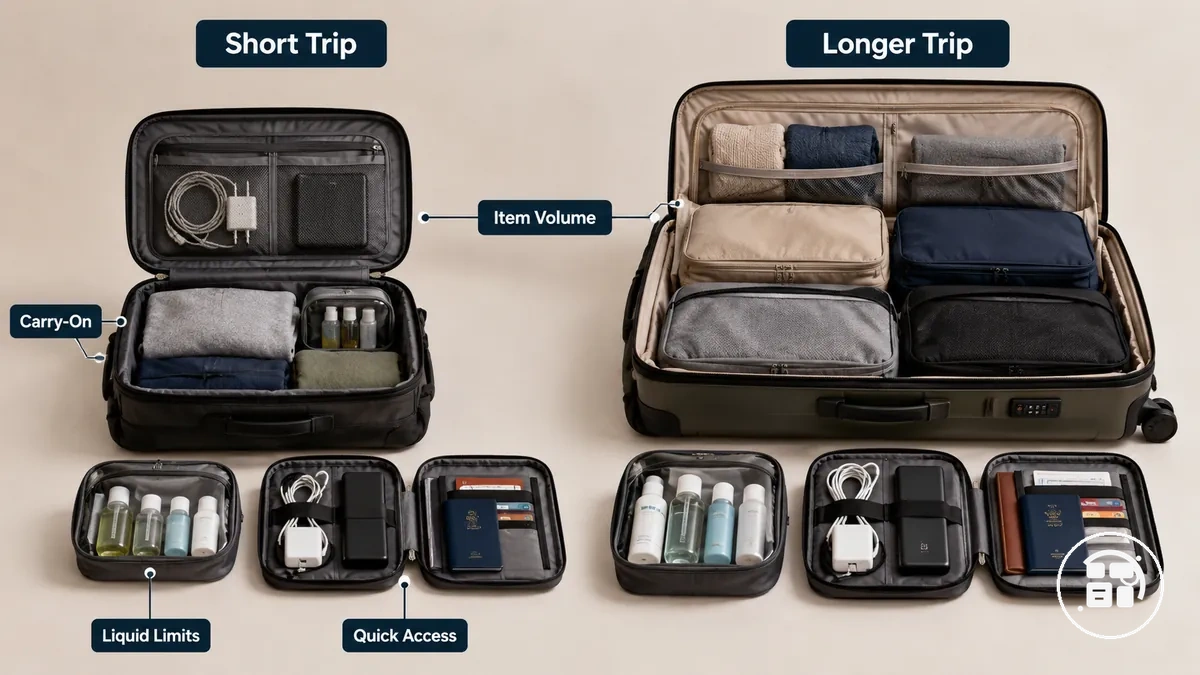
Trip length, item volume, and packing-rule limits help verify organizer quantity, organizer size, and content organization choices.
- If trip length increases and item volume grows, organizer quantity may increase to maintain category separation.
- If liquid limits apply to a toiletry organizer bag or waterproof pouch, smaller and more clearly separated contents may be easier to organize.
- If carry-on space is limited, organizer size may depend on available volume and access needs.
- If checked luggage allows a larger item load, bulkier categories may be separated into dedicated organizers when additional capacity is available.
- If documents or electronics require frequent access, a dedicated pouch or organizer may improve accessibility while keeping items separate.
Organizer coverage checks for sets and separate pieces
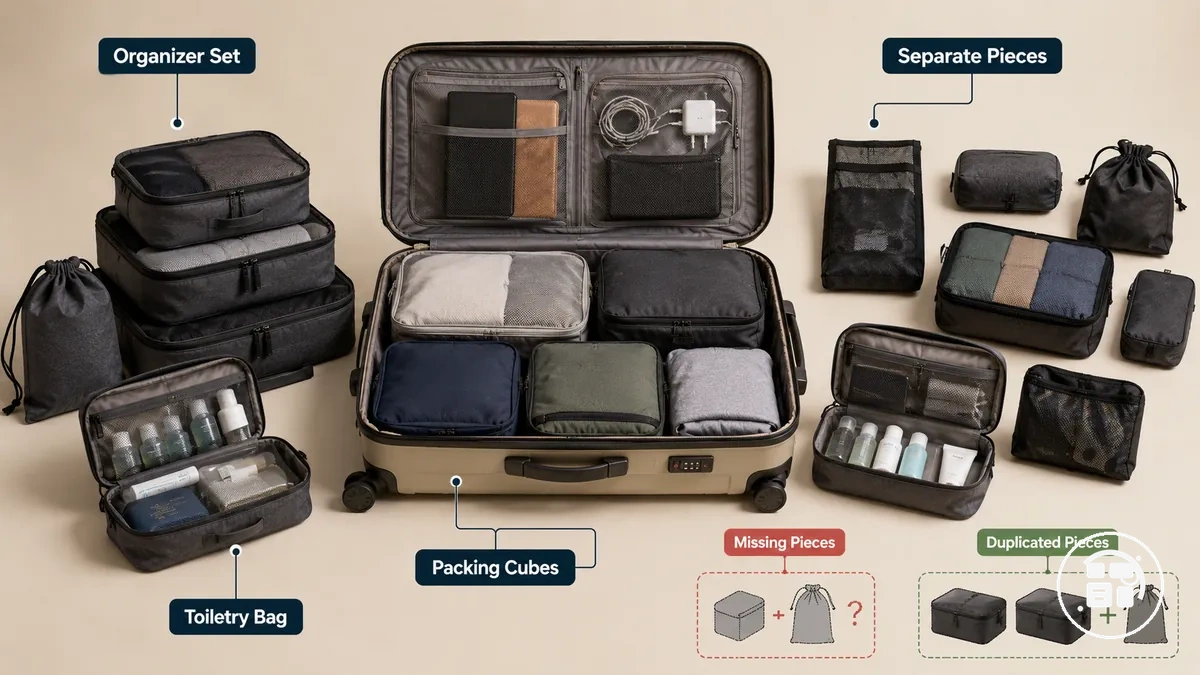
Organizer coverage is about whether each packing job has the right organizer for its item category. A travel organizer set can cover multiple categories at once, while separate pieces can target specific needs with more control. The main risk is ending up with missing pieces for certain packing jobs or duplicated pieces that add little value.
A travel organizer set may suit a packing situation that includes clothing, toiletries, electronics, and documents across multiple categories. Separate pieces may fit better when only selected item categories need organization or when existing organizers already cover part of the packing load. The choice depends on whether coverage gaps or duplicated pieces are more likely for the intended packing habits. The checklist below helps verify that coverage.
Coverage problems often appear when an item category has no dedicated organizer or when multiple organizers serve the same purpose. The comparison below highlights coverage differences, and the set or separate piece decision can help evaluate the trade-off between broader coverage and greater control.
Organizer coverage checks for sets and separate pieces compare coverage gaps and duplicated-piece risks across common organizer types.
| Organizer option | Packing job covered | Watch for | Better fit when |
|---|---|---|---|
| Travel organizer set | Multiple item categories in one organizer set | Duplicated pieces or unused components | Several packing jobs need coverage at the same time |
| Packing cubes | Clothing separation and volume management | Missing coverage for non-clothing categories | Clothing organization is the main need |
| Toiletry bags | Liquids and personal care items | Overlap with other liquid-storage organizers | Liquid separation is a priority |
| Electronics organizers | Cables, chargers, and small devices | Unused compartments when electronics are limited | Frequent access to electronic items is needed |
| Document holders | Travel papers and important documents | Missing quick-access storage if omitted | Documents require organized access |
| Shoe bags | Shoe separation inside luggage | Unnecessary duplication if footwear is already isolated | Dirt separation from clothing is preferred |
Packing cubes, luggage organizer bags, and clothing storage
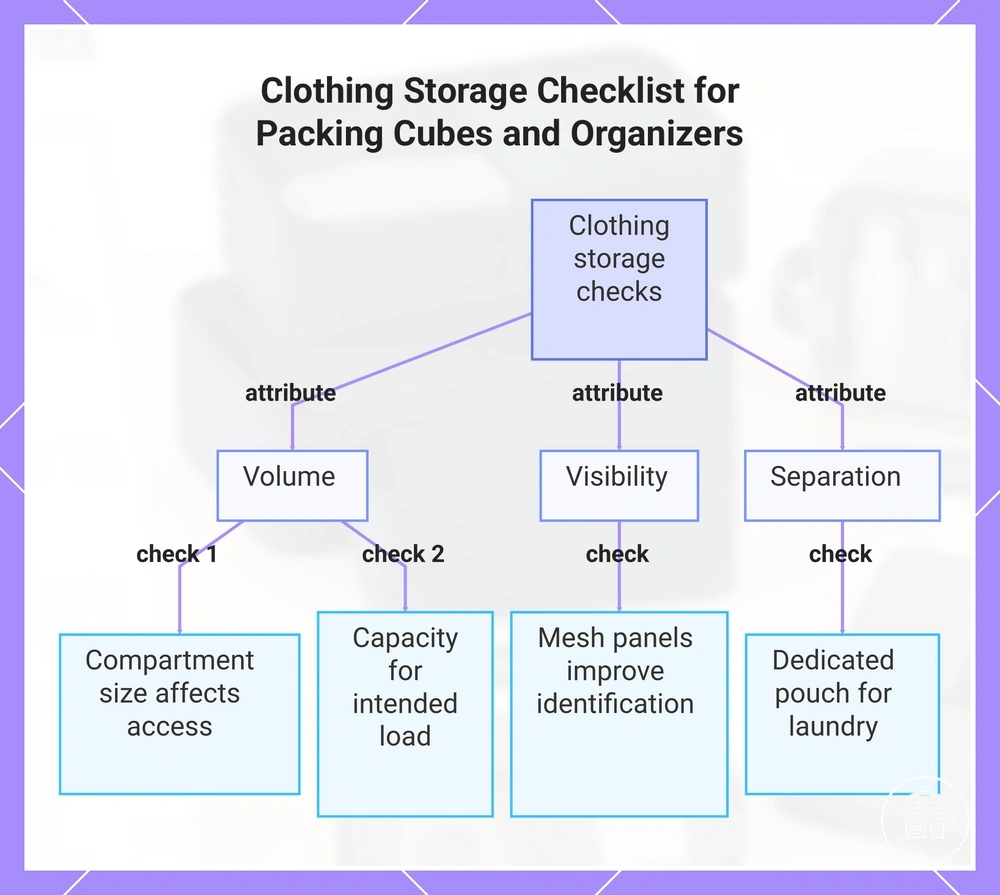
Clothing storage checks focus on volume, visibility, and separation needs. Packing cubes, luggage organizer bags, and other clothing organizers should be judged by how they manage folded clothes, access, and organization inside luggage. The mini-checklist below helps verify these clothing-storage attributes.
Packing cubes and luggage organizer bags can improve organization when clothing volume matches their capacity and layout. A packing cube set with mesh panels may make folded clothes easier to identify, while compression behavior may vary depending on fabric bulk and packing conditions. Packing cubes are one organizer type within broader travel organization accessories, and the most suitable option depends on clothing volume, laundry separation needs, and suitcase fit.
Packing cubes, luggage organizer bags, and clothing storage checks verify how organizer attributes connect to packing outcomes.
- If packing cubes are used for folded clothes, volume and compartment size can influence clothing separation and access.
- If luggage organizer bags have enough capacity for the intended clothing load, they may improve category separation inside a suitcase.
- If mesh panels are included, visibility may improve because folded clothes can be identified without opening every organizer.
- If compression behavior is used with bulky clothing, space savings may vary based on fabric type, clothing amount, and packing conditions.
- If laundry separation is needed, a dedicated pouch or clothes storage bag can help keep clean clothes separate from dirty clothes.
- If suitcase fit is limited, organizer dimensions and clothing volume should be checked together before adding multiple clothing organizers.
This chart shows the three key clothing-storage attributes to verify when choosing packing cubes and luggage organizer bags.
Toiletry bags, electronics organizers, document holders, and shoe bags
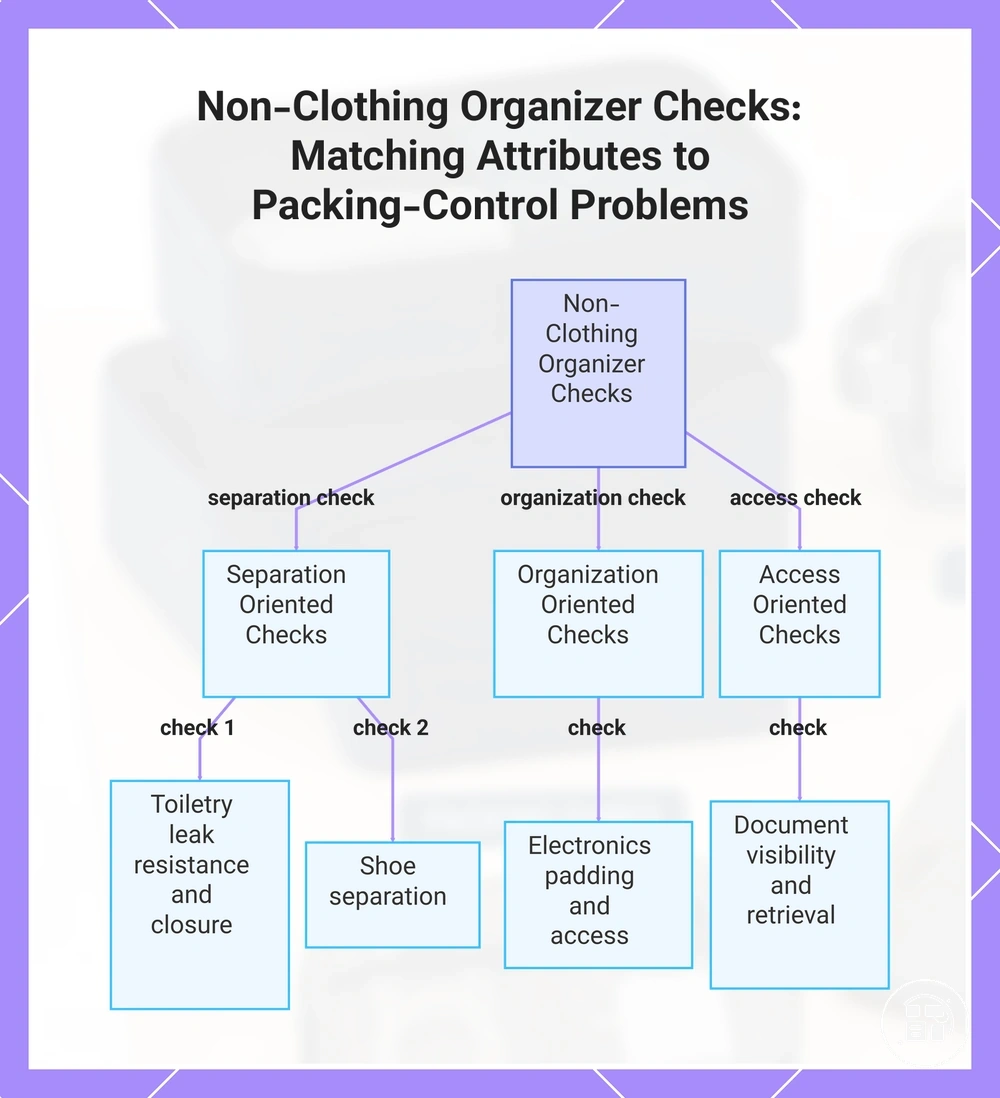
Non-clothing organizers are checked by item risk and access need. Toiletry bags, electronics organizers, document holders, and shoe bags each address a different packing-control problem through separation, visibility, protection, or access. The main checklist goal is matching organizer attributes to the item-control problem.
When toiletries, electronics, documents, and shoes are packed together, each category usually requires a different storage approach. Toiletry bags focus on liquid separation, electronics organizers focus on cable and device organization, document holders focus on visibility and access position, and shoe bags focus on keeping footwear separate from clothing. The grouped bullets below verify these non-clothing organizer checks.
Toiletry bags, electronics organizers, document holders, and shoe bags checks verify how organizer attributes connect to different packing-control needs.
- Toiletry bags: If liquids are carried, leak resistance and closure quality should be checked because separation may reduce the risk of contents affecting nearby packed items.
- Electronics organizers: If cables, chargers, or small devices need organization, padding and access position may help keep items easier to locate and manage during travel.
- Document holders: If passports, travel papers, or similar items require frequent retrieval, visibility and access position can support quicker access when needed.
- Shoe bags: If footwear is packed alongside clothing, separation should be checked because shoe bags may help isolate dirt and keep clothing categories distinct inside luggage.
This chart shows the main checks for non-clothing organizers grouped by their packing-control problem: separation, organization, and access.
Size, capacity, and luggage-fit checks
Size, capacity, and luggage fit depend on organizer dimensions, available luggage space, and packing volume. Checking these attributes helps determine whether organizers can fit while preserving usable packing space and practical access. Measurements and luggage compatibility should be verified before final organizer selection.
Organizer dimensions that exceed available packing space can create overfilling, inefficient stacking, and reduced access position options. A suitcase compartment shape that does not match organizer size may limit usable space even when overall capacity appears sufficient. For additional fit criteria, the luggage fit checklist can help evaluate layout decisions when compatibility conditions vary.
When using a carry-on only, compact organizer size and accessible placement often become more important because packing space is limited. Checked luggage may allow greater volume and more stacking flexibility, while mixed bag setups may require organizers to be distributed across separate compartments. The fit checklist below helps verify these luggage-fit conditions.
Size, capacity, and luggage-fit checks verify how organizer dimensions, suitcase compartment conditions, and packing space influence packing decisions.
| Organizer or luggage part | Size or capacity attribute | Fit condition | Packing decision |
|---|---|---|---|
| Packing cubes | Organizer dimensions and packing capacity | Fits within the suitcase compartment while preserving access | Use when packing space remains practical after placement |
| Toiletry pouches | Volume and organizer size | Fits available compartment space without crowding nearby items | Place where separation and access remain practical |
| Electronics organizers | Capacity and thickness | Fits the intended storage area without creating stacking issues | Use when access position remains convenient |
| Document holders | Profile size | Fits a location that supports visibility and retrieval | Place in an accessible area when frequent access is needed |
| Carry-on compartments | Available packing space | Organizer size matches compartment limits | Prefer compact layouts when capacity is restricted |
| Checked-luggage compartments | Overall volume | Compression behavior and stacking do not reduce usability | Use larger layouts only when packing space remains functional |
Material, waterproofing, zipper, and cleaning checks
Material and construction checks reduce quality and maintenance surprises by showing how a travel organizer may perform under repeated use. Fabric type, zipper quality, and cleanability often influence usability more than appearance alone. The criteria below help connect construction signals to practical travel conditions.
Zipper smoothness issues, weak stitching, or unsuitable waterproofing claims can become noticeable when organizers are opened frequently or exposed to changing travel conditions. Closure quality and seam condition should be checked because access and durability may depend on construction quality. For broader evaluation criteria, see features to check before comparing; material performance can vary by design, condition, and use.
When comparing lightweight, washable, padded, or water-resistant designs, trade-offs may affect maintenance needs and carrying comfort. Water-resistant surfaces can help reduce exposure risks in some situations, but water-resistant and waterproof are not interchangeable terms. The table below helps evaluate material, waterproofing, zipper, and cleaning checks through practical criteria.
Material, waterproofing, zipper, and cleaning checks evaluate how construction features connect to usability, maintenance, and buying confidence.
| Feature | Check condition | Why it matters | Buying decision cue |
|---|---|---|---|
| Fabric type | Material feels appropriate for expected use and load | Material condition can influence durability and maintenance needs | Choose based on expected travel conditions and handling |
| Mesh | Mesh panels provide visibility without excessive exposure | Visibility may improve item identification and access | Useful when contents need quick visual checking |
| Water resistance | Water-resistant surface matches expected liquid exposure risk | May help reduce exposure to moisture in some situations | Avoid assuming waterproof performance without verification |
| Zipper | Zipper smoothness and closure quality remain consistent during use | Access and reliability can depend on zipper condition | Check operation before prioritizing other features |
| Stitching | Seams appear secure and evenly constructed | Stitching quality may affect long-term durability | Look for consistent construction quality |
| Washability | Cleaning method aligns with material and care guidance | Washability can affect maintenance effort and odor retention | Prefer cleaning requirements that match expected use |
| Drying behavior | Material dries appropriately for the intended travel routine | Drying behavior may influence convenience after cleaning | Consider drying needs when maintenance is expected |
Compartment, visibility, access, and separation checks
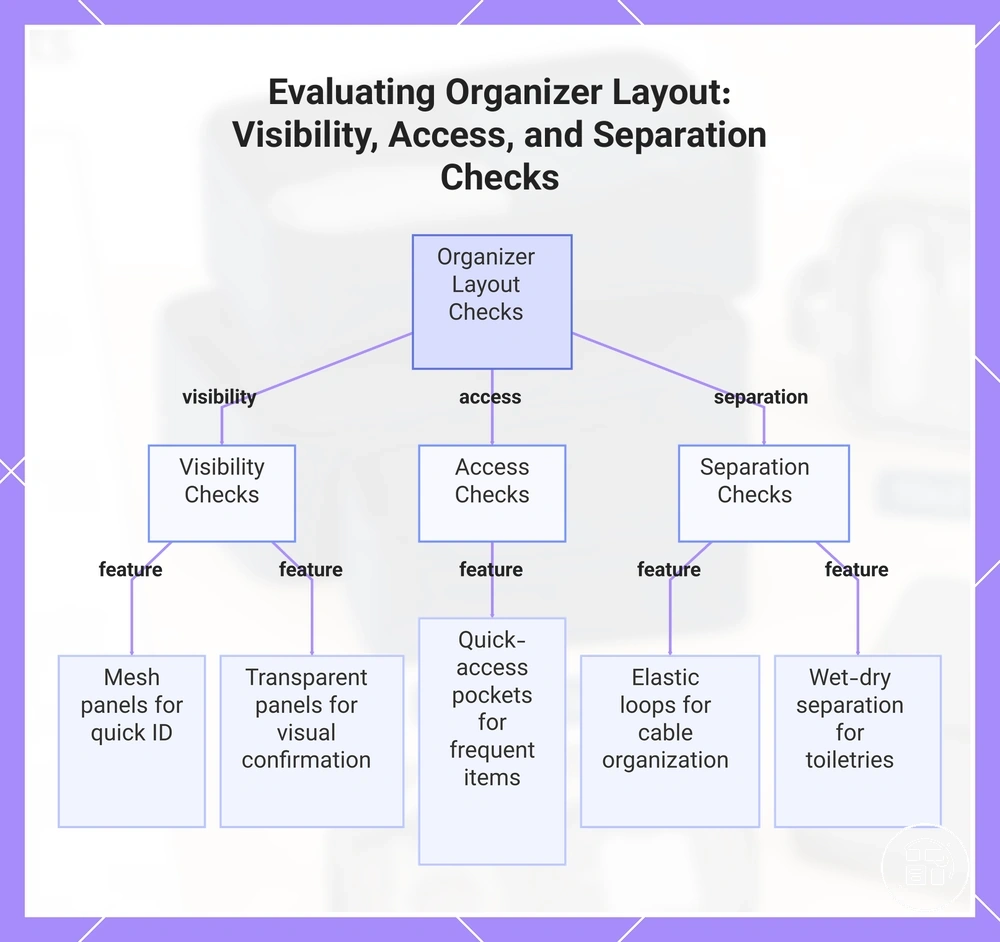
Layout checks determine whether items are easy to separate, see, and reach during travel. Compartments, dividers, and access features influence how efficiently items can be organized and retrieved when needed. Internal layout should be evaluated through visibility, access, and separation attributes.
Mixed items, hidden contents, and tangled accessories often result from layout limitations rather than storage volume alone. Compartments and dividers can support item grouping when different categories share the same organizer. Visibility features help identify contents, while access features may make frequently used items easier to reach.
When organizing small items, toiletries, documents, cables, or shoes, different layout features may support different access needs. Elastic loops may help keep cables separated, while quick-access pockets may make documents easier to reach. The checklist below helps evaluate compartment, visibility, access, and separation checks through practical layout attributes.
Compartment, visibility, access, and separation checks help organize layout criteria that affect everyday packing convenience.
- If organizer compartments include dividers, small clothing items or mixed accessories may remain easier to separate through clearer item grouping.
- If mesh visibility panels are included, toiletries or accessories may be identified more quickly without opening every compartment.
- If transparent panels are used, item visibility may improve when documents or small travel essentials need visual confirmation.
- If elastic loops are available, cables and small electronics accessories may stay more organized and experience less tangling.
- If quick-access pockets are positioned for convenient reach, frequently used documents may be easier to access when needed.
- If wet-dry separation is included, toiletries and similar items may remain separated from other packed categories when moisture exposure is a concern.
- If layout supports dedicated item grouping, shoes, accessories, and personal items may remain more clearly separated throughout travel.
This chart shows the key layout checks for evaluating how well an organizer separates, reveals, and provides access to items during travel.
Protection checks for liquids, electronics, documents, and shoes
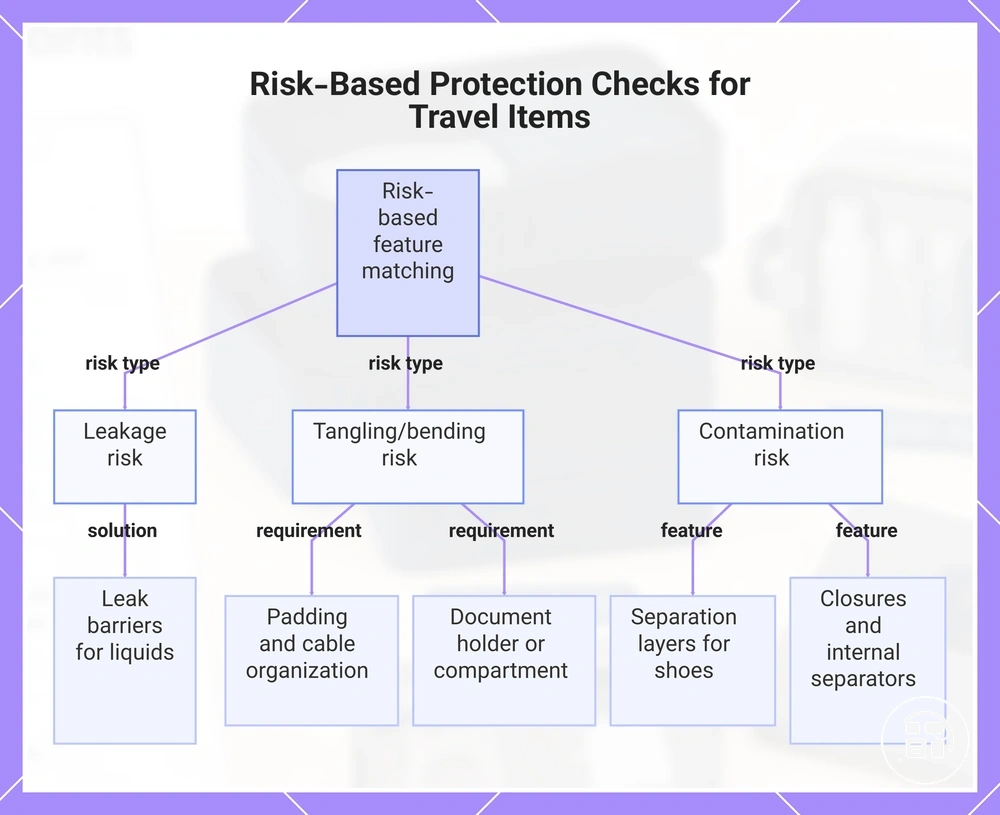
Protection checks match item risks to organizer features so that travel items receive protection that aligns with their specific conditions. Liquids, electronics, documents, shoes, and cables face different risks during travel and may require different protective features. The main risk categories are leakage, tangling, bending, contamination, and access-related handling.
Liquid leakage can affect nearby packed items when closures or leak barriers are not appropriate for the contents being carried. Shoes may introduce dirt or residue when separation layers are not used. Protective packing should include a leak-resistant pouch or separation method when contamination risk is a concern.
Electronics and cables can become difficult to manage when tangling reduces visibility or access inside an organizer. Documents may require protection from bending when stored with heavier items or inside crowded compartments. A padded organizer, cable-control feature, or document holder may support the protective requirement when handling conditions increase risk.
When leakage, tangling, bending, or contamination becomes more likely because of item type or packing arrangement, the protective requirement often changes as well. Protection checks for liquids, electronics, documents, and shoes focus on matching organizer features such as padding, closures, leak barriers, and separation layers to the relevant item risk. This risk-to-feature approach can support more confident organizer selection decisions.
Here are product examples that may make comparison easier. Before buying, always review the compatibility criteria, essential features, and product details.
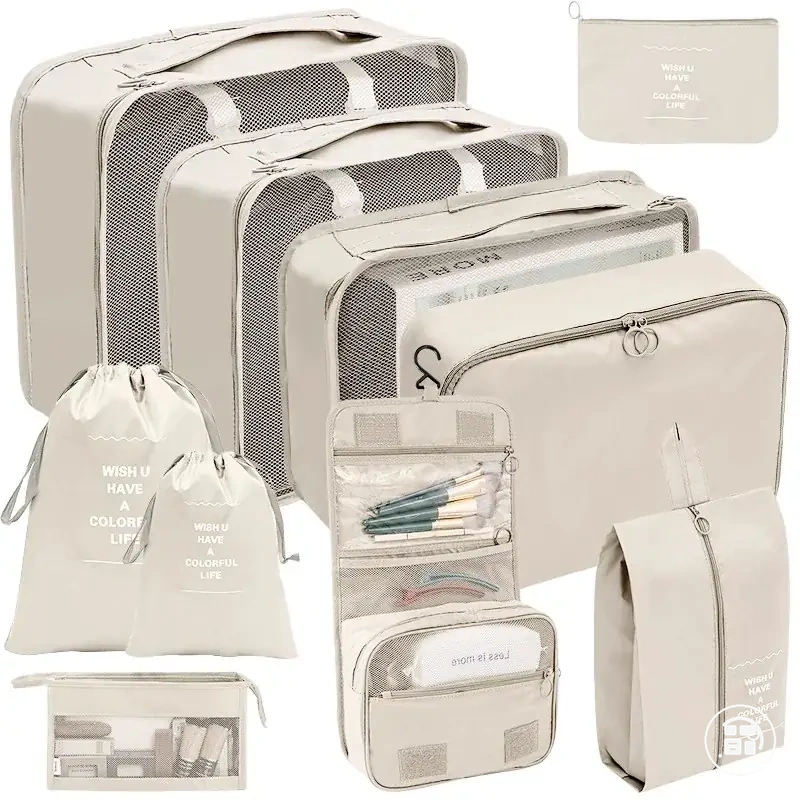
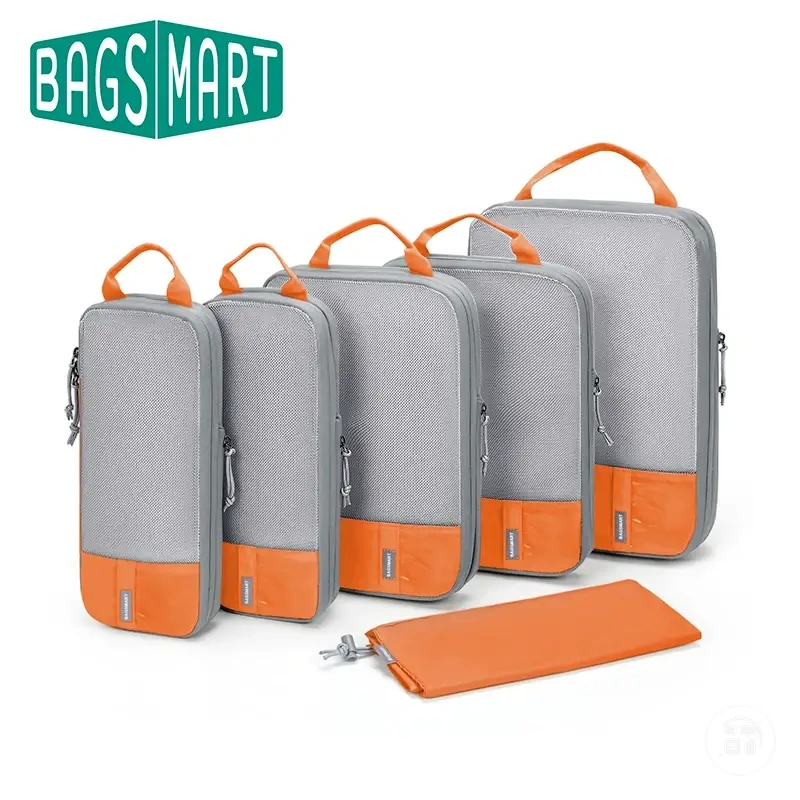
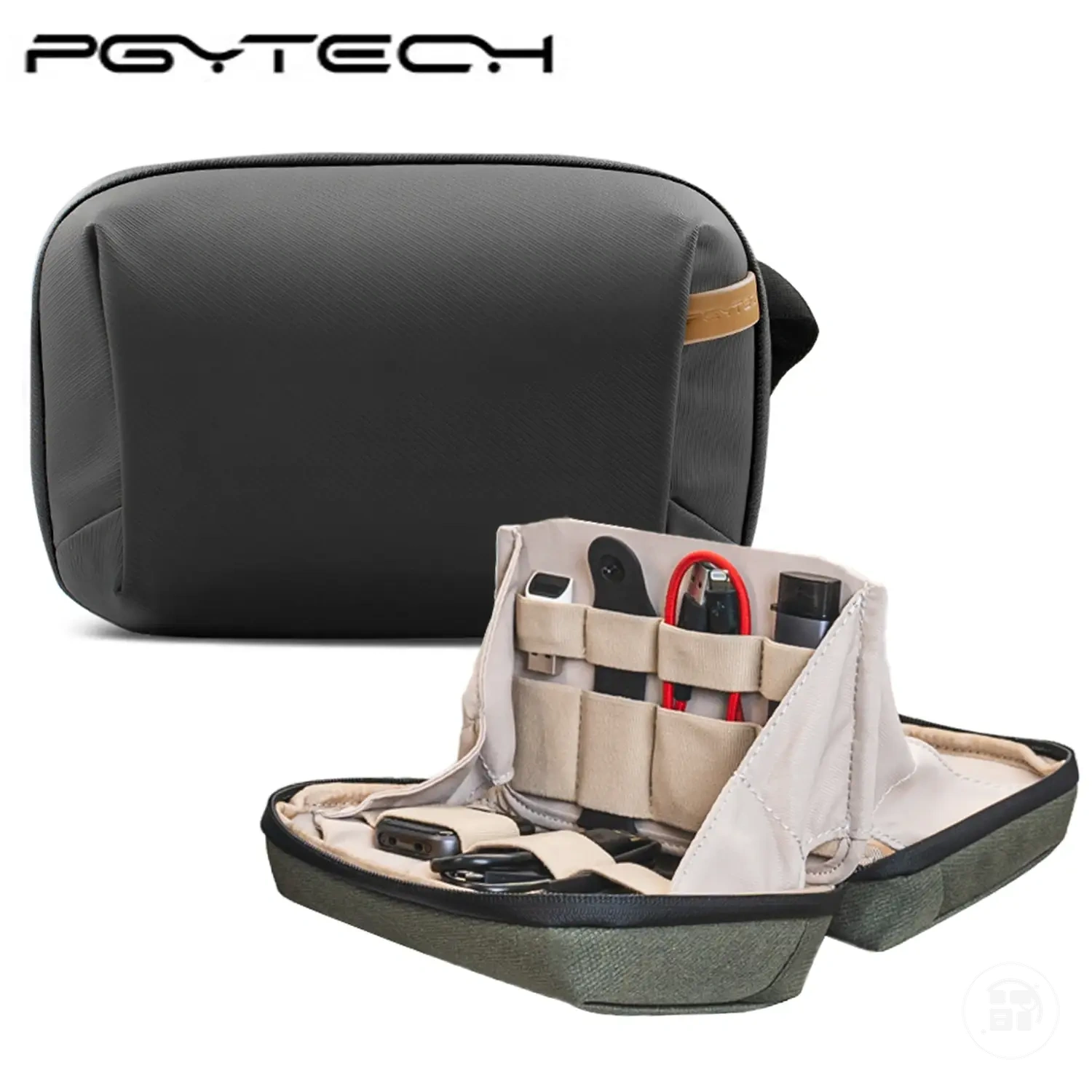
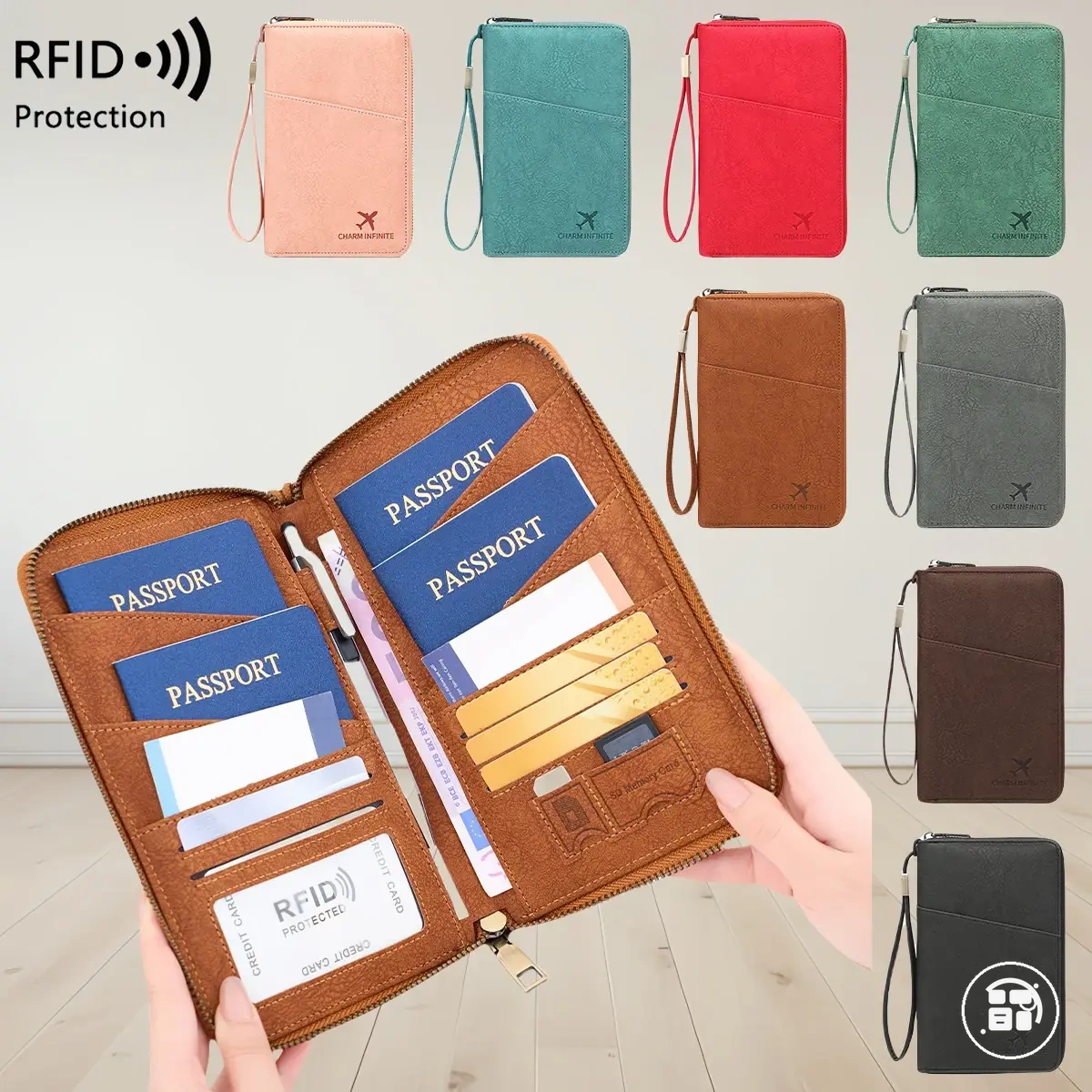
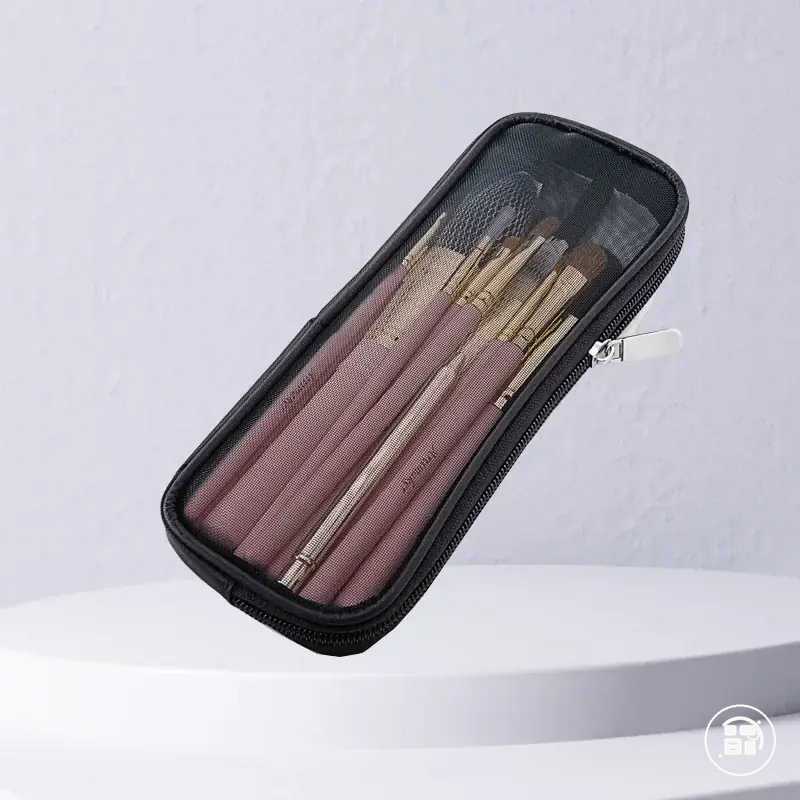
- If liquids are carried, leak barriers and secure closures may help reduce leakage risk when containers are stored together.
- If electronics and cables share storage space, padding and cable organization features may help limit tangling and contact between items.
- If documents require frequent handling, a holder or dedicated compartment may help reduce bending while maintaining access.
- If shoes are packed with clothing or personal items, separation layers may help reduce contamination concerns.
- If mixed item categories are stored together, closures and internal separation features may support clearer protection boundaries.
This chart shows how to match travel organizer features to the specific risks of liquids, electronics, documents, and shoes for effective protection.
Durability, value, and purchase-readiness checks
Purchase readiness depends on durability, value, and fit with expected use. An organizer may be ready to compare when its construction, coverage, and maintenance expectations align with packing needs and travel habits. The main value-check frame combines durability signals, indicative value, and decision confidence.
Weak stitching, unreliable zippers, or limited material thickness may affect long-term usability when organizers are used frequently. Cleaning expectations can also influence value because maintenance effort may vary by material and design. Together, these factors can provide a useful quality signal before comparison.
When usage is occasional, a budget-oriented option may provide sufficient coverage if durability requirements remain modest. When travel is more frequent or packing demands are higher, additional construction features may contribute to a different value trade-off. For a broader comparison of these trade-offs, see cheap and premium value factors.
Incomplete coverage can reduce value when additional organizers are needed to fill gaps. Separate-piece flexibility may offer more control when only selected organizer types are required. Return expectations should be reviewed through the retailer or partner offer where available, and these checks can improve comparison readiness.
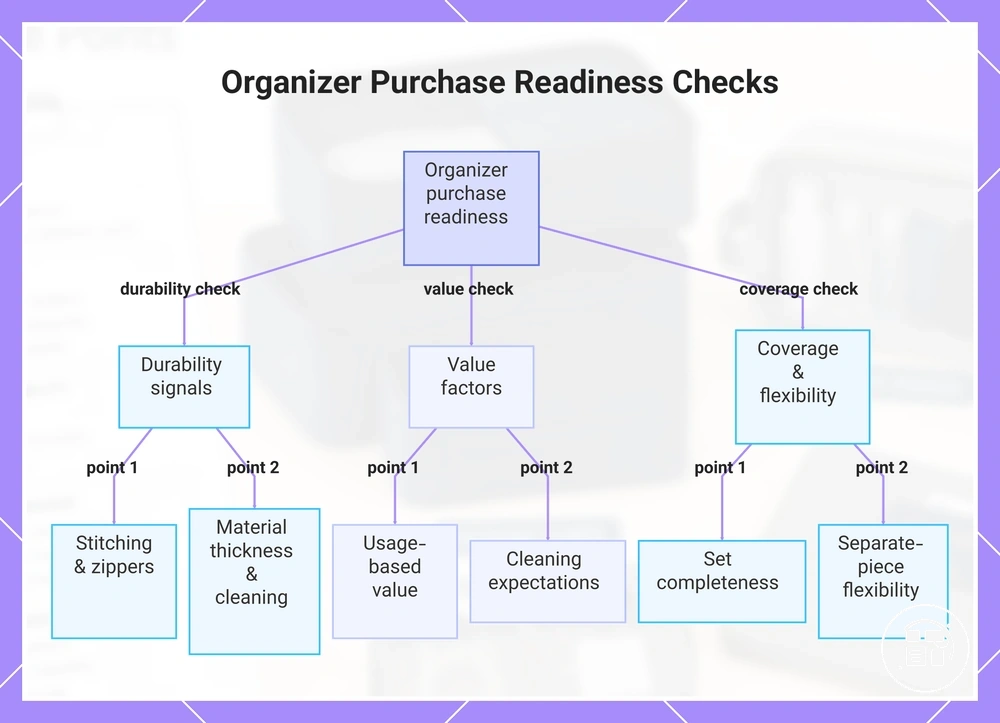
Durability, value, and purchase-readiness checks help verify whether an organizer option is ready for comparison. The checklist below focuses on durability signals, coverage, flexibility, and value reasoning rather than product rankings. A stronger match between these criteria and travel needs can support a clearer purchase-readiness decision.
Here are product examples that may make comparison easier. Before buying, always review the compatibility criteria, essential features, and product details.
- If stitching and zippers appear consistent with expected use, they may provide positive durability signals.
- If material thickness and cleaning expectations match travel habits, maintenance requirements may remain more practical over time.
- If set completeness covers the intended packing categories, fewer coverage gaps may need attention later.
- If separate-piece flexibility is important, individual organizers may allow more targeted selection decisions.
- If indicative value reflects both expected use and organizer features, value trade-offs may be easier to compare.
- If return expectations are reviewed before selecting an option, decision confidence may improve when comparing partner offers.
- If major criteria have been checked consistently, compare options using the same durability, value, and coverage standards.
This chart shows the key checks for assessing whether an organizer option is ready for comparison, covering durability signals, value factors, and coverage flexibility.