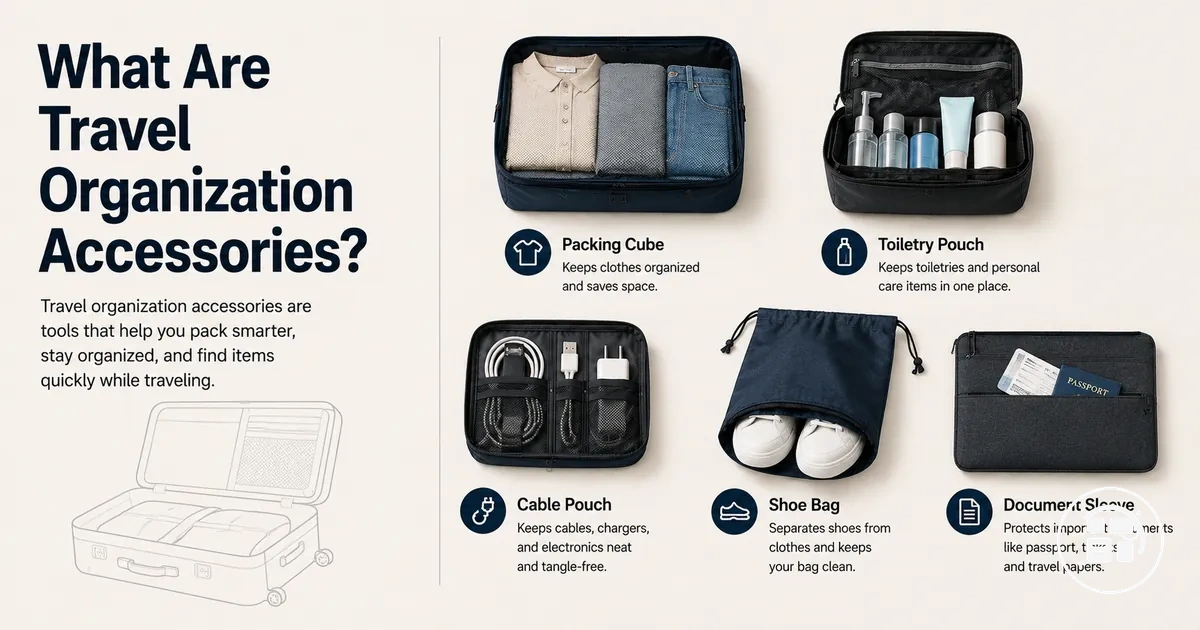
What Are Travel Organization Accessories?
Travel organization accessories are travel items used to organize, separate, contain, and access belongings inside luggage or a travel bag. Their scope is organization-first, not general comfort or decoration.
Their purpose is to keep travel belongings easier to group by use, item type, or access need. Travel organizers can help separate clothes, toiletries, documents, cables, small devices, and loose items when the luggage layout supports that use. They may make packing easier in many cases, but their main boundary is clear: the accessory must help organize belongings.
Common forms include packing cubes, a toiletry pouch, a document holder, an electronics organizer, and small travel storage pouches. These items can separate clean and used items, contain smaller belongings, or keep important items easier to find during travel. A basic organizer setup may be enough when belongings are limited, the luggage has enough space, and the traveler only needs simple separation and access.
General travel accessories can include many things, but travel organization accessories are the part of that wider category built around containment, separation, visibility, and access inside a travel context.
Travel Organization Accessories Meaning and Core Purpose
Travel organization accessories are items used to separate, contain, protect, or make belongings easier to access during travel. They provide physical support for organization inside luggage rather than serving as travel items for unrelated purposes.
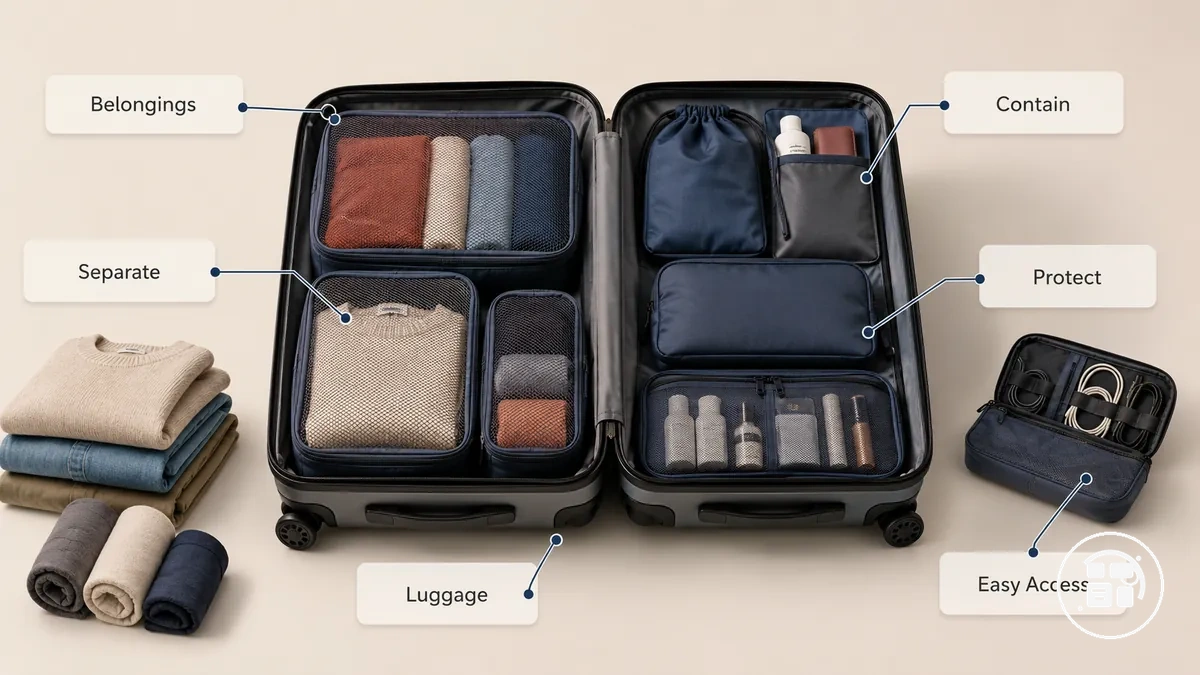
Travel organization accessories help organize belongings by giving them a defined place within luggage or other travel storage spaces. Their purpose is to separate items that might otherwise become mixed together, contain smaller objects, provide basic protection from contact with other belongings, and improve access when needed. Travel organizers, travel bag organizers, and packing organizer accessories support organization as a function through physical support items. This focus on organization can make belongings easier to locate and manage during travel.
A traveler may place documents, toiletries, or electronic accessories into separate organizers so grouped belongings remain easier to manage inside luggage. The result can vary based on the type and amount of belongings being carried, but the organizing purpose remains the same. For a broader overview of related categories and topics, visit the travel organization accessories hub.
What Counts as a Travel Organization Accessory
A physical item counts as a travel organization accessory when its main job is to organize belongings during travel. The inclusion rule depends on primary function rather than the item's appearance or storage capacity alone.
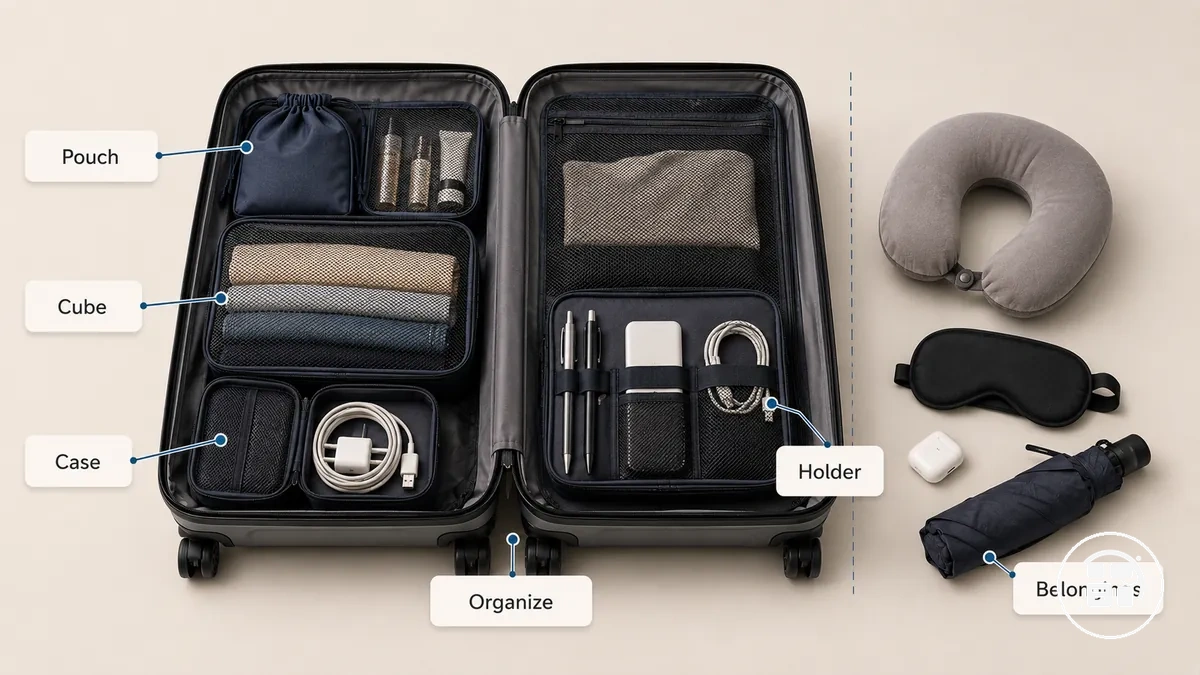
Qualifying items often include a container, pouch, cube, case, sleeve, or holder designed to separate, contain, or arrange belongings inside luggage. A travel organization accessory helps keep related items grouped so they are easier to access when needed. The organizing function must remain the main purpose of the physical item during travel. An organizer item may support different travel conditions, but its role stays focused on managing belongings rather than providing unrelated convenience.
What Counts as a Travel Organization Accessory becomes easier to understand when comparing primary functions. The image below highlights common organizer forms that qualify because they are built around organization-first use.
| Organization-first Item | General Travel Accessory |
|---|---|
| Purpose: Organize belongings | Purpose: Support travel in another way |
| Relationship to belongings: Separates, contains, or groups items | Relationship to belongings: May not organize items directly |
| Luggage role: Creates structure inside luggage | Luggage role: May serve comfort, convenience, or another function |
A strong boundary case is an item that includes storage but is not designed primarily for organization. If the main job is convenience or another travel function, it may not qualify as a travel organization accessory even when it can hold belongings.
Physical Organizers for Belongings Inside Luggage
Physical organizers are containers placed inside luggage or bags to keep belongings grouped or contained during travel. Physical Organizers for Belongings Inside Luggage focus on the items stored within the bag, where separation and containment can support easier access when belongings need to be found.
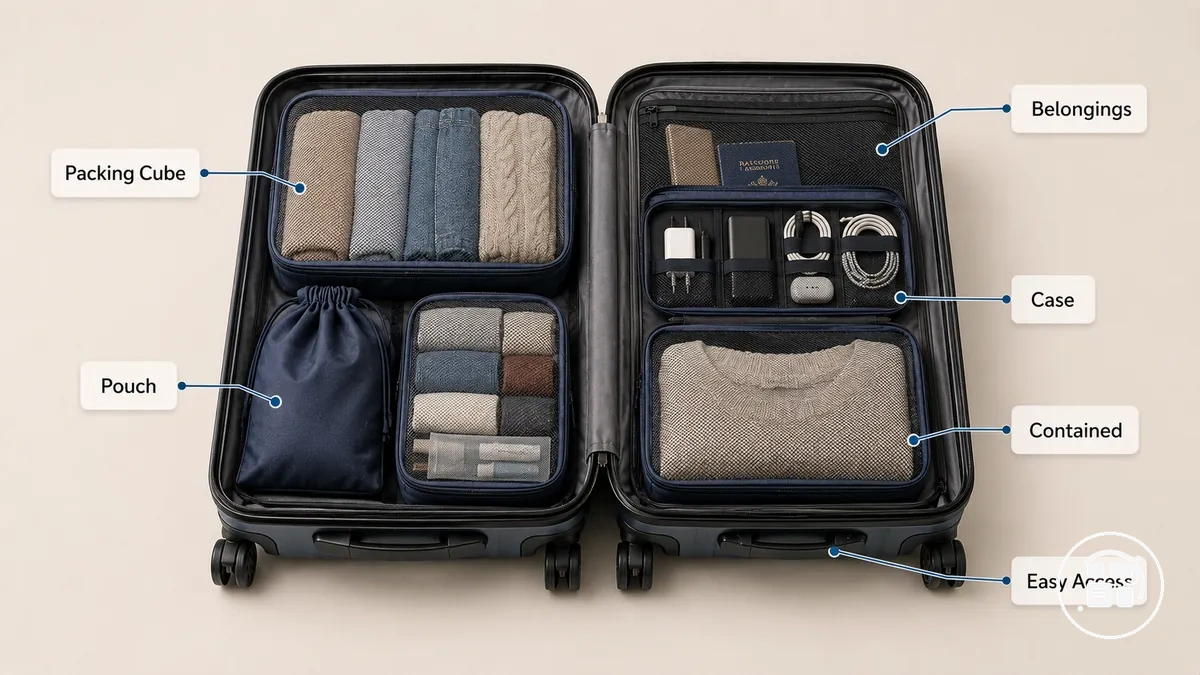
Packing cubes, pouches, and cases are representative examples of physical organizers because they hold belongings in defined containment forms inside luggage. These travel organizers can help keep items grouped and contained, which may support easier access depending on the luggage arrangement and travel situation. For examples of broader organizer categories, see main types of travel organizers.
Travel Accessories That Are Not Mainly Organizers
Travel accessories that are not mainly organizers are items whose primary function is comfort, safety, convenience, or transport rather than organizing belongings. An accessory does not automatically qualify as an organizer because the distinction depends on primary function, not on the word accessory.
| Mainly Organizer | Not Mainly Organizer |
|---|---|
| Function: Organize belongings | Function: Support comfort, safety, convenience, or transport |
| Relationship to belongings: Separates or contains items | Relationship to belongings: May hold items without primarily organizing them |
| Luggage role: Creates structure inside luggage | Luggage role: Serves another travel purpose |
Non-organizer accessories can support travel without acting as organizers. A travel accessory may include storage, but it is not mainly an organizer when its primary function is not to separate or contain belongings for organization. The primary-function test is the boundary: if organizing belongings is not the main job, the item belongs in the not mainly organizers category.
Organizing Functions That Define Travel Organization Accessories
Organizing functions are the functional attributes that make an accessory organizational rather than merely travel-related. These functions are defined by how they change the arrangement, management, or accessibility of belongings inside luggage.
Organizing functions can be compared by the attribute they affect and the condition in which that attribute becomes useful. The table below connects function, condition, and likely packing outcome.
| Function | What It Changes | When It Matters | Practical Outcome |
|---|---|---|---|
| Separation | Keeps belongings apart | When different item groups share luggage space | Items may remain easier to distinguish |
| Containment | Holds belongings within a defined area | When loose items could shift inside luggage | Items may stay more organized within the bag |
| Visibility | Makes belongings easier to identify | When multiple stored items need quick recognition | Finding items may require less searching |
| Protection | Adds a layer between belongings | When items are stored together | Contact between belongings may be reduced |
| Access | Improves item retrieval | When belongings are used frequently during travel | Items may be reached more efficiently |
Each organizing function connects an attribute to a condition and a likely outcome. Separation and containment influence how belongings are arranged, while visibility and access influence how belongings are identified and retrieved. Protection relates to how belongings are stored together and may reduce direct contact in certain situations. The effect of any function depends on luggage layout, the belongings involved, and travel conditions.
These functional attributes help define the organizational role of an accessory. A useful classification signal is whether the accessory performs the features that define travel organizers through separation, containment, visibility, protection, or access.
Separation, Containment, and Visibility
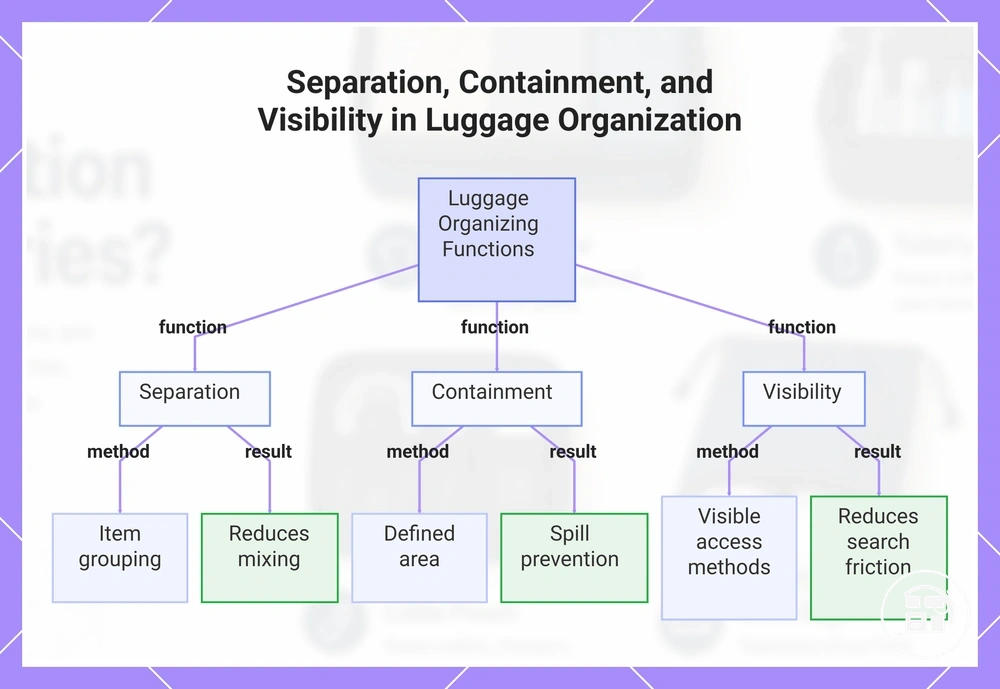
Separation, containment, and visibility are organizing functions that influence how belongings are arranged and identified inside luggage. These functions support item grouping, controlled storage, and clearer access to stored categories.
- Separation: Separation keeps belongings in distinct categories through item grouping. When multiple item types share the same luggage space, separation can reduce mixing and make categories easier to recognize.
- Containment: Containment keeps belongings within a defined area. When items could shift during travel, containment may support spill prevention and mix prevention by limiting movement between groups.
- Visibility: Visibility makes belongings easier to identify through visible access, labels, mesh panels, or similar organizing methods. When items can be seen more easily, search friction may decrease and access clarity may improve.
This chart shows the three organizing functions—Separation, Containment, Visibility—and their key methods and benefits for luggage organization.
Space Control, Protection, and Easier Access
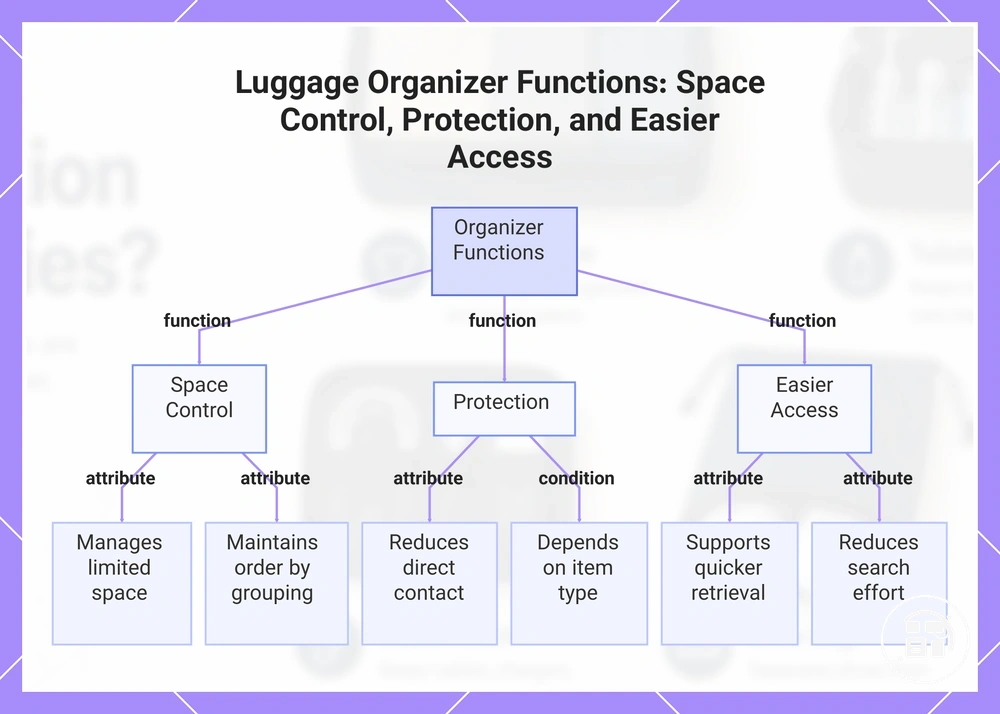
When belongings are organized within limited or changing luggage space, organizer functions can influence how items are stored and retrieved. The outcome depends on luggage size, item type, packing style, and the condition of the luggage arrangement.
Space control relates to space management and may help maintain order when belongings are grouped into defined areas. Protection refers to basic protection created by reducing direct contact between item groups, although the outcome depends on item type and storage condition. Easier access may occur when belongings remain organized and easier to locate, which can support quicker retrieval and reduced search effort. The overall outcome depends on the specific use case rather than the organizer function alone.
This chart shows the three main organizer functions—space control, protection, and easier access—along with their key attributes and conditional outcomes.
Common Examples of Travel Organization Accessories
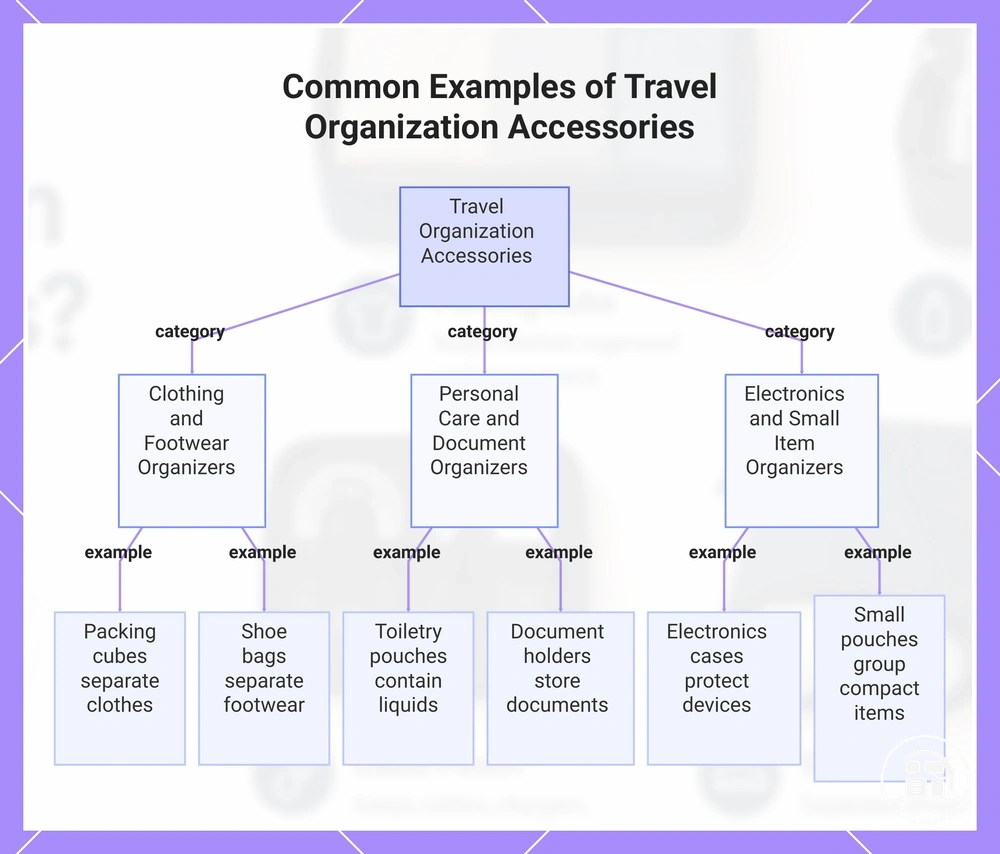
When different categories of belongings need to stay organized during travel, representative examples help show how travel organization accessories are used in practice. These examples are grouped by what they organize rather than by popularity, brand, or travel preference.
The following organizer examples connect a specific item type to its organizing purpose and travel use.
- Packing cubes organize clothes through separation, helping keep clothing categories distinct within luggage.
- Toiletry pouches organize liquids and personal care items through containment, keeping related items stored together.
- Document holders organize passports and travel documents in one location, which may support easier access when needed.
- Electronics cases organize cables, chargers, and small devices through structured storage and basic protection.
- Shoe bags organize footwear through separation, helping keep shoes apart from other belongings.
- Laundry pouches organize used items through separation, which may reduce mixing with unused belongings.
- Small accessory pouches organize compact travel items by keeping them grouped within a defined space.
These examples are representative rather than exhaustive, and their usefulness may vary by trip type, luggage arrangement, and travel needs. For broader category coverage, see the main types of travel organizers. Each example belongs to the category because it helps organize belongings through separation, containment, access, or related organizing functions.
This chart shows common travel organization accessories grouped by the type of belongings they organize, with each example's organizing purpose.
How Travel Organization Accessories Support Better Packing
When belongings become difficult to manage inside luggage, travel organization accessories can support better packing by creating a more structured arrangement. The level of packing support depends on the belongings being carried, the luggage layout, and the trip context.
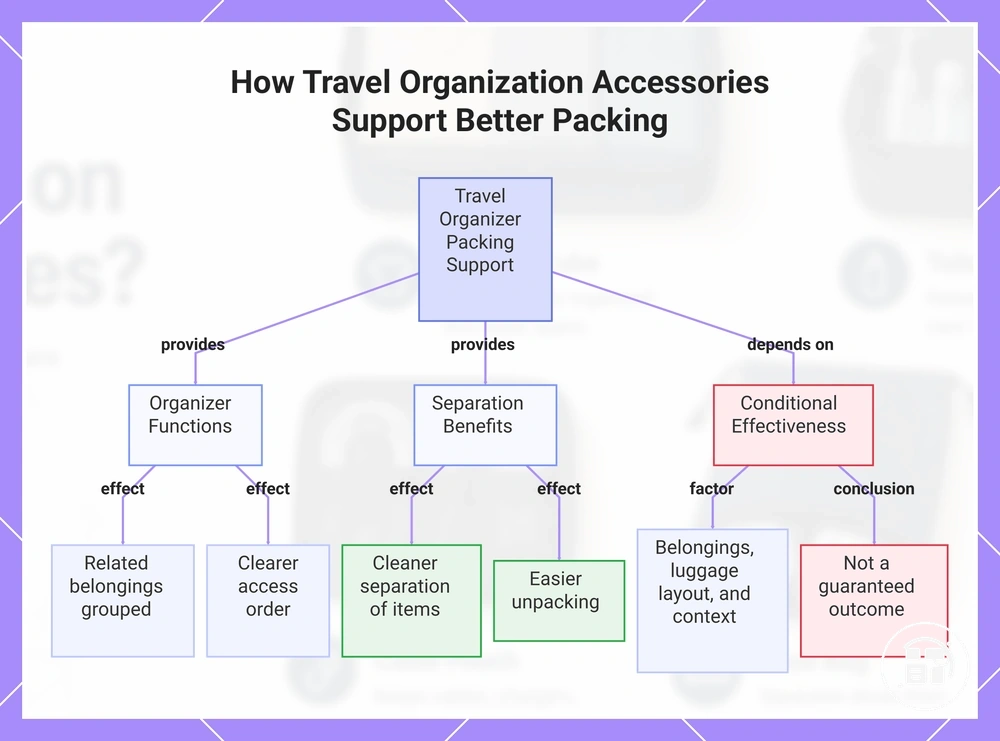
Organizer functions can improve grouping by keeping related belongings together and supporting a clearer access order. When frequently used items remain easier to identify within an organized packing arrangement, retrieving them may require less searching. The outcome depends on how the luggage layout and item categories are arranged.
Travel organization accessories can also support reduced mixing and cleaner separation between different types of belongings. When travel items are stored in separate organizers, clothing, personal items, documents, or accessories may remain easier to distinguish during the trip and may support easier unpacking. This effect varies by trip context, luggage organization, and the number of belongings being carried.
Packing support is a practical result of organizer function rather than a guaranteed outcome, because travel needs and luggage conditions differ. For a more detailed process-focused approach, see how to pack with travel organizers.
This chart shows how travel organization accessories improve packing through grouping and separation, along with the factors that affect their effectiveness.
Basic Travel Organizers Versus Broader Travel Accessories
Basic travel organizers and broader travel accessories differ by main purpose. Basic travel organizers are intended to support organization of belongings inside luggage, while broader travel accessories may support comfort, convenience, transport, or other travel-related functions.
The distinction depends on primary function rather than a product name or store category. The comparison below focuses on how each category relates to belongings, luggage use, and packing outcome.
| Basic Travel Organizers | Broader Travel Accessories |
|---|---|
| Main purpose: Organize belongings | Main purpose: Support comfort, convenience, or another travel function |
| Relationship to belongings: Groups, separates, or contains items | Relationship to belongings: May support travel without directly organizing items |
| Luggage role: Creates organization within luggage space | Luggage role: May be used inside or outside luggage depending on function |
| Packing outcome: May support clearer organization and item access | Packing outcome: Depends on the accessory's intended purpose |
This comparison helps clarify meaning and scope without turning the distinction into a value judgment. A travel item can belong to the broader travel accessories category even when it includes storage features if organization is not its main purpose. Classification depends on primary function rather than appearance, name, or store placement.
When a Basic Travel Organizer Set Is Enough
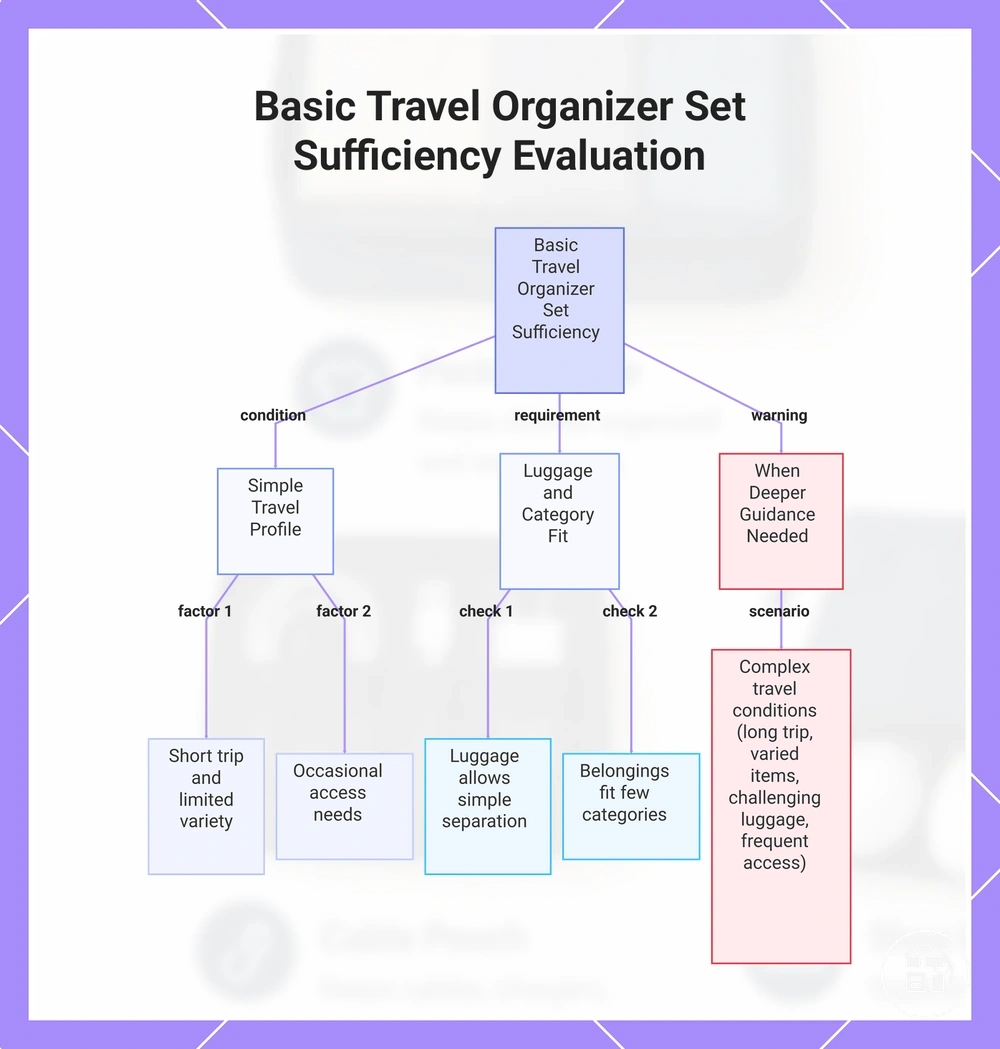
A basic travel organizer set is often enough when trip length, item variety, luggage size, and access needs remain relatively simple. Whether a basic travel organizer set is sufficient depends on the travel condition and the organization needs of the belongings being carried.
The checklist below provides a light way to evaluate sufficiency without moving into deeper selection decisions.
- If trip length is short and item variety is limited, a basic travel organizer set may be sufficient for keeping belongings grouped and easier to manage.
- If luggage size allows simple separation of belongings, basic organizers may provide enough organization for the travel condition.
- If access needs are occasional rather than frequent, a simple organizer setup may be enough to keep belongings easier to locate when needed.
- If belongings fit into only a few categories, a starter organizer set may provide sufficient containment and separation.
- If the desired packing outcome is straightforward organization rather than specialized storage needs, a basic set may be enough for the trip context.
Deeper selection guidance may be useful when trip length increases, item variety expands, luggage size creates additional organization challenges, or access needs become more demanding. In those conditions, organizer attributes may require closer evaluation, while a basic travel organizer set can remain sufficient for many uncomplicated travel situations.
This chart shows the key conditions that indicate a basic travel organizer set is sufficient and warns when deeper selection guidance becomes useful.