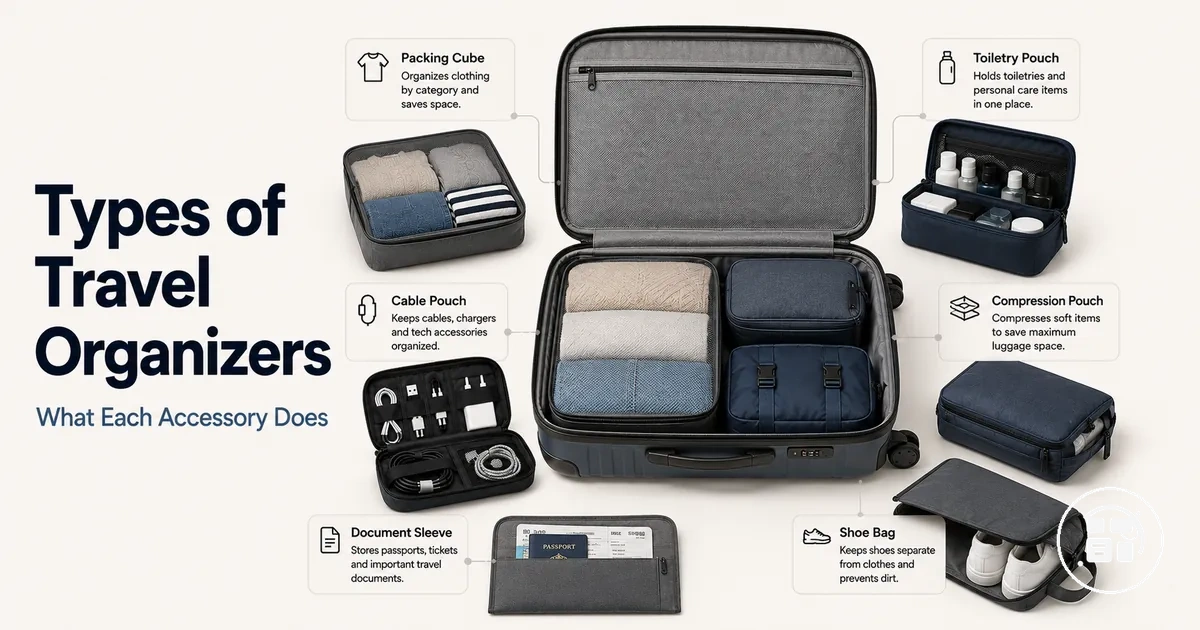
Travel organization accessory types for different packing roles
Travel organization accessories are type families of packing tools that group belongings by item group, access need, protection level, separation need, and space control. The main organizer types include formats for clothes, toiletries, electronics, documents, shoes, and small mixed items. Packing role is the organizing logic that separates one organizer type from another.
Clothes often fit packing cubes because folded clothing needs structure inside a suitcase. Toiletries usually fit a toiletry organizer because liquids, grooming items, and small containers may need leak control and visibility. Cables and chargers fit an electronics organizer when protection and access matter, while papers fit a document organizer when fast retrieval is important. Shoes and loose accessories may need a shoe bag or travel pouch, depending on trip length, luggage style, and packing priorities.
The table below maps travel organization accessories to their typical packing roles and item groups. For the broader category context, see the travel organization accessories overview. Use these organizer types as a starting point for understanding category boundaries before comparing more specific formats.
| Organizer type | Typical items | Main packing role | Main caution |
|---|---|---|---|
| Packing cubes | Folded clothes and soft garments | Group clothing by category or suitcase section | Compression may reduce quick access when cubes are tightly packed |
| Toiletry organizer | Toiletries, grooming items, and liquids | Separate spill-prone or small bathroom items | Leak control depends on closure, material, and packing conditions |
| Electronics organizer | Cables, chargers, adapters, and small devices | Reduce tangling and keep tech items grouped | Padding and water resistance should not be treated as complete protection |
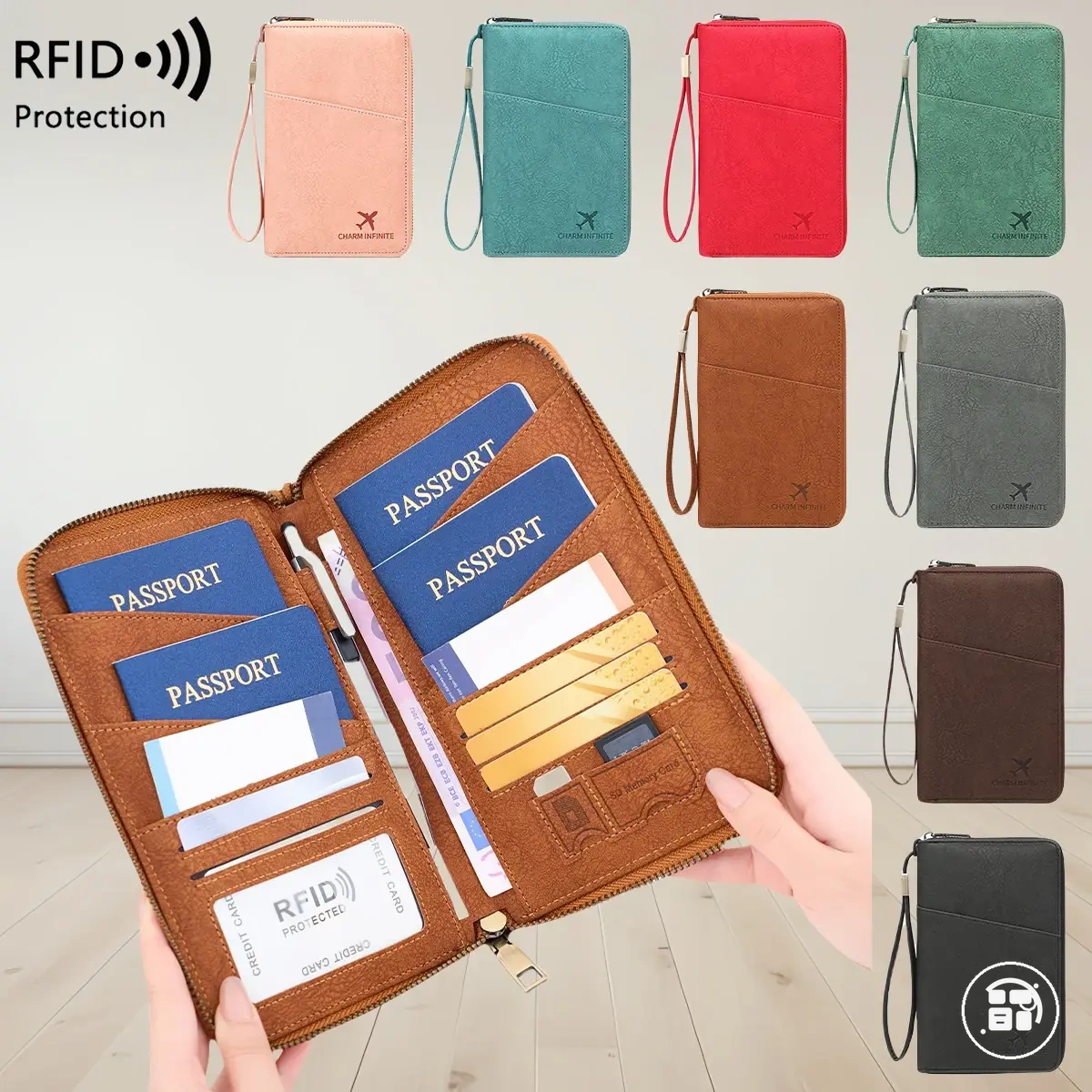
| Document organizer | Passports, tickets, cards, and travel papers | Keep important papers together for retrieval | Organization supports access but does not guarantee security |
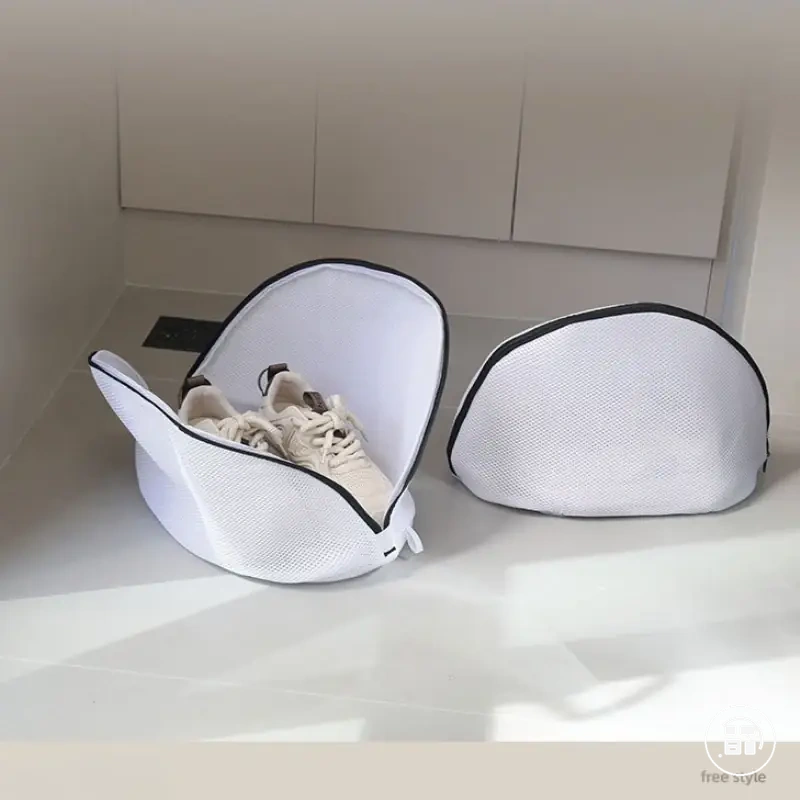
| Shoe bag | Shoes or sandals | Create separation between footwear and other items | Cleanliness outcomes depend on shoe condition and bag design |
| Travel pouch | Small mixed items and loose accessories | Hold changing item groups that do not need a specialist organizer | Mixed storage may reduce separation when contents vary widely |
What makes one travel organizer type different from another
A travel organizer type is a category of accessory distinguished by what it holds, how it separates items, and what packing problem it helps address. Different types use different combinations of compartment layout, closure design, material, and access method. Travel organizer types are classified by role and item group rather than by appearance.
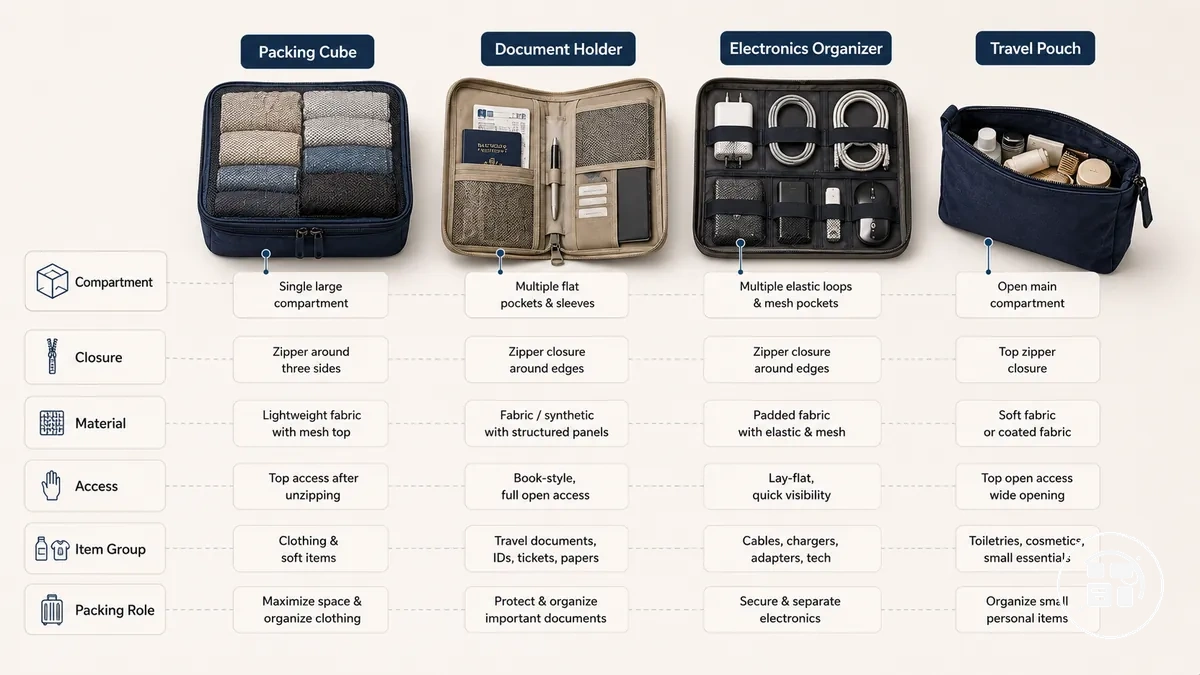
What makes one travel organizer type different from another is the set of attributes connected to its role. A packing cube may use structure and optional compression for folded clothes and space control, while a document organizer may use pockets and a secure closure to support easier access to travel papers. An organizer category for electronics may focus on compartment separation, whereas a travel pouch may prioritize flexible storage for mixed belongings. The boundary between types follows entity, attribute, and value relationships.
A common misconception is that organizer types are defined by brand, color, or retailer presentation. In practice, a travel organizer type is defined by its item group, compartment design, closure, material, access pattern, and intended packing problem. This keeps classification focused on role-based differences and belongings rather than commercial or visual distinctions.
- Compartment layout influences separation and visibility.
- Closure design affects containment and access.
- Material choice can influence structure, flexibility, and protection.
- Item group determines the primary packing role.
Clothes and suitcase organizers
Clothes organizers and suitcase organizers are packing formats used to manage garments, luggage compartments, and bulky soft items inside travel luggage. They help group belongings by purpose, improve separation, and support retrieval without relying on a single packing method. The main item groups include folded clothing, dirty laundry, footwear, and structured garments.
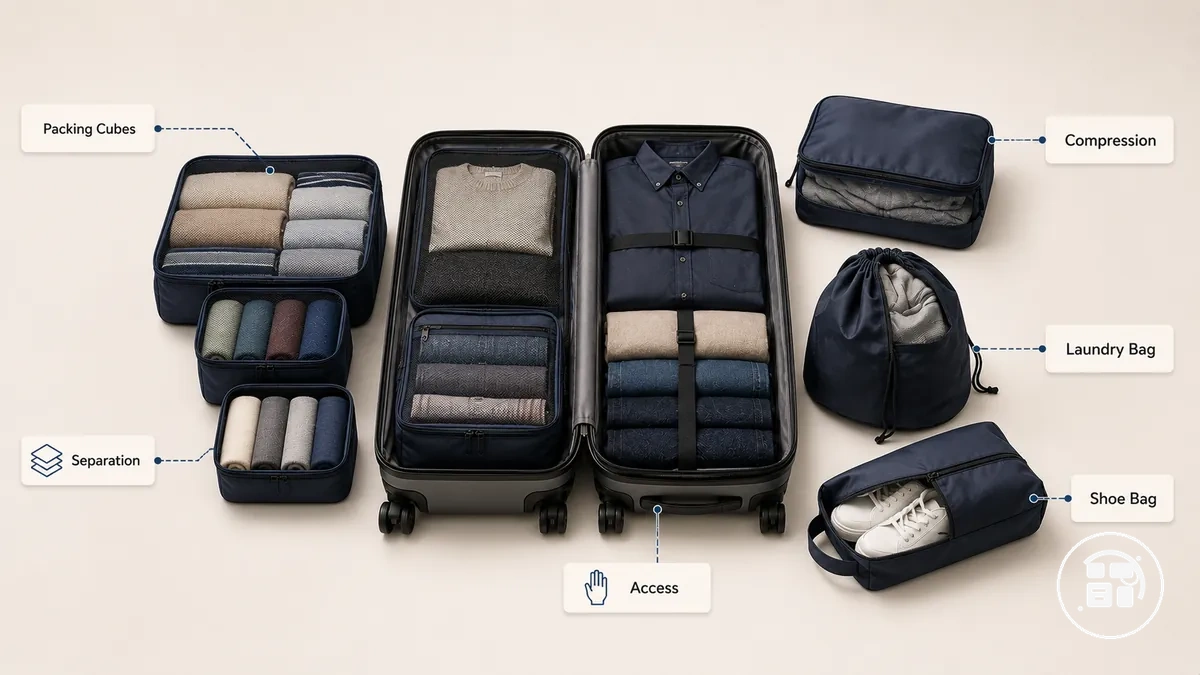
When packing different clothing-related items, organizer choice depends on the item group and the intended outcome. Packing cubes are commonly used for folded clothing because they keep garments grouped together, while compression cubes may help control volume when clothing can be compressed. Laundry bags separate dirty clothes from clean belongings, and shoe bags create a barrier between footwear and clothing. Space outcomes vary because many clothes organizers focus on separation, cleanliness, or access rather than reducing luggage volume.
Clothes and suitcase organizers differ by containment method, space behavior, and retrieval needs. For an example that combines related storage categories, see organizers for clothes and toiletries. The table below compares how common organizer formats balance space control, separation, and access.
| Organizer type | Best item group | Primary role | Trade-off |
|---|---|---|---|
| Packing cubes | Folded clothing | Grouping and containment | May require opening multiple cubes for retrieval |
| Compression cubes | Bulky garments | Space control | Access may be slower after compression |
| Garment folders | Structured clothing | Fold control | May need more careful arrangement |
| Laundry bags | Dirty laundry | Separation and cleanliness | Usually do not change suitcase space usage |
| Shoe bags | Footwear | Barrier between shoes and clothing | Space use depends on footwear size and shape |
A common misconception is that all clothes organizers exist primarily to save space. In practice, packing cubes, compression cubes, garment folders, laundry bags, and shoe bags serve different goals such as space control, separation, or access, which leads into the more specific organizer categories covered next.
Standard packing cubes and compression cubes
Standard packing cubes and compression cubes differ mainly in how they manage volume and access. Standard packing cubes use a compartment structure to organize folded clothes, while compression cubes add a compression zipper that can reduce bulk when clothing condition and fabric type allow. Compression may affect visibility, access, and clothing condition differently depending on how tightly items are packed.
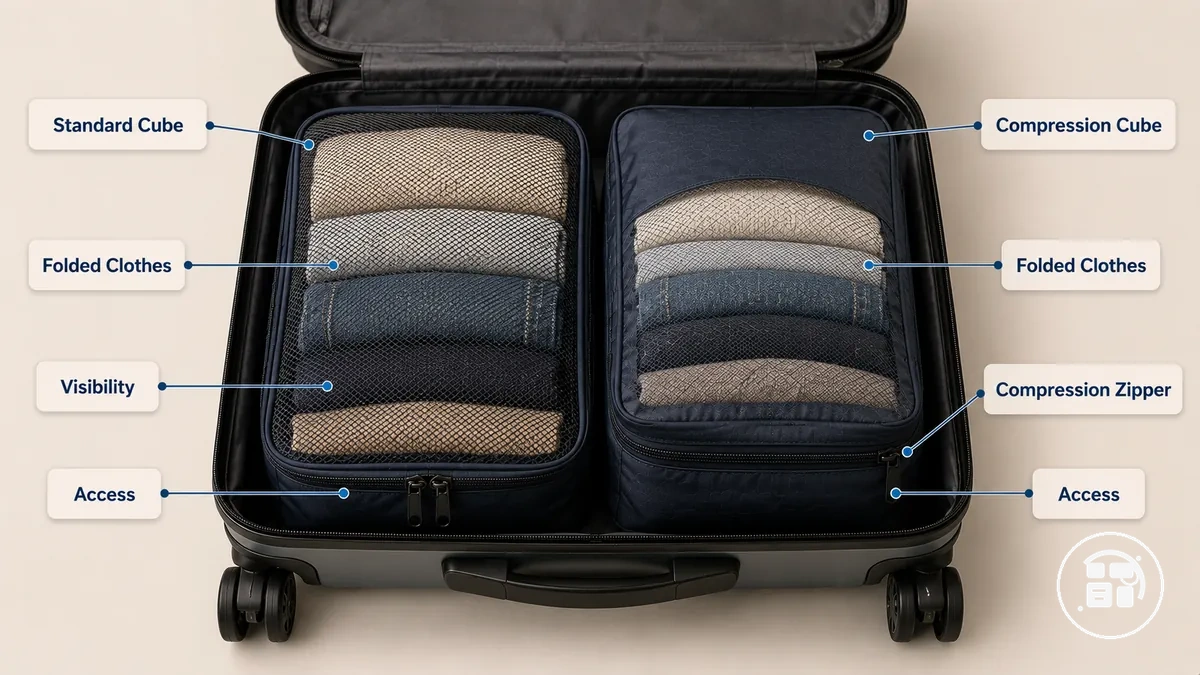
When visibility and quick access are the priority, standard packing cubes keep folded clothes easier to view and retrieve. When volume control is more important, compression cubes may condense clothing through a compression zipper, although access can become slower and pressure on clothing may vary by packing condition. The comparison below highlights the local trade-offs between standard packing cubes and compression cubes.
| Cube type | What it changes | Best use case | Caution |
|---|---|---|---|
| Standard packing cubes | Improves organization and visibility | Folded clothes needing easy access | Usually changes organization more than volume |
| Compression cubes | Uses a compression zipper to manage packed volume | Clothing that can be compressed | May reduce visibility and slow access after compression |
A common misconception is that compression cubes always create major space savings. In practice, volume reduction depends on clothing type, packing condition, and how the cube is used. For a broader category comparison, see packing cubes versus travel organizers.
Garment folders, laundry bags, and shoe bags
Garment folders, laundry bags, and shoe bags are separation formats used for different item conditions inside luggage. Garment folders organize structured clothing, laundry bags isolate dirty laundry, and shoe bags create a barrier between footwear and other packed items. Each format is intended for clean clothes, worn clothing, or shoes.
When clothing and footwear need to remain separated by condition, these organizers serve different roles within the suitcase. Garment folders may help maintain fold control for structured garments, while laundry bags keep dirty laundry apart from clean clothes. Shoe bags place a barrier around footwear, which may help reduce contact with surrounding items, although cleanliness, odor, and protection outcomes depend on the condition of the contents and how they are packed.
- Garment folders: Structured clothing and clean clothes; support fold control and organized separation.
- Laundry bags: Dirty laundry and worn clothes; create separation that may support cleanliness inside luggage.
- Shoe bags: Footwear; provide a barrier between shoes and other packed belongings.
A common misconception is that these formats replace laundry care or wardrobe planning. In practice, garment folders, laundry bags, and shoe bags focus on separation by item condition rather than clothing maintenance or long-term storage.
Toiletry, makeup, and liquid organizers
Toiletry, makeup, and liquid organizers are containment-focused formats designed for items that may need leak control, visibility, hanging access, or compartment separation. A toiletry organizer, makeup organizer, or liquid organizer groups items with different storage needs, such as liquids, grooming tools, and cosmetics. The most suitable format often depends on travel context, item type, and how frequently access is needed.
When liquids, grooming items, and cosmetics are packed together, their containment needs can differ. Toiletry, makeup, and liquid organizers vary by closure, material, compartments, and access style. The table below compares common organizer formats based on the items they are intended to manage.
| Organizer format | Items it suits | Attribute to check | Limitation |
|---|---|---|---|
| Toiletry bag | Mixed toiletries and grooming items | Closure and compartment layout | Visibility may vary by design |
| Dopp kit | Dry grooming tools and personal-care items | Material and access | May offer limited separation for small items |
| Clear pouch | Liquids and small containers | Visibility and closure | Suitability may depend on travel context and local requirements |
| Hanging organizer | Toiletries used in shared or compact spaces | Hook access and compartments | Hanging convenience depends on the available environment |
| Makeup case | Cosmetics and small beauty items | Small compartments and visibility | May not suit larger grooming products |
When leak-prone liquids are the main concern, closure and material often become the primary attributes. For dry grooming items, access may matter more, while a makeup organizer usually emphasizes visibility and small compartments. A common misconception is that any organizer guarantees leak control or universal travel acceptance. In practice, performance depends on the container, closure condition, and travel context. For an example that combines related storage categories, see organizers for clothes and toiletries, where toiletries are grouped alongside other travel item categories.
Electronics, cable, and gadget organizers
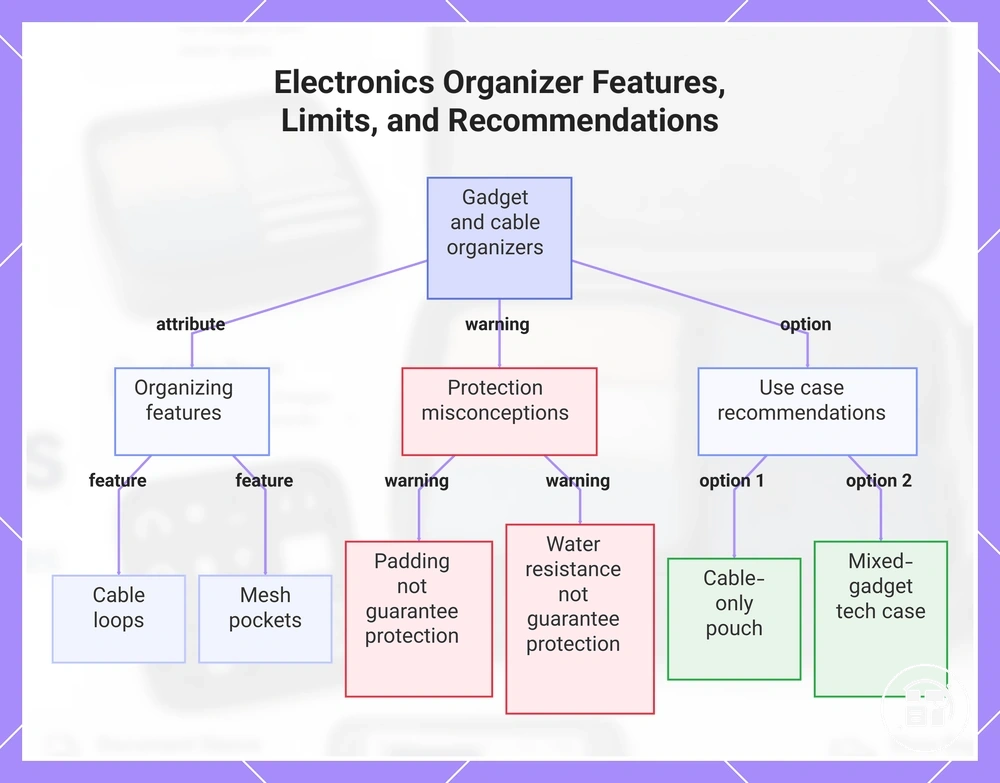
Electronics, cable, and gadget organizers are storage formats designed to reduce tangling, limit scattered small-device storage, and improve access to travel tech items. An electronics organizer, cable organizer, or gadget organizer uses separation features such as cable loops, mesh pockets, padding, and closures to keep accessories grouped by type. These organizers may help reduce pressure exposure, but protection depends on the organizer design, packed items, and travel conditions.
When carrying cables, chargers, power banks, earbuds, and adapters, organizer attributes affect separation and retrieval. The checklist below highlights common features used to organize these items and improve access while reducing clutter.
- Cable loops: Help keep cables separated and reduce tangling.
- Mesh pockets: Support visibility and retrieval of chargers, adapters, and small accessories.
- Padding: May help reduce pressure exposure for certain devices and accessories.
- Pocket size: Should match the size of the charger, power bank, or gadget being stored.
- Closure: Helps keep contents contained during transport.
- Water resistance: May provide limited protection depending on material and travel conditions.
A common misconception is that water resistance or padding makes an electronics organizer fully protective. In practice, these attributes may reduce certain risks, but they do not guarantee protection from impact, moisture, or damage in all situations. For cable-only carry, a cable pouch may provide sufficient separation and access, while mixed gadget carry often benefits from a tech case or gadget sleeve with additional compartments and padding.
This chart outlines the key organizing features of electronics and gadget organizers, their protection misconceptions, and recommended use cases for different carry needs.
Document, passport, wallet, and valuables organizers
Document, passport, wallet, and valuables organizers are formats designed to keep travel papers, identity items, payment items, and small valuables grouped for fast access and organized retrieval. A document organizer, passport holder, travel wallet, valuables pouch, or jewelry case uses compartments and a closure system to separate sensitive items by purpose and access need. These organizers support secure grouping and may help reduce the chance of overlooking items when contents are organized consistently.
Document, passport, wallet, and valuables organizers can be evaluated through a few practical attributes. The checklist below highlights factors that help match the organizer to different item groups and carrying situations.
- Capacity: Should accommodate the number of documents, cards, jewelry pieces, or valuables being carried.
- Closure: Helps keep contents grouped and contained during travel.
- Visibility: Supports faster identification of documents, passports, cards, or small valuables.
- Carrying style: May influence whether a document pouch, travel wallet, or valuables organizer is more suitable.
- Item sensitivity: Passports, payment cards, and jewelry may benefit from dedicated compartments.
- Separation: Small compartments can help group items by type and support tangle prevention for jewelry.
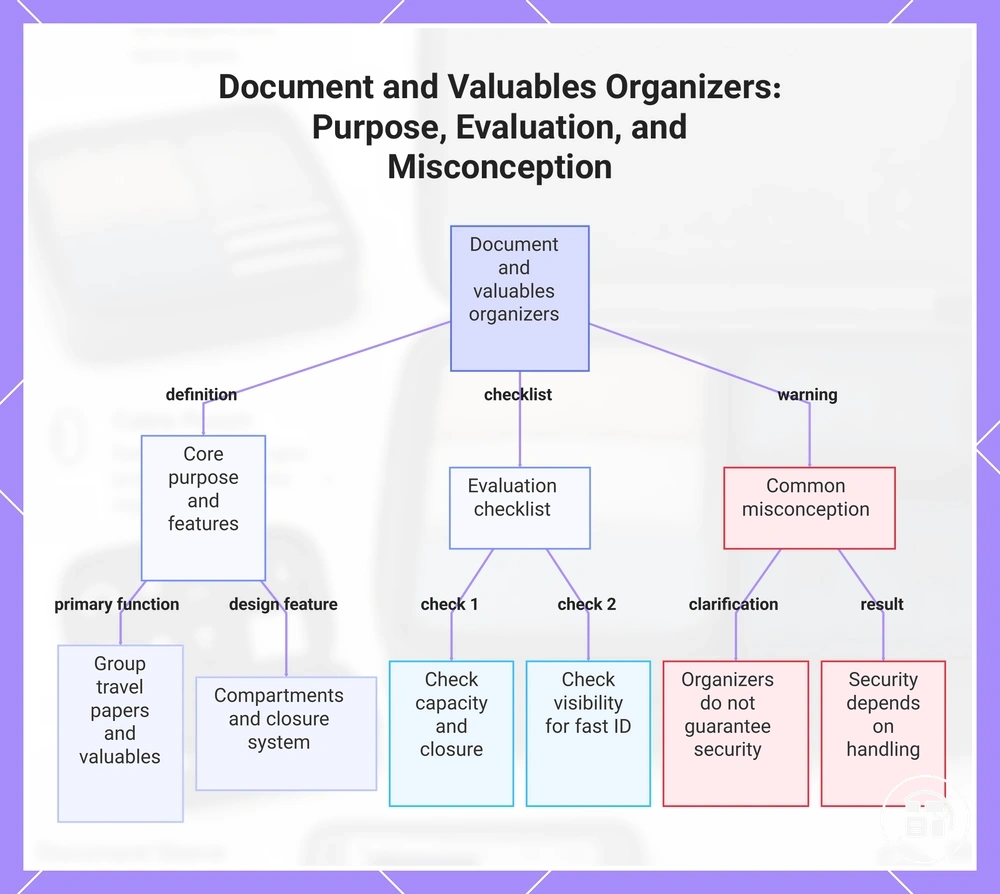
A common misconception is that a document organizer, passport holder, travel wallet, jewelry case, or valuables pouch guarantees security or prevents loss. In practice, these formats focus on organization, visibility, and access, while protection outcomes depend on handling and travel conditions. For example, a document organizer may suit family documents, a passport holder may fit single-passport carry, and a travel wallet may group cash and cards, with the most suitable option often depending on carrying style and access needs.
This chart explains what document, passport, wallet, and valuables organizers are, how to evaluate them using key attributes, and a common misconception about their security.
Travel pouches and small-item organizers
Travel pouches and small-item organizers are flexible storage formats designed to hold mixed items that do not always fit a single specialist category. A travel pouch can function as a small-item organizer for changing contents such as accessories, personal items, or travel essentials, depending on pouch size, closure, material, and visibility. This overlap makes a travel pouch useful when item groups are mixed or changing, while specialist organizers may suit repeated high-sensitivity item groups more consistently.
When contents vary between trips, travel pouches and small-item organizers are usually judged by contents, closure, material, and visibility. The attributes below help explain how flexible storage changes with different use cases.
- Pouch size: Should match the volume and type of mixed items being carried.
- Compartment depth: May improve separation when small items need dedicated spaces.
- Closure: A zipper or drawstring closure affects containment and access.
- Visibility: A clear pouch may make small items easier to identify, while an opaque pouch may reduce visibility.
- Body structure: A soft pouch may adapt more easily to changing contents, while a structured pouch may provide more consistent organization with the trade-off of less flexibility.
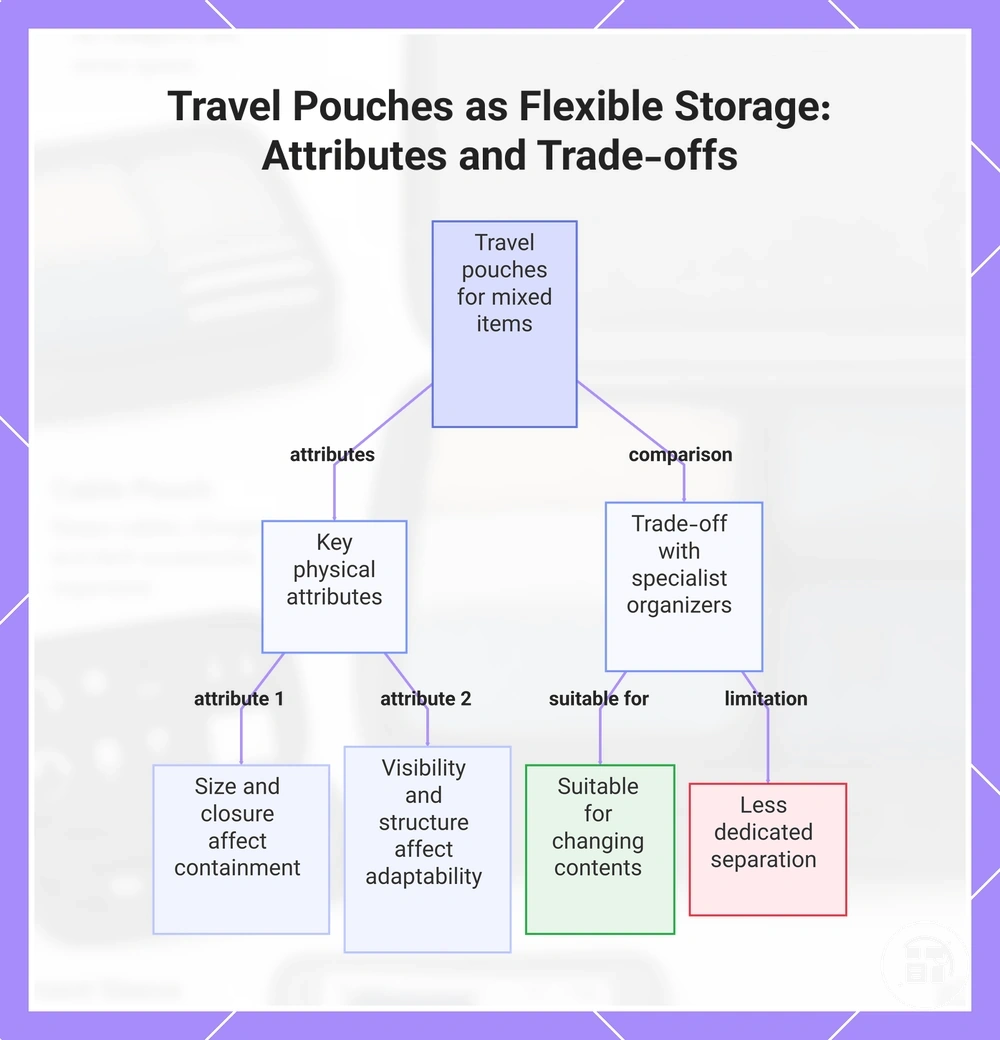
A common misconception is that a travel pouch can replace every specialist organizer. In practice, a travel pouch offers flexible storage for mixed items, but it may not provide the same dedicated separation as organizers designed for a specific item group. A travel pouch is often suitable when contents change frequently, while a specialist organizer may fit better when the same items require repeated organization and separation.
This chart shows the key attributes of travel pouches and small-item organizers as flexible storage solutions, and explains how they compare to specialist organizers.
How organizer types differ by access, protection, separation, and space control
Organizer types are evaluated through four core criteria: access, protection, separation, and space control. Each criterion highlights a different condition that influences how an organizer type supports retrieval, safeguarding, item separation, or volume control. The most suitable outcome depends on the condition being managed, and a trade-off may occur when improvement in one criterion reduces performance in another.
How organizer types differ by access, protection, separation, and space control becomes easier to evaluate when the criteria are organized by condition and effect. The table below connects organizer types to the criterion they emphasize and the outcome that may follow.
| Organizer type | Criterion | Value or condition | Effect or decision |
|---|---|---|---|
| Clear pouch | Access | High visibility | May support faster retrieval when access frequency is high |
| Electronics case | Protection | Padded compartments | May lower scratch or pressure risk for sensitive contents |
| Laundry bag | Separation | Dedicated item grouping | May improve cleanliness by keeping contents apart |
| Compression cube | Space control | Compression condition | May reduce packed volume when contents can be compressed |
When retrieval frequency is high, access often becomes the dominant criterion because visibility can influence how quickly contents are located. When item sensitivity is a stronger concern, protection may become more relevant through padding or compartment structure. The outcome depends on the organizer type, the condition being managed, and the intended retrieval or safeguarding need.
When cleanliness, containment, or suitcase organization are the primary concerns, separation and space control often become the deciding criteria. Separation may help keep contents apart, while space control may help manage volume through compression or packing arrangement. A common trade-off is that greater space control can reduce volume while also making access slower under certain conditions.
A common misconception is that organizer types should be compared only by features. In practice, access, protection, separation, and space control provide broader evaluation criteria than a simple feature list. For a closer examination of features across organizer types, criteria can be viewed at the attribute level, while organizers by packing problem applies the same decision factors to different packing situations.
When one organizer type can cover multiple packing roles
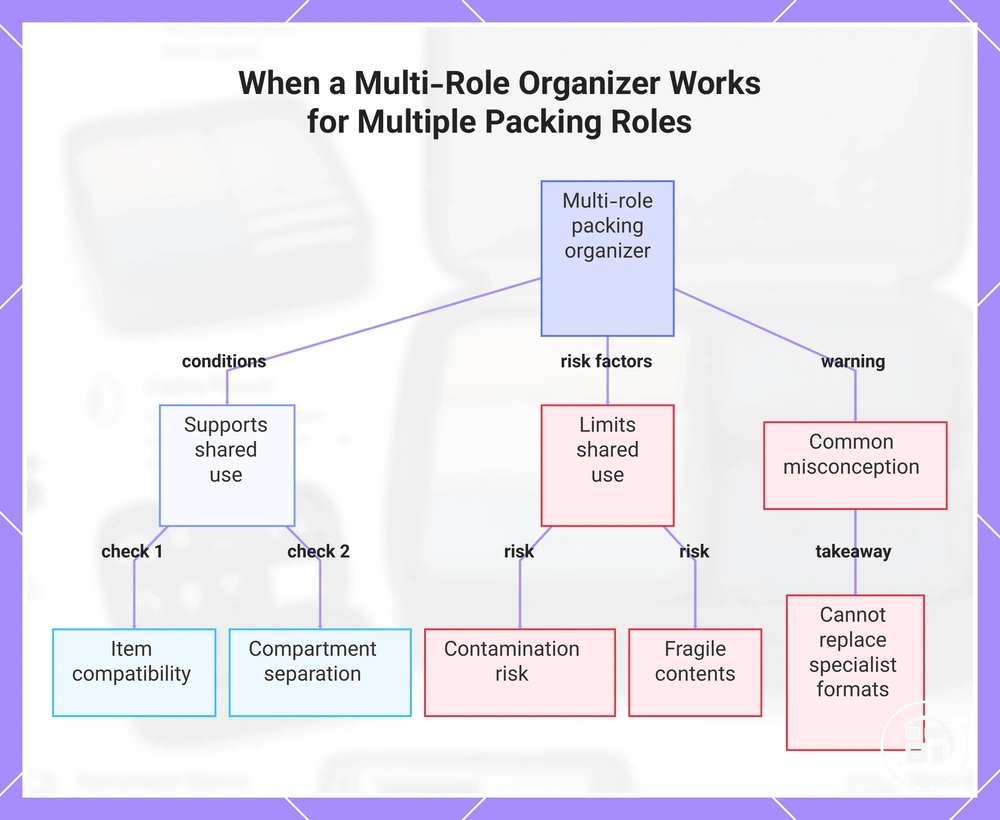
One organizer type can cover multiple packing roles when item compatibility, compartment separation, and trip context support shared storage without creating unnecessary risk. A multi-role organizer may suit mixed items that have similar storage conditions, protection needs, and access frequency. The decision becomes more restrictive when contamination risk, fragility, or sensitive contents are involved, which creates a practical boundary for combined packing roles.
When one organizer type can cover multiple packing roles, the checklist below verifies whether shared use is practical or whether separate organizers may be the safer decision.
- Item compatibility: Contents should have similar storage conditions and handling requirements.
- Contamination risk: Liquids, dirty items, or contents that may affect other items often require clearer separation.
- Fragility: Fragile electronics or delicate contents may need dedicated protection rather than mixed storage.
- Access frequency: Items used at different times may become harder to retrieve when grouped together.
- Compartment separation: Internal compartments may support mixed use when contents remain clearly separated.
- Trip context: Travel duration, luggage constraints, and item priority can influence the decision.
When a mixed-use pouch carries compatible accessories or travel essentials, a shared organizer may be practical because the contents have similar storage needs and limited contamination risk. A common misconception is that a multi-role organizer can replace every specialist format. In practice, liquids, documents, dirty items, and fragile electronics often require greater caution, and clear compartment separation remains the safer rule when contamination risk or fragility is present.
This chart shows the conditions that allow shared use, the risk factors that require separate organizers, and a common misconception about multi-role organizers.
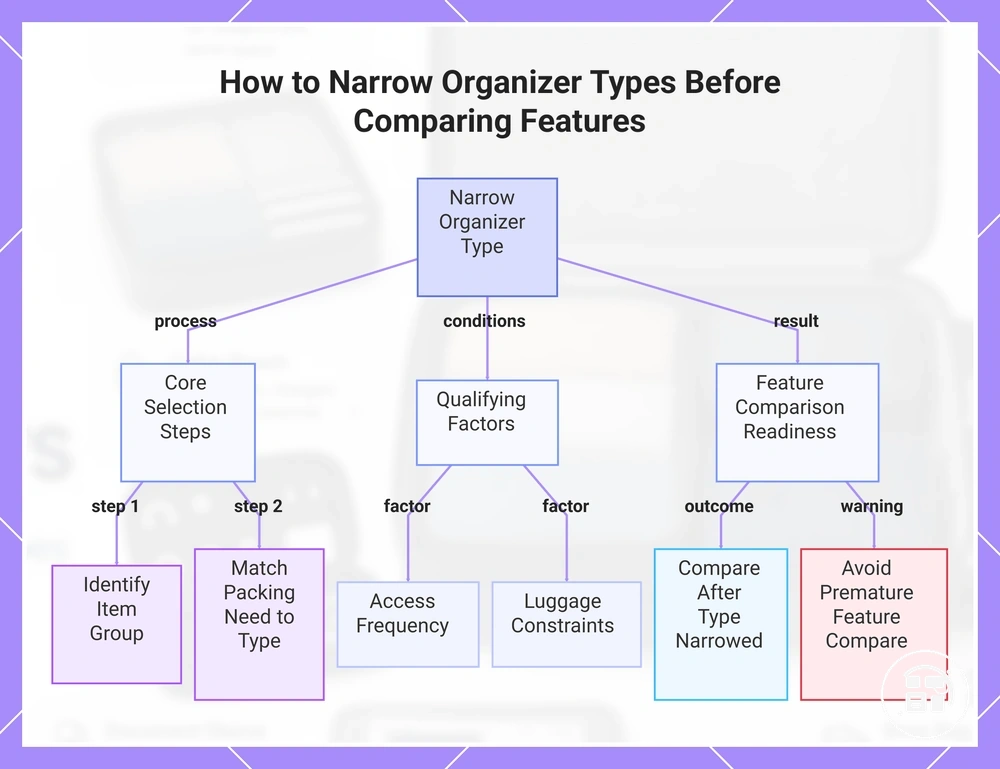
How to narrow organizer types before comparing specific features
Organizer type selection depends on the item group being packed and the packing need being addressed. Matching belongings to a packing role helps narrow the organizer type before comparing materials, compartments, closures, or other details. The final selection may vary based on trip length, luggage style, access frequency, and personal packing habits.
When luggage constraints limit space or when certain contents need frequent access, narrowing by packing problem often simplifies the decision. An item group that needs separation may point to a different organizer type than an item group that prioritizes visibility or space control. Access frequency and luggage constraints help qualify the selection, while the main trade-off is balancing organization against convenience.
How to narrow organizer types before comparing specific features becomes easier when the checklist below is used to verify feature comparison readiness.
- Item group: Identify the belongings that need organization.
- Packing need: Determine whether the goal is separation, access, protection, or space control.
- Organizer type: Match the packing need to an organizer category before evaluating details.
- Access frequency: Consider how often the contents will need to be retrieved.
- Luggage constraints: Check whether luggage style, available space, or packing limits affect the decision.
- Feature comparison readiness: Compare materials, compartments, and closures only after the organizer type has been narrowed.
A common misconception is that feature comparison should happen before organizer type selection. In practice, item group, packing need, access frequency, and luggage constraints usually narrow the decision first, while trip length and packing habits may further qualify the outcome. For a closer look at features across organizer types, feature-level evaluation becomes more useful after the organizer category has been narrowed.
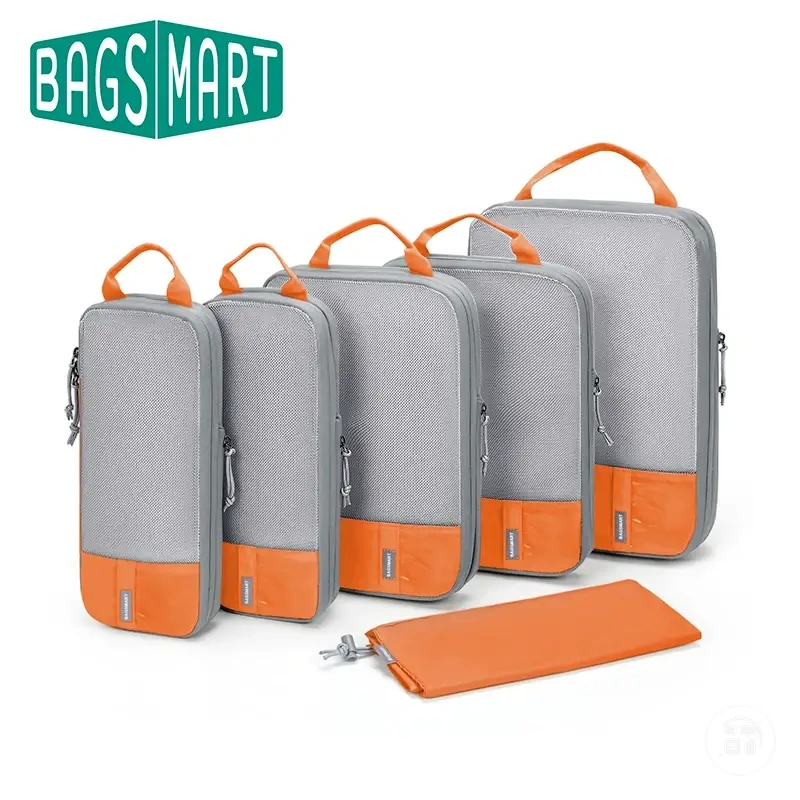
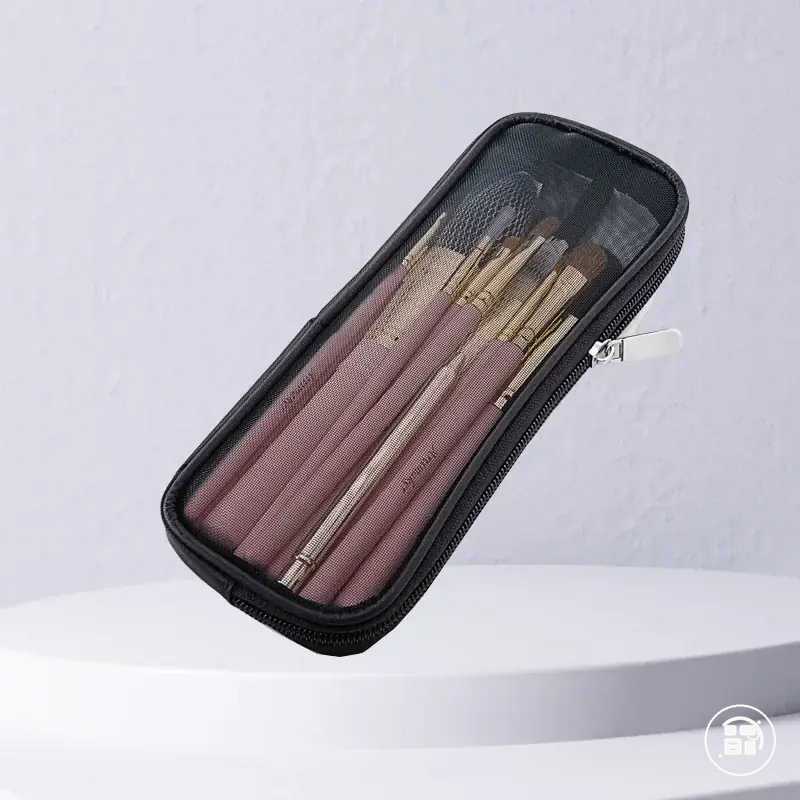
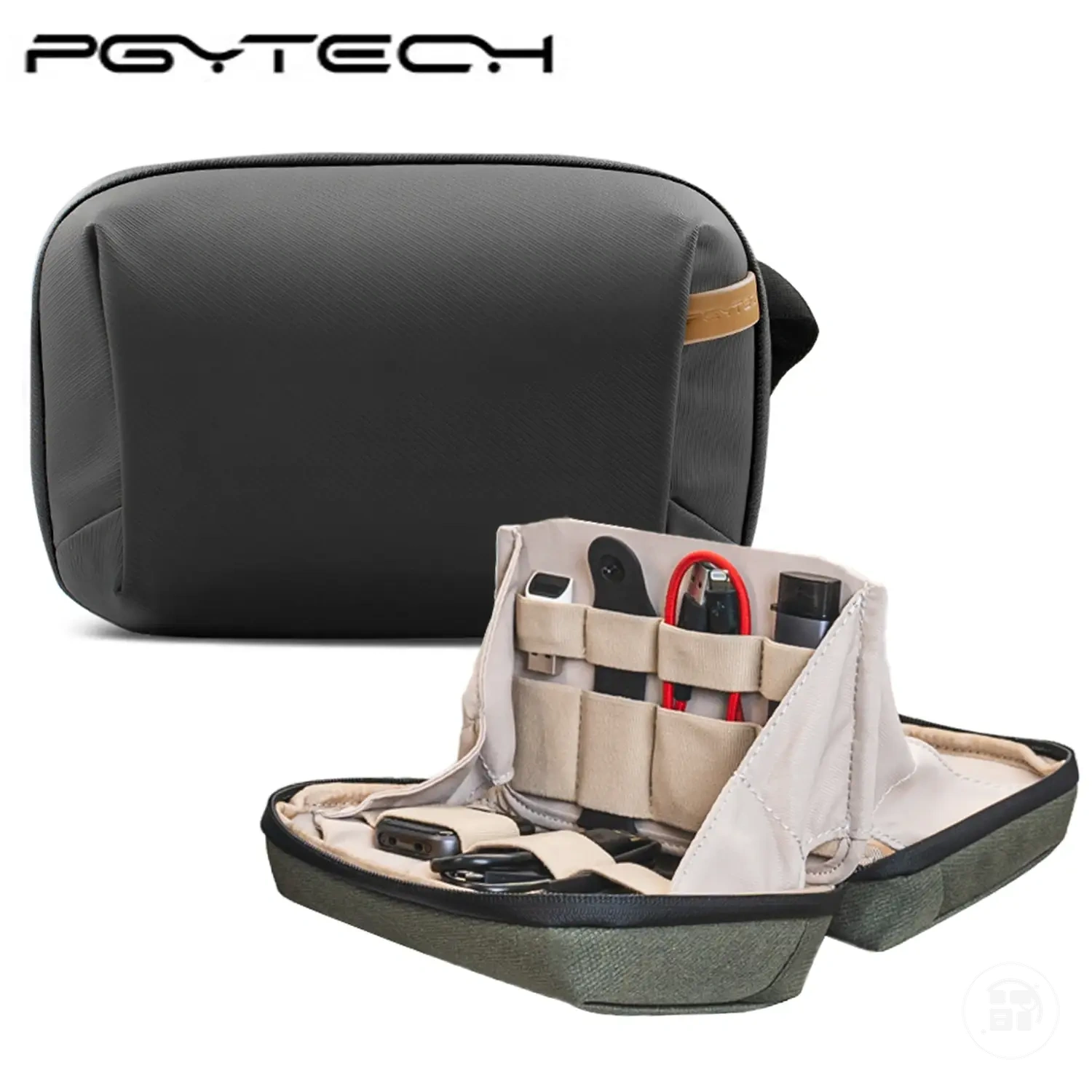
The products below are useful examples for comparing available options. Before buying, check that the compatibility criteria, key features, and product details match your needs.
This chart shows the process of selecting an organizer type based on item group, packing need, and qualifying conditions before comparing specific features.