
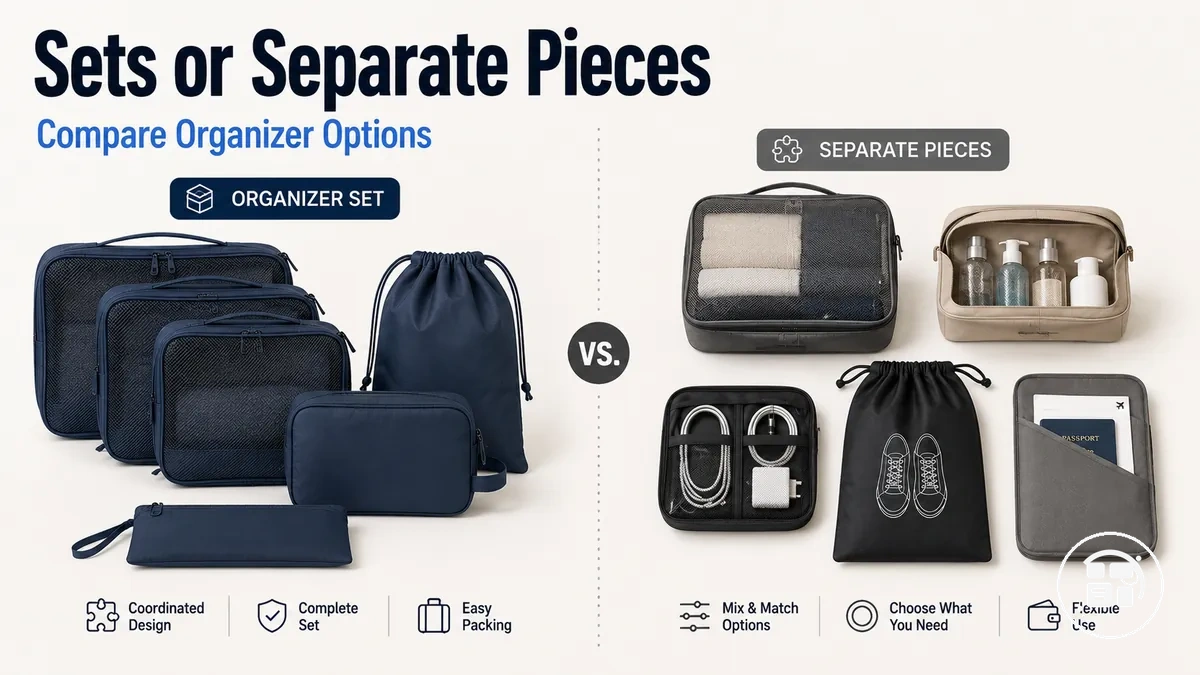
Travel Organization Accessory Sets vs Separate Pieces
Travel organization accessory sets usually work better for broad starter coverage, while separate pieces usually work better for custom packing needs. A travel organizer set, packing cube set, travel pouch set, or luggage organizer set can simplify the first decision, but the stronger choice depends on coverage, flexibility, value, carry-on or checked luggage fit, and quality.
A traveler comparing bundled organizers with individual organizers may be deciding between quick bundle convenience and separate-piece control. A ready set can cover clothing, toiletries, cables, and small items in one purchase path. Separate travel pouches or cubes can make more sense when the item mix is specific, the luggage space is tight, or the traveler wants a custom organizer setup. The decision should move from format preference to criteria-based comparison.
Buying by piece count alone can create waste risk if the useful pieces do not match the actual packing job. A multi-piece organizer with weak fit, repeated sizes, or low-use pouches may offer less value than fewer separate pieces with clearer quality and purpose. The comparison starts by defining what counts as a set and what counts as a separate organizer piece.
What Counts as a Travel Organizer Set or a Separate Organizer Piece
A travel organizer set is a multi-piece set of bundled organizers, and a separate organizer piece is an individual pouch, packing cube, toiletry bag, or item-specific organizer selected on its own. A travel organizer set groups included organizers into a single format, while a separate organizer piece is chosen individually. This distinction matters because it creates the comparison boundary used throughout the evaluation.
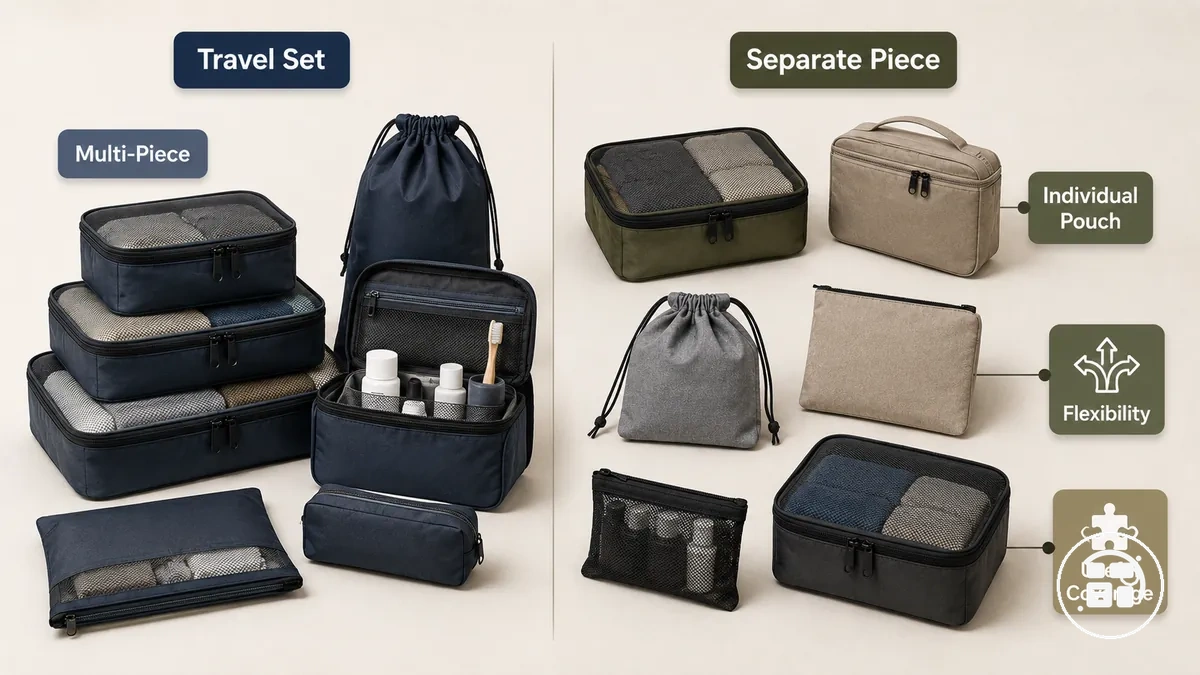
The comparison is about buying format rather than every organizer type. For broader context, see the travel organization accessories overview. A travel organizer set combines bundled pieces and included organizers into one multi-piece set, while a separate organizer piece, such as an individual pouch, separate travel pouch, packing cube, toiletry bag, or item-specific organizer, supports a more specific custom need and greater flexibility. The comparison boundary depends on useful coverage, not on the number of included pieces alone, especially when duplicate pieces add limited value.
What a Useful Travel Organizer Set Should Include
A useful travel organizer set includes pieces that match real packing roles rather than simply increasing the number of included pieces. The strongest coverage usually comes from organizer types that help separate clothing, toiletries, cables, or other commonly packed items. A useful travel organizer set is judged by how well the included pieces create usable coverage.
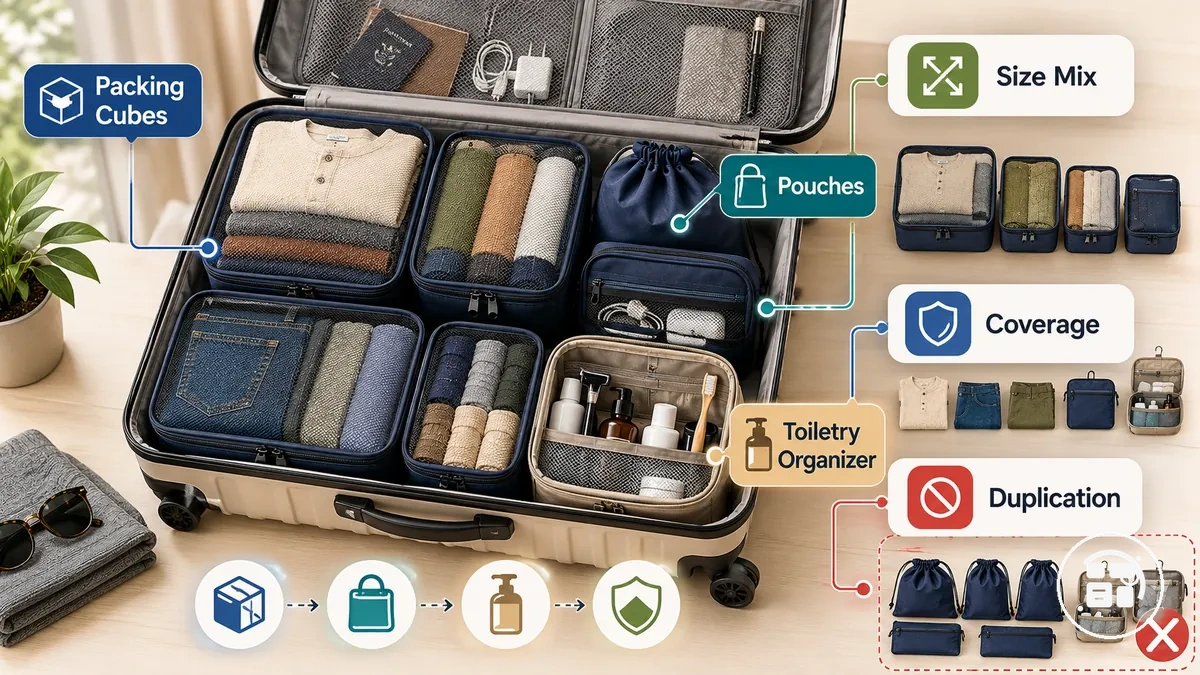
High piece counts can sometimes hide weak coverage when multiple organizers serve the same purpose. Duplicate pieces may increase duplication without improving organization for a specific trip. A bundled set with only one organizer type can leave gaps in packing roles even when the total piece count appears generous. More useful set contents often depend on a balanced size mix and practical specialization.
A traveler using mostly clothing may value different included pieces than a traveler carrying toiletries, electronics, or small accessories. A packing cube, pouch, or toiletry organizer can add value when it supports a specific packing need rather than repeating an existing function. For a closer look at types included in organizer sets, it helps to compare organizer types by their practical role before judging the bundle.
Usefulness depends on included organizer types and real packing roles. The table below separates useful pieces from potential filler pieces by focusing on practical coverage rather than quantity alone.
| Piece type | Packing role | Useful when | Risk if unnecessary |
|---|---|---|---|
| Packing cubes | Clothing organization | Separating garments by category or size | Unused capacity or duplication |
| Toiletry organizer | Liquids separation | Keeping personal care items together | Extra space used without need |
| Pouches | Small-item access | Managing cables or accessories | Filler pieces with limited use |
| Specialized organizer | Specific item category | Supporting a defined packing role | Waste when the role is not needed |
Core packing pieces versus filler pieces
Core packing pieces are pieces tied to a real packing job, such as organizing clothing, toiletries, cables, or small accessories. Useful coverage comes from matching an item category to a packing role, while filler pieces increase item count without a clear need, creating a filler risk.
A duplicate pouch or extra organizer can be useful when luggage space, trip length, or item separation requires it. The same piece may become a filler piece when it repeats an existing function without improving access, organization, or protection for that traveler. The checklist below helps judge core packing pieces and filler pieces within one set.
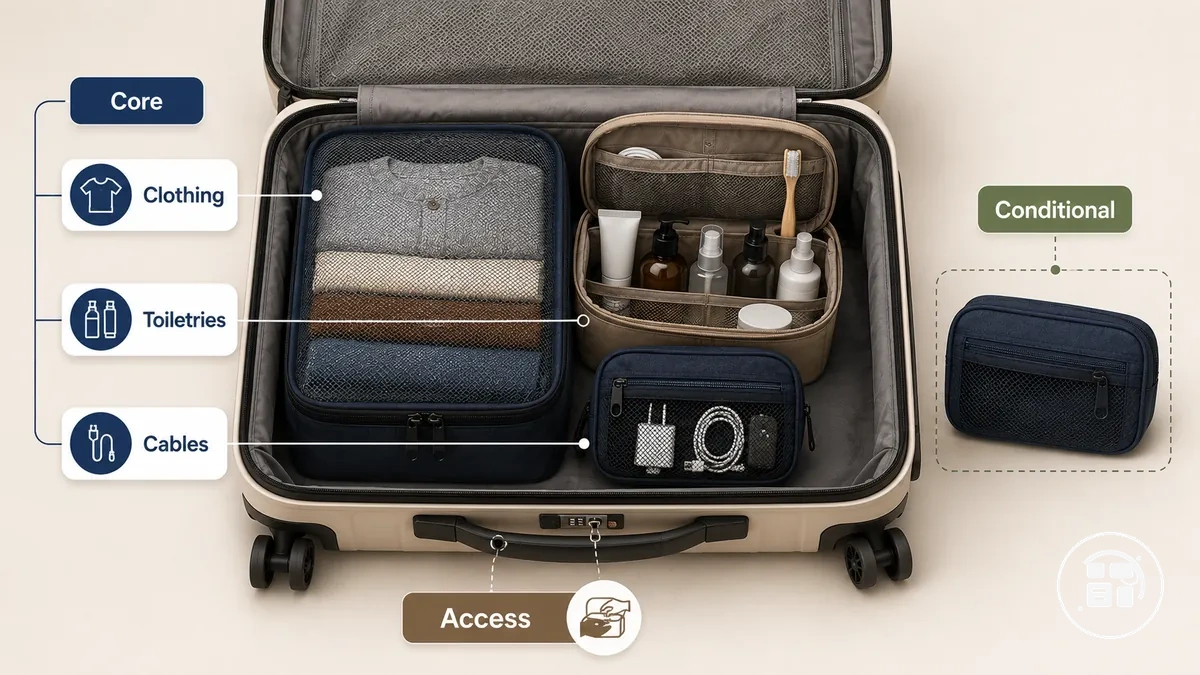
This checklist verifies whether included pieces contribute to useful coverage or mainly increase item count.
- Item category: Does the piece support a specific packing job for clothing, toiletries, cables, small accessories, or spare bags?
- Frequency of use: Is the organizer likely to be used on most trips rather than only in uncommon situations?
- Size fit: Does the organizer size match the items being packed and the available luggage space?
- Duplication: Do duplicate sizes add meaningful organization, or do repeated pieces create waste for the current travel need?
- Protection: Does the piece help separate or contain items that benefit from organization?
- Access: Does the organizer improve access to frequently used items during travel?
Packing cubes, pouches, toiletry bags, and item-specific organizers
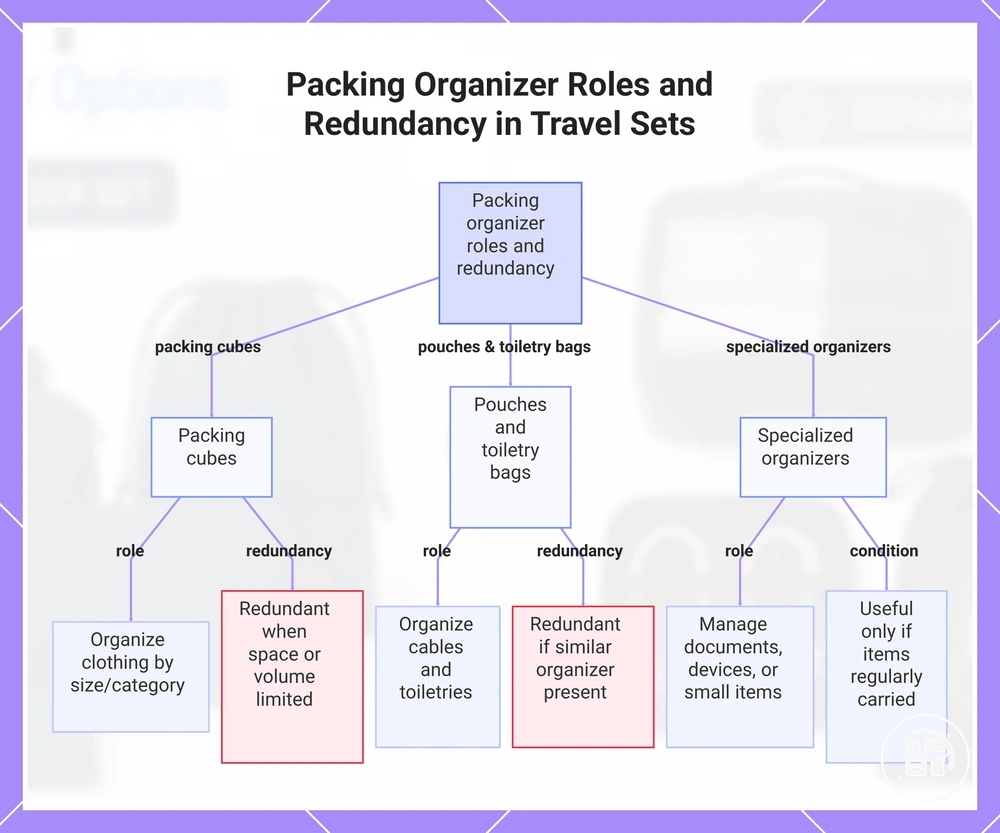
Packing cubes, pouches, toiletry bags, and item-specific organizers are set components with different packing roles. Each format is linked to a specific item category, access need, or protection role rather than serving the same purpose. Their usefulness should be evaluated as part of set usefulness rather than as a full accessories list.
- Packing cubes: A packing cube helps organize clothing by size, category, or capacity. It helps when clothing separation is needed, but additional cubes can create redundancy when luggage space or clothing volume is limited.
- Pouches: A pouch helps organize cables and small accessories for easier access. A bundled pouch may be enough when it matches the intended item category and storage need.
- Toiletry bags: A toiletry bag helps separate toiletries and supports a protection role for liquids and personal care items. It can become redundant when another included toiletry organizer already provides the required separation.
- Item-specific organizers: An item-specific organizer can help manage documents, devices, or another defined use case. Its usefulness depends on whether those items are regularly carried.
- Accessory organizers: An accessory organizer can combine storage for multiple small items into one format. It helps when small accessories travel together, but overlap may occur when similar pouches are already included.
A bundled format may be enough when it fulfills a clear role for a specific item category without overlapping with another included organizer. Redundancy can increase when multiple formats perform the same function for the same items.
This chart shows how each packing organizer format serves a specific role and when it becomes redundant within a set.
How Sets and Separate Pieces Differ in Packing Coverage
Packing coverage depends on item categories, quantity, and layout control. Bundled sets often provide broader starting coverage through included pieces, while separate pieces allow a custom layout tailored to a specific item mix. The practical difference depends on clothes, toiletries, electronics, small accessories, and how those categories are distributed within the luggage layout.
Bundled sets can create duplicate coverage when repeated sizes or similar organizers perform the same role. Separate pieces can reduce duplicate coverage by focusing on specific needs, but they can also create missing categories when an organizer for a needed item category is not selected. Both coverage gaps and overlap depend on the item mix and can affect clothes, toiletries, electronics, and small accessories differently.
A traveler carrying a mixed item mix may need a different balance between included coverage and layout control. A complete bundle may simplify organization across multiple categories, while separate pieces can provide more flexibility when one category requires additional attention. The tradeoff is between broader default coverage and a more customized layout.
The table below compares how packing coverage may differ between bundled sets and separate pieces across common organizer needs.
| Coverage dimension | Organizer set behavior | Separate-piece behavior | Decision effect |
|---|---|---|---|
| Clothing | Often includes organizers for clothing separation | Can be adjusted to clothing quantity and category | Depends on clothing volume and layout control needs |
| Toiletries | May include a dedicated organizer for separation | Can focus on toiletry-specific requirements | Depends on the level of separation needed |
| Electronics | Coverage depends on the included pieces | Can prioritize electronics organization directly | Useful when electronics occupy a larger share of the item mix |
| Small items | Often covered through pouches or accessory organizers | Can target specific small accessories | Depends on access and organization preferences |
| Duplicate coverage | May occur when repeated sizes overlap in function | Can be reduced through selective organizer choices | May affect space use and organization efficiency |
| Missing categories | May occur when a needed organizer type is not included | May occur when a needed piece is not selected | Can create coverage gaps for specific item categories |
Unified packing systems versus custom organizer layouts
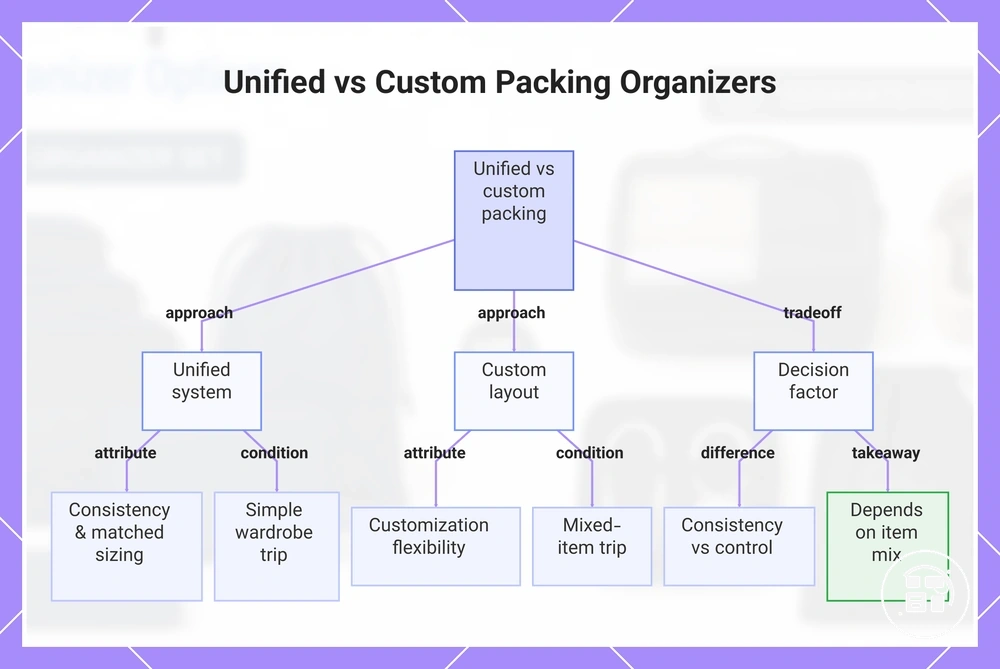
A unified packing system prioritizes system consistency, matched sizing, and visual order, while a custom organizer layout prioritizes customization around a specific item mix. A ready-made system can create a more coordinated set of organizers, whereas a custom organizer layout provides greater control over which pieces are included. The tradeoff is between consistency and layout control.
For a simple wardrobe-focused trip, a unified packing system may provide enough structure through matched sizing and a consistent visual order. For a mixed-item trip that includes clothes, toiletries, electronics, and small accessories, a custom organizer layout may offer more flexibility by reducing unnecessary pieces and limiting mismatch between organizer roles and item categories. The better option depends on the item mix, with the focus remaining on packing coverage choice.
This chart compares unified packing systems and custom organizer layouts, highlighting their priorities and the tradeoff to choose the right option based on trip item mix.
Coverage gaps, duplicate pieces, and unused organizers
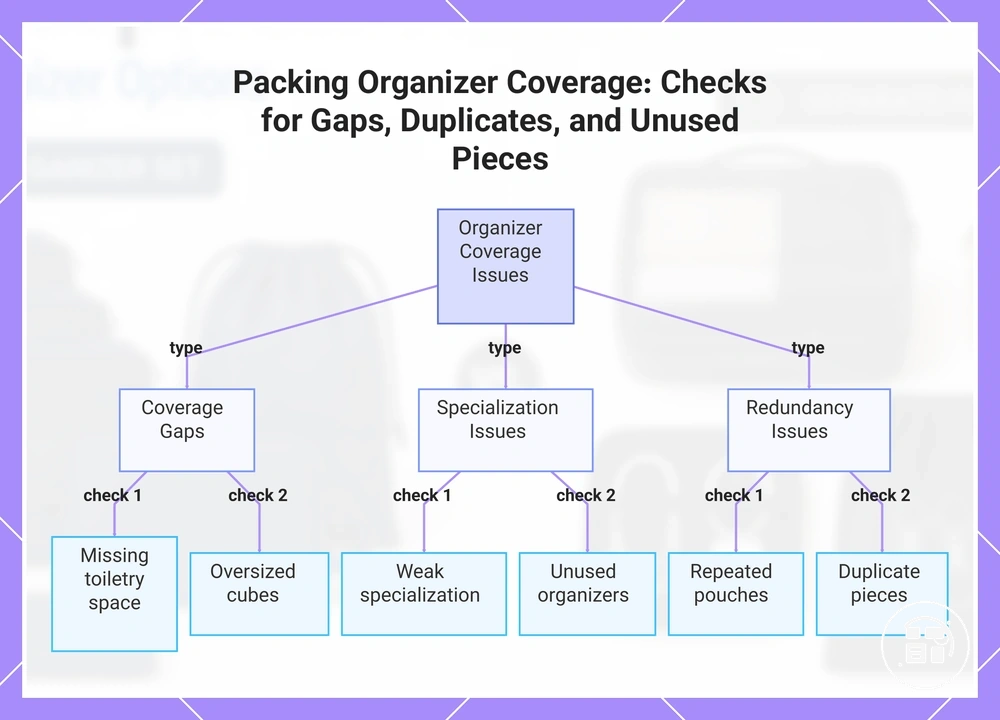
Coverage gaps, duplicate pieces, and unused organizers can reduce practical packing coverage when the included organizers do not match the traveler’s item mix. Missing toiletry space, oversized cubes, or weak specialization may leave important categories under-served even when a set appears complete. The risk depends on how well the included pieces align with actual packing needs.
Duplicate pieces are only a concern when they do not support repeated packing needs. Repeated pouches or repeated sizes may remain useful for family packing, category separation, or a larger item mix, but they can become unused organizers when no clear role exists. The checklist below helps verify whether a set’s coverage is meaningful.
The following checks help confirm whether coverage gaps, duplicate pieces, or unused organizers are likely to affect practical use.
- Missing toiletry space: Check whether toiletries have a dedicated organizer or whether a missing category may create a coverage gap.
- Oversized cubes: Check whether cube size matches the clothing volume, or whether oversized cubes may be difficult to use efficiently.
- Repeated pouches: Check whether repeated pouches support separate item groups or duplicate the same storage role.
- Weak specialization: Check whether organizers serve distinct purposes rather than overlapping across the same category.
- Unused organizers: Check whether each organizer matches the expected item mix instead of becoming an unused piece.
- Duplicate pieces: Check whether repeated sizes support repeated packing needs or create unnecessary overlap.
This chart groups the six key checks to identify whether a packing organizer set has meaningful coverage or risky gaps, duplicates, or unused organizers.
Value Tradeoffs Between Organizer Sets and Individual Pieces
Value depends on useful pieces rather than sticker price or item count. A value tradeoff between organizer sets and individual pieces is usually determined by how many organizers are actually used, how well they fit the packing need, and how long they remain functional. The comparison centers on bundle efficiency versus piece-level control.
Wasted items can reduce cost per usable piece when included organizers do not match the intended item mix. A large bundle may appear to offer broad coverage, but replacement cost can increase if unsuitable pieces are rarely used and additional organizers are needed later. Durability factors such as material quality, closure strength, zipper quality, and seam construction may influence usable value more than organizer count alone. Evaluating useful pieces alongside these quality signals can provide a clearer picture of bundle value.
When a bundle contains many low-use organizers, a smaller collection of better-fitting pieces may provide stronger long-term value. In other situations, organizer sets may offer broader coverage when most included organizers are likely to be used. The stronger value choice depends on actual use, replacement flexibility, and packing requirements.
Value depends on useful pieces, durability, and replacement flexibility rather than item count alone. The comparison below focuses on practical value factors without relying on price comparisons. For a broader cost and value comparison, it can help to evaluate material and usage factors separately from bundle size.
| Value factor | Set advantage | Separate-piece advantage | What to check |
|---|---|---|---|
| Usable pieces | May provide wider coverage from one bundle | Can focus only on needed organizers | How many pieces are likely to be used regularly |
| Durability | Quality may remain consistent across the set | Can prioritize stronger individual organizers | Material quality, seams, and closure strength |
| Replacement | Coverage is included from the start | Allows replacement of only unsuitable pieces | Replacement flexibility and replacement cost |
| Fit | Matched sizing can support a coordinated layout | Provides greater fit precision for the item mix | How well organizer sizes match packing needs |
| Wasted items | May include organizers that are not needed | Can reduce unused organizers through selective choices | Whether included pieces match actual use |
Lower bundle cost versus better piece-by-piece control
Lower bundle cost can help when most included organizers are likely to be used and the usable-piece ratio remains high. The value benefit depends on how many included pieces match actual packing needs, making the tradeoff a comparison between lower bundle cost and piece-by-piece control.
When a traveler needs only a missing organizer type or has specific size requirements, piece-by-piece control can reduce waste by avoiding unnecessary additions. Individual selection may also help when fit precision is more important than broader coverage or when a preferred material is needed for a specific packing role. The stronger option depends on whether coverage or customization is the higher priority.
The comparison below highlights the local cost-control tradeoff without relying on exact price differences.
| Lower bundle cost | Piece-by-piece control |
|---|---|
| May provide broader coverage through one bundle | Can focus only on the missing organizer type |
| Value depends on a strong usable-piece ratio | Value depends on fit precision for the item mix |
| May include pieces that are not needed | Can reduce waste through targeted piece selection |
| Material choices depend on the bundle contents | Can prioritize a preferred material when needed |
Replacement flexibility when one organizer fails or does not fit
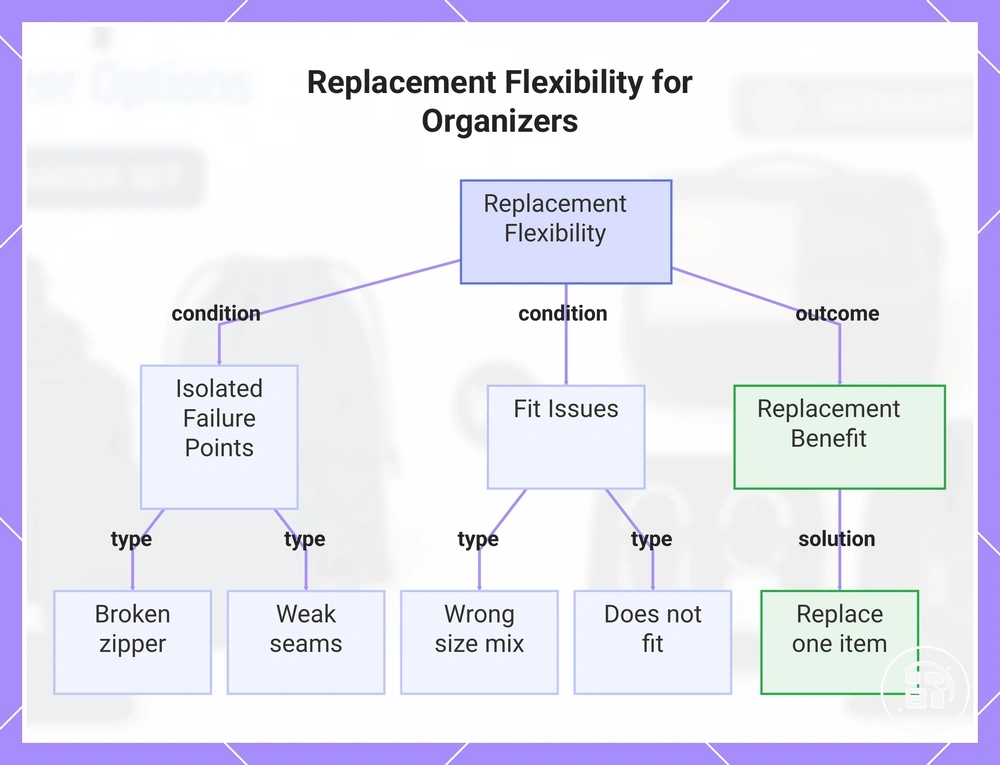
Replacement flexibility matters when one organizer fails or no longer fits the packing need. If an organizer fails because of a broken zipper, weak seams, or another failure point, the ability to replace one item instead of changing the entire setup can provide more long-term control. The same consideration applies when an organizer does not fit the current item mix.
When evaluating replacement flexibility, the following conditions can influence the long-term decision:
- Broken zipper: If a broken zipper affects only one organizer, replacing that single piece may be sufficient.
- Weak seams: If weak seams appear in one organizer, replacement flexibility can help preserve the rest of the setup.
- Wrong size mix: A wrong size mix may create a fit issue even when other organizers remain useful.
- Does not fit: If an organizer no longer fits the packing style or item mix, a separate piece can address the mismatch directly.
- Replace one item: If coverage needs change, replacing one item may be enough without rebuilding the whole setup.
Replacement flexibility may matter more than an initial bundle discount when size mismatches, fit issues, or isolated failure points are more likely to affect a single organizer than the entire arrangement.
This chart shows the key conditions where replacement flexibility allows replacing a single organizer without rebuilding the entire setup.
Luggage Fit and Trip Style Conditions That Change the Better Choice
Luggage fit and trip style can change the better choice because organizer effectiveness depends on available space, bag layout, trip length, and item mix. An organizer set may work better in some packing contexts, while separate pieces may work better in others depending on how those conditions interact.
For a carry-on, limited space may favor compact organizers when only a few categories need separation. For checked luggage, broader organizer set coverage may be easier to use when bag capacity is less restrictive. A compartment-heavy bag layout may favor separate pieces when organizer size and compartment layout need closer alignment. These conditions can change the organization outcome through layout implications.
For short trips, a smaller organizer selection may be enough when the item mix is simple. For long trips, family packing situations, or mixed clothing-toiletry-device loads, coverage needs may change because more categories require organization. The stronger choice depends on whether the packing context favors broader coverage or more targeted organization.
Luggage fit is a deciding condition for organizer choice, not a separate luggage-buying topic.
The decision matrix below connects common luggage and trip conditions to the set-versus-separate choice.
| Condition | Set may work better when | Separate pieces may work better when | Decision cue |
|---|---|---|---|
| Carry-on | Included organizers match limited space efficiently | Only a few targeted organizers are needed | Check luggage fit and available space |
| Checked luggage | Broader set coverage supports larger bag capacity | Specific categories need different organizer sizes | Compare coverage needs with bag capacity |
| Short trip | A simple organizer set covers most packed items | A small custom selection avoids excess pieces | Match organizer count to trip length |
| Long trip | Multiple organizer types support wider coverage | Specific categories require more fit precision | Evaluate item mix complexity |
| Family packing | Duplicate pouches or organizers help separate shared items | Different travelers need different organizer types | Consider category separation needs |
| Mixed items | Coverage spans clothing, toiletries, and devices | Individual categories need targeted organization | Assess the balance of the item mix |
Carry-on limits, checked luggage space, and bag layout
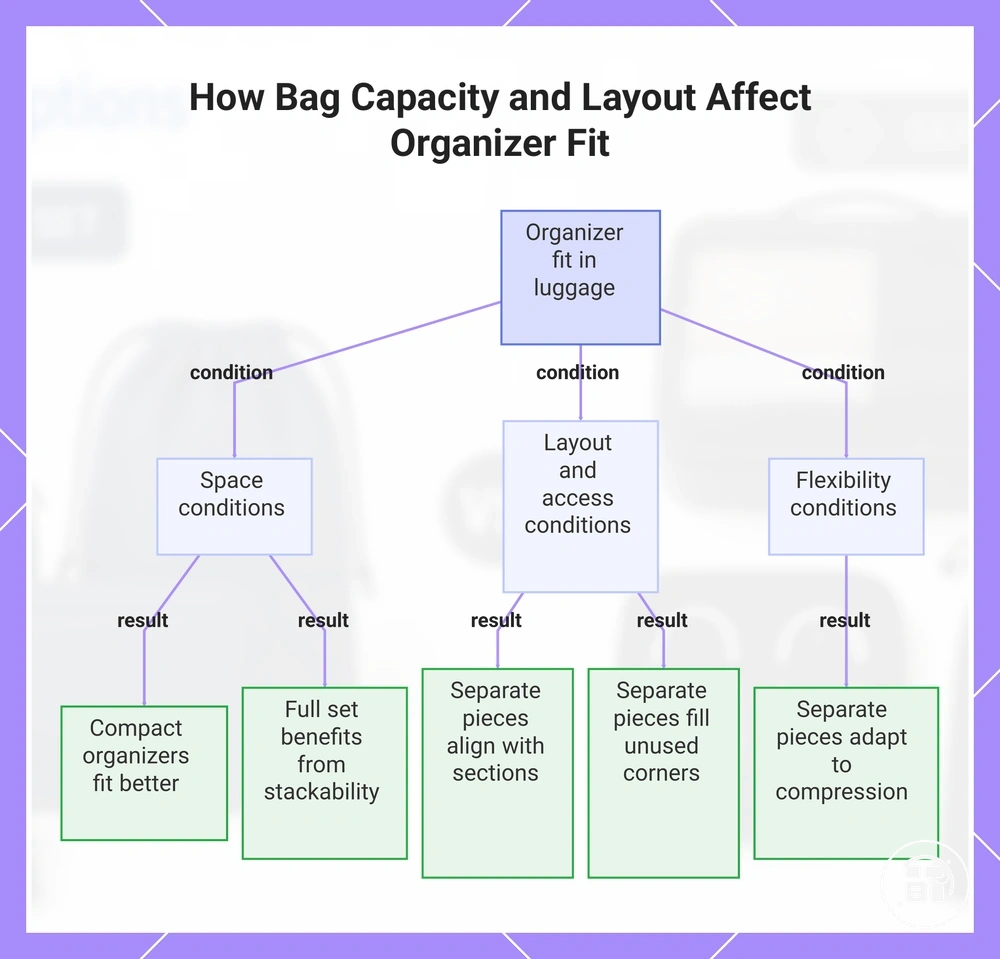
Bag capacity and layout determine whether an organizer set fits cleanly or whether separate pieces provide a better match. Carry-on limits, checked luggage space, and bag layout can change organizer usefulness based on organizer dimensions, stackability, compression tolerance, unused corners, and access points.
The local fit factors below can influence whether bundled or separate organizers work more effectively inside existing luggage.
- Carry-on limits: When packing space is limited, compact organizers with suitable organizer dimensions may fit more cleanly than a larger organizer set.
- Checked luggage space: When larger suitcase space is available, a full organizer set may benefit from greater stackability across the available layout.
- Bag layout: When a compartment layout includes multiple sections or access points, separate pieces may align more closely with those storage areas.
- Compression tolerance: When organizers need to adapt to changing packing space, separate pieces may provide more flexibility if different categories compress differently.
- Unused corners: When an organizer set leaves unused corners because of shape or size, separate pieces may help use available space more effectively.
Organizer fit depends on how organizer dimensions interact with bag capacity, access points, and compartment layout rather than on any universal compatibility assumption.
This chart shows the key bag-related conditions that determine whether bundled or separate organizers work best.
Short trips, long trips, family packing, and mixed item loads
Short trips, long trips, family packing, and mixed item loads can change organizer count and specialization because different trip types create different organization requirements. The same organizer set may feel excessive for a short trip and insufficient for a more complex packing context, as shown in the scenarios below.
- Short trips: When fewer items are packed, a separate pouch or minimal setup may provide enough organization, which can favor separate pieces.
- Long trips: When more categories need organization, a higher organizer count and broader specialization may be useful, which can favor an organizer set.
- Family packing: When family items require separation, duplicate cubes or pouches may help organize shared categories, which can favor an organizer set.
- Mixed item loads: When toiletries, devices, and small items need different storage roles, separate organizers may provide more targeted specialization, which can favor separate pieces.
- Toiletry- and device-heavy loads: When toiletries or devices occupy a larger share of the packing space, additional category-specific organizers may be more useful than extra general-purpose organizers, which can favor separate pieces.
Quality Signals to Check Before Choosing a Multi Piece Organizer Set
Quality signals determine whether a multi piece organizer set is usable beyond its piece count. A set that looks complete may provide limited practical value if organizer quality, construction quality, or coverage distribution do not support real packing needs. The main attributes to assess are size mix, fabric strength, zipper reliability, seams, visibility, compression behavior, and pouch specialization.
Weak construction quality or a poor size mix can reduce value even when a set includes many organizers. Repeated sizes may create coverage overlap, while missing sizes can limit usable distribution across item categories. Weak closures, inconsistent seams, or limited visibility may affect access and organization during use. These issues are easier to identify through clear inspection criteria before choosing a usable set.
When evaluating a multi piece organizer set, a traveler can focus on whether each organizer serves a distinct packing role rather than simply increasing piece count. A usable set often balances coverage, access, and specialization across common packing categories. The table below highlights practical decision signals and can complement a broader buying checklist.
| Quality signal | Acceptable condition | Packing effect | Risk if weak |
|---|---|---|---|
| Size mix | Usable distribution across different organizer sizes | Supports fit and coverage for multiple item categories | Coverage gaps or unnecessary duplication |
| Fabric strength | Material strength appropriate for repeated packing use | May support organizer durability over time | Higher risk of wear-related issues |
| Zipper reliability | Consistent closure operation and access | Supports usability and containment | Higher risk of closure-related failure |
| Seams | Consistent stitching and construction quality | May help maintain organizer structure | Higher risk of seam-related damage |
| Visibility | Contents remain easy to identify through design features such as mesh panels when present | Supports quick access and usability | Slower item identification |
| Compression behavior | Compression remains manageable for clothing organization | May improve capacity use with tradeoffs | Reduced packing flexibility |
| Pouch specialization | Different pouches support different item categories | Improves organization and packing effect | Overlapping functions and redundancy |
Size mix, material strength, zipper quality, and visibility
Size mix, material strength, zipper quality, and visibility control fit, durability, and access during daily use of a multi piece organizer set. These attributes can be evaluated through observable checks before choosing a set, and the attribute checks below connect each condition to its packing effect.
- Size mix | What to check: Check whether the set includes usable sizes for different item categories rather than repeated sizes with overlapping roles. Why it matters: A balanced size mix can improve fit, coverage, and packing effect while reducing coverage gaps.
- Material strength | What to check: Check fabric strength, seam consistency, and visible signs of construction quality during handling. Why it matters: Stronger material strength and seams may support durability and reduce wear-related concerns, improving packing effect.
- Zipper quality | What to check: Check whether the closure moves smoothly and aligns consistently during opening and closing. Why it matters: Better zipper quality can improve access and may reduce the risk of closure-related failure, improving packing effect.
- Visibility | What to check: Check whether mesh visibility or similar design features make contents easy to identify. Why it matters: Clear visibility supports quick identification, usability, and a smoother packing effect.
Standard cubes, compression pieces, and pouch-style organizers
Organizer format changes capacity, structure, and access, which directly affects how a set performs during daily packing use. Standard cubes, compression pieces, and pouch-style organizers differ in how they manage clothing, small items, and organization needs, including flat pouches, toiletry pouches, and soft accessory bags.
When clothing occupies most of the luggage space, compression pieces may help manage clothing capacity, but they may not provide the same separation for small items as pouch-style organizers. For example, if cables and toiletries need separate access, compression cubes may still need to be paired with travel pouches, as shown below.
The comparison below highlights how organizer formats differ within a set.
| Format | Strength | Limit | Better use case |
|---|---|---|---|
| Standard cubes | Provide structure and stackability for clothing organization | May offer less capacity reduction than compression pieces | Clothing categories that benefit from organized separation |
| Compression pieces | May help manage clothing capacity through compression | Can involve tradeoffs in access and packing flexibility | Clothing-focused packing when capacity management is important |
| Flat pouches | Provide flexible access for small items | Offer limited structure for bulkier contents | Cables, documents, or compact accessories |
| Toiletry pouches | Support separation and protection for liquids and personal care items | May be less suitable for mixed-item storage | Toiletries that benefit from dedicated organization |
| Soft accessory bags | Provide adaptable storage for small-item categories | May offer less structure than more rigid organizer formats | Accessories that need flexible access and organization |
When a Set Is Better and When Separate Pieces Are Better
A set is better when broad coverage, convenience, and coordinated organization are the main priorities, while separate pieces are better when custom fit, specific item categories, or quality preferences matter more. Neither option is the better choice in every situation because the decision depends on coverage, value, fit, and quality signals already evaluated.
When a traveler needs starter coverage across clothing, toiletries, and accessories, a starter set may provide a practical starting point. Family packing can also benefit when duplicate organizers help separate shared items. Broader packing needs often align with a bundled setup because multiple organizer types are already included. A set is better when that coverage is likely to be used rather than left unused.
When luggage space is tight or a traveler focuses on specific item categories, separate pieces are better because organizer selection can be more targeted. Individual pieces may also suit travelers with strong quality preferences for certain organizer formats or materials. To choose the right organizer setup, it helps to match organizer types to the actual item mix rather than selecting extra coverage that may not be needed. Separate pieces are better when control and custom fit are more important than bundled coverage.
When coverage gaps or changing packing needs create uncertainty, a mixed setup can provide a practical solution. A starter set can be supplemented later with individual pieces that address missing categories, size preferences, or access needs. The decision matrix below separates common conditions and can help identify the better choice without relying on an absolute rule.
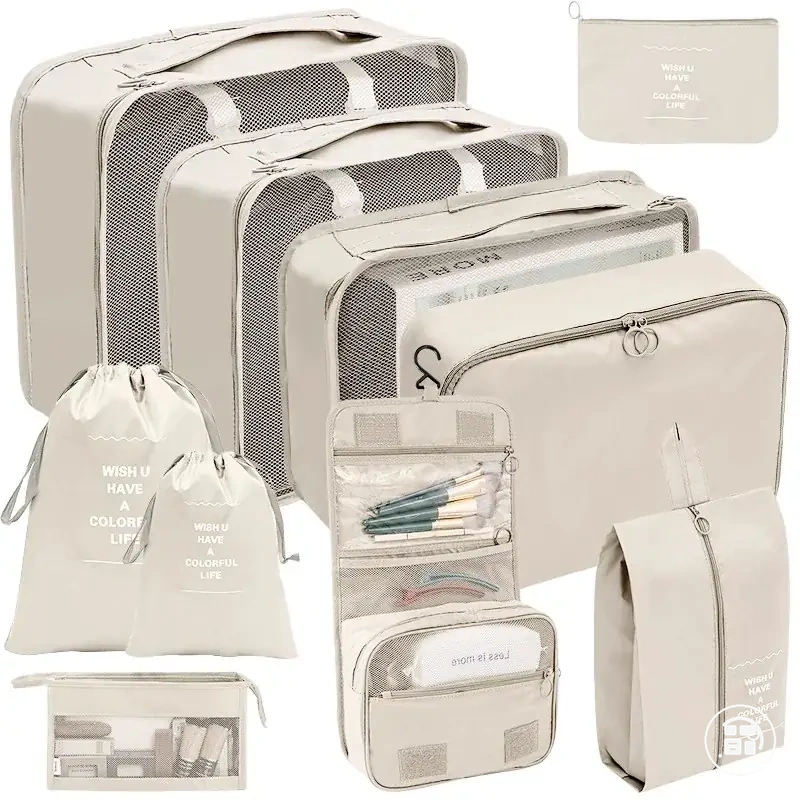
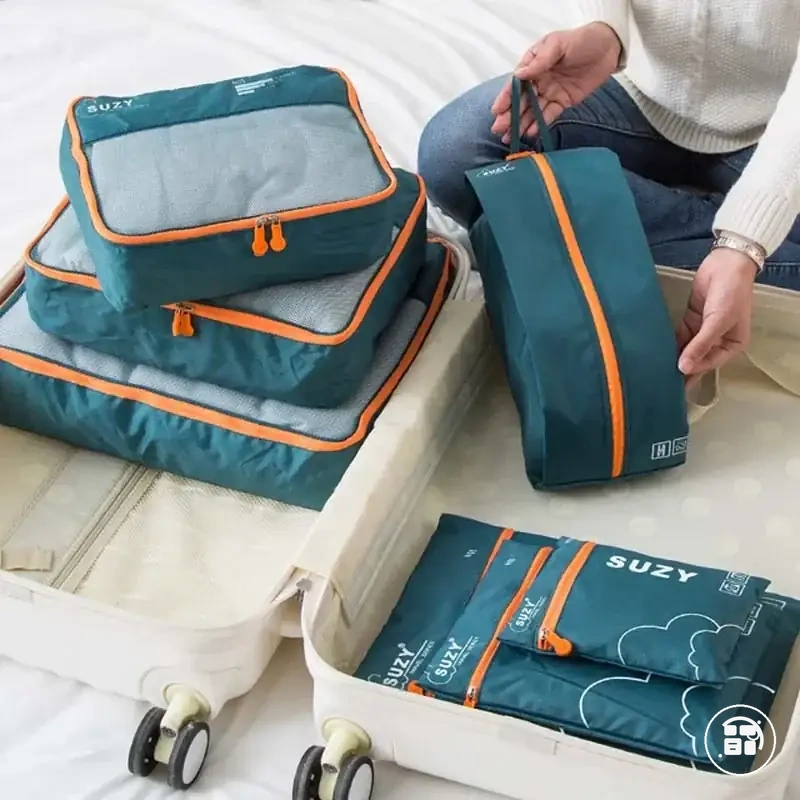
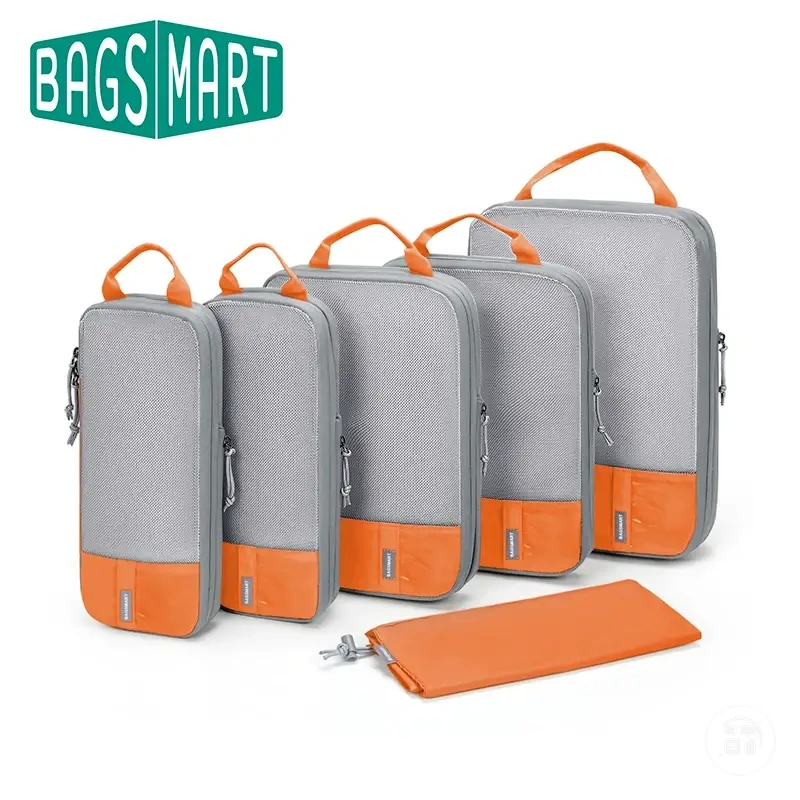
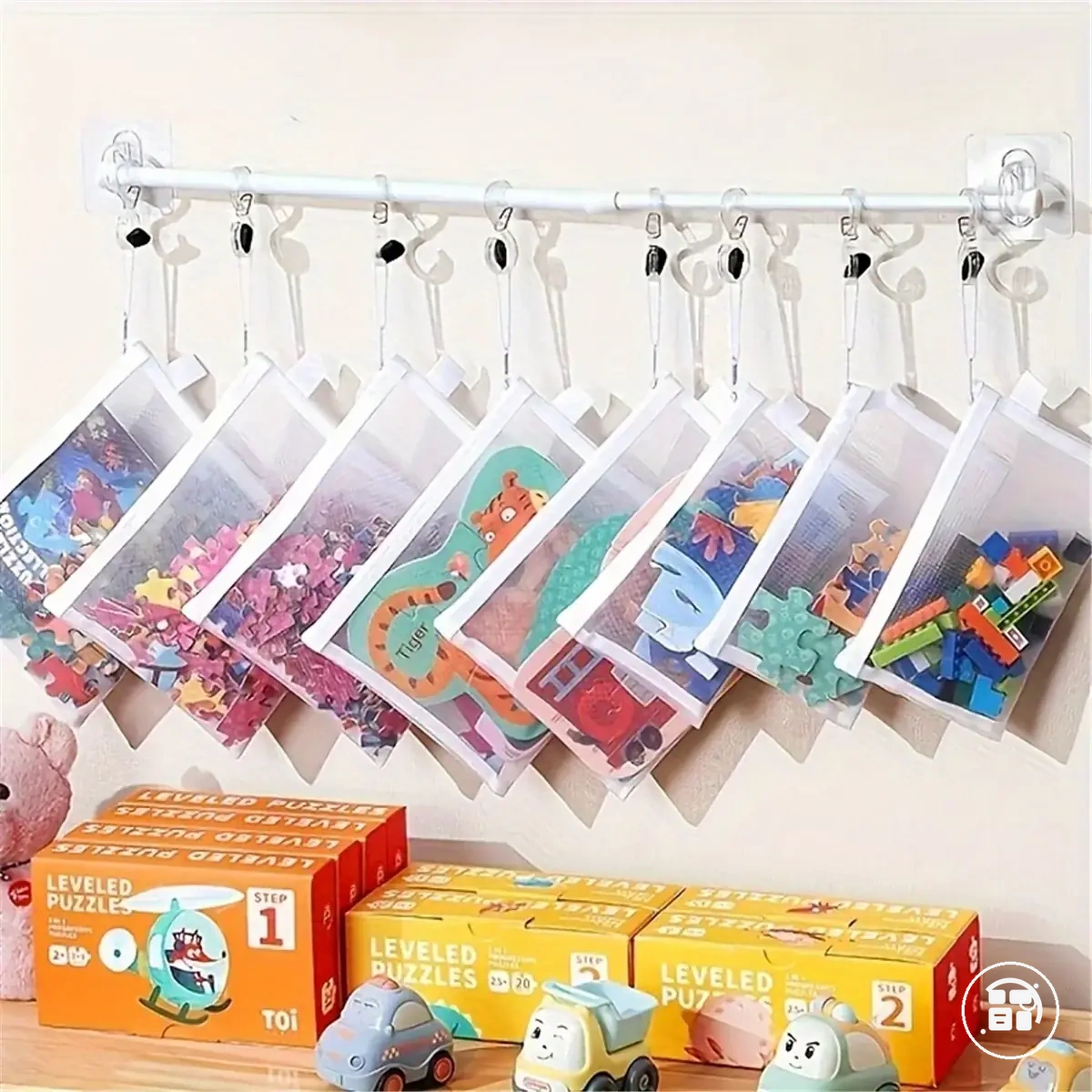
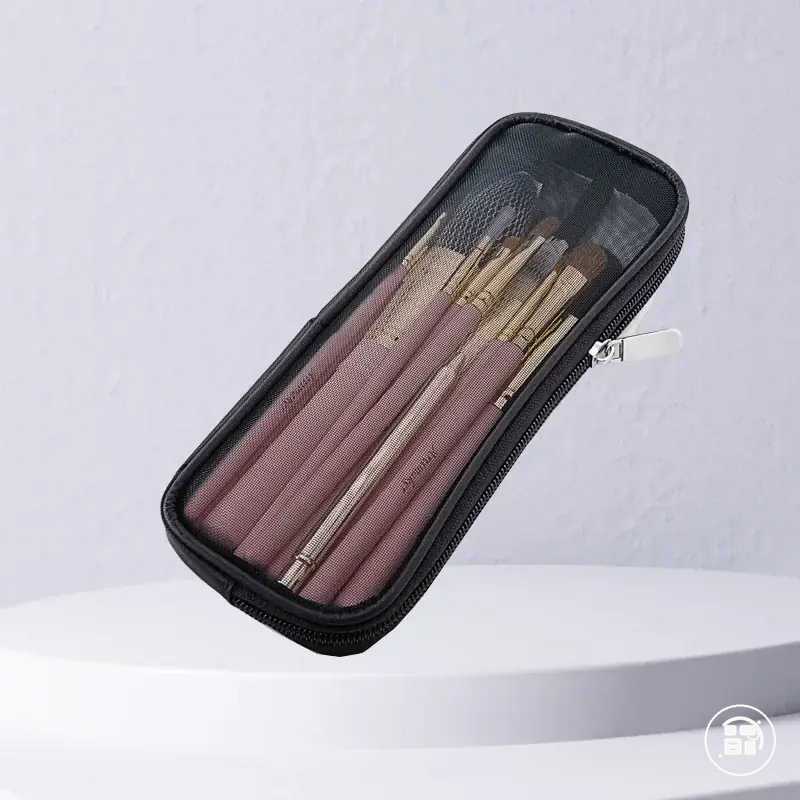
The products below are useful examples for comparing available options. Before buying, check that the compatibility criteria, key features, and product details match your needs.
| Packing situation | Choose a set when | Choose separate pieces when | Decision note |
|---|---|---|---|
| Starter coverage | Multiple organizer categories are needed from the start | Only a few organizer types are required | Coverage needs drive the selection |
| Tight luggage fit | Included sizes already match the available space | Specific sizes are needed for better fit | Fit depends on luggage layout |
| Family packing | Duplicate organizers support item separation | Different users need different organizer formats | Organization needs may vary by traveler |
| Specific item categories | Included organizers already match the categories | Category-specific organization is the priority | Targeted organization can reduce overlap |
| Quality preferences | Consistent organizer quality across the set is acceptable | Specific quality signals matter more | Quality evaluation may favor individual pieces |
| Mixed setup | A starter set provides the initial coverage | Additional pieces address specific gaps | Supplement later when needs change |