Cheap vs premium travel organization accessories: cost, durability, and value
Cheap and premium travel organization accessories differ by value under use conditions, not by price label alone. A lower-cost option can make sense for lighter use, while a higher-cost option may be easier to justify when durability, material quality, and zipper strength matter more. The decision frame should stay around cost-value, durability, and travel frequency.
For occasional trips, cheap travel organizers may provide enough basic separation if the packing stress is low and the belongings are not protection-sensitive. For frequent travel, heavier packing, repeated opening, or more cleaning, premium travel organizers can offer stronger construction signals such as reinforced seams, smoother closure, better washability, or a more stable lightweight organizer design. The useful comparison is between attributes and use cases, not between budget organizers and higher-end organizers as fixed quality labels.
Premium does not automatically mean better value, and cheap does not automatically mean poor value. A travel organizer set should be judged by organizer type, expected use, material quality, zipper strength, washability, and the compromise the user can accept. When the result depends on packing stress, moisture risk, cleaning ease, or replacement risk, the safer choice is the one that matches the real travel condition.
What usually changes between budget and premium travel organizers
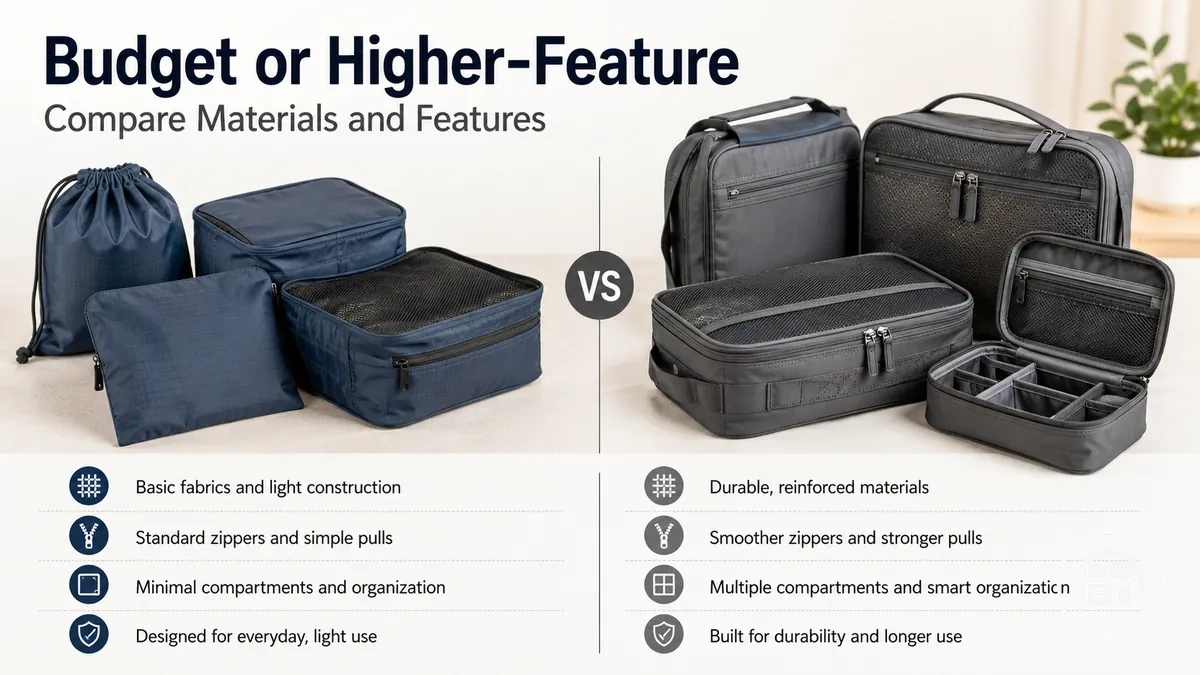
Budget travel organizers and premium travel organizers usually differ in fabric density, zipper build, seam strength, compartment layout, water resistance, washability, weight, finish quality, and set completeness. These differences are value signals, not fixed proof that one tier is better for every packing need.
Budget travel organizers are lower-cost value tiers that often focus on basic separation, lighter use, and simpler compartments. Premium travel organizers are higher-end value tiers that may add stronger seams, smoother zipper behavior, better finish quality, or more complete set design when repeated use creates more packing stress. For the broader category context, use the travel organization accessories overview as the boundary for this comparison.
Premium does not always mean better value unless the added attributes match the travel context. A lighter organizer may be enough when the goal is simple clothing separation, while a more structured organizer may make more sense when washability, water resistance, or repeated packing stress matters. What usually changes between budget and premium travel organizers is clearer when visible attributes are compared without making universal claims.
What usually changes between budget and premium travel organizers can be seen through material texture, zipper detail, and compartment structure. The comparison image should clarify visible attribute differences before the table organizes the same differences by value caution.
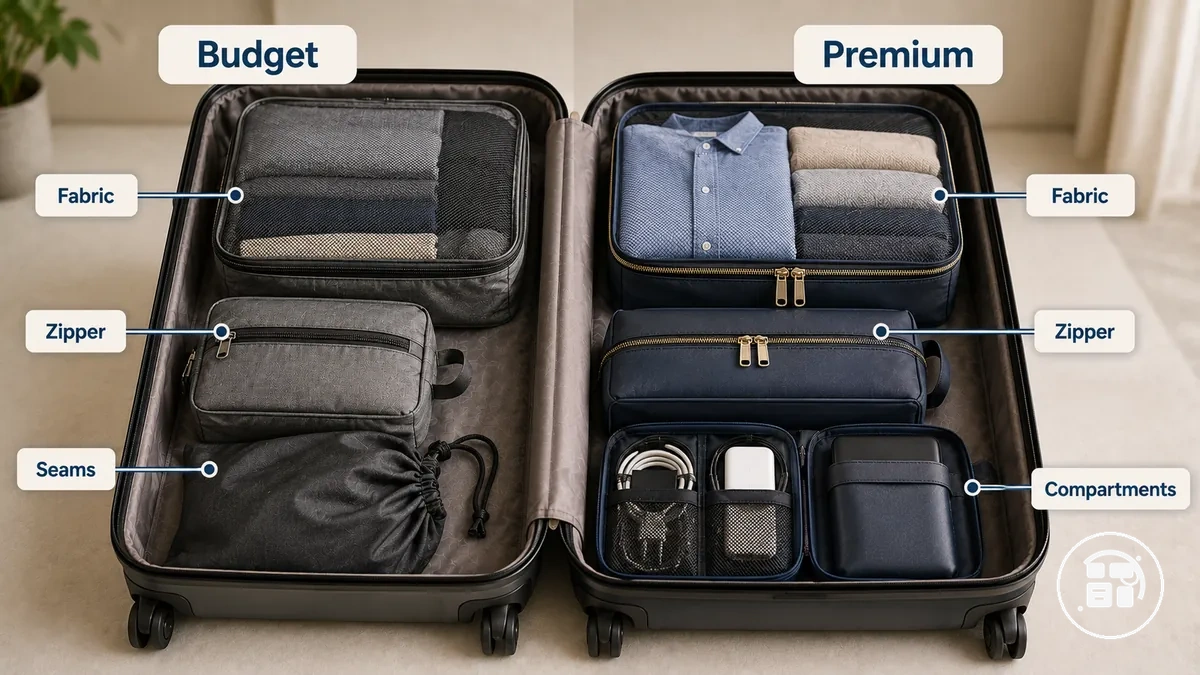
| Attribute | Budget organizer tendency | Premium organizer tendency | Value caution |
|---|---|---|---|
| Fabric | Thinner fabric may suit lighter use and basic separation. | Denser fabric may support repeated use or heavier packing. | Fabric density matters only when the organizer faces enough packing stress. |
| Zipper | A simpler zipper build may be acceptable for low-stress packing. | A smoother zipper build may help when the organizer is opened and compressed often. | Zipper strength should match use frequency, not price label. |
| Seams | Basic seams may be enough for light loads. | Stronger seams may add value under repeated packing pressure. | Seam strength is more relevant when the organizer is filled tightly. |
| Compartments | Simpler compartments may work for broad item separation. | More defined compartment layout may help with smaller items or mixed belongings. | Extra compartments add value only when the layout matches packing needs. |
| Water resistance | Basic material may offer limited moisture handling depending on construction. | Higher-end materials may add more water resistance for moisture-prone items. | Water resistance is a tradeoff, not a full protection promise. |
| Washability | Washability may be limited or depend on fabric and seams. | Washability may improve cleaning ease when the material supports it. | Cleaning value depends on item type, fabric, and travel use. |
| Weight | Lower weight may come from simpler or thinner materials. | Premium weight may vary depending on structure, padding, or fabric density. | A lighter organizer is not automatically better if durability is the main need. |
Price and value expectations for travel organizer sets
Price and value expectations for travel organizer sets should be judged against usable pieces and expected durability rather than the total cost of the set alone. A travel organizer set can offer stronger cost-value when the usable pieces, material grade, zipper reliability, protection level, and practical use match the travel need.
A large budget set may include more pieces, but extra pieces do not automatically increase value if only a portion of the set is used regularly. A smaller premium set may provide better value when stronger construction, more reliable zippers, or better material quality support repeated travel. Cost-value depends on how often the organizer bundle is used and whether the included pieces remain useful over time.
Judging a travel organizer set by piece count alone can make price expectation less accurate because set size and value are not the same thing. Checking whether the usable pieces solve a real packing need often provides a clearer signal than comparing quantity alone. The difference between sets and separate pieces can also change how value is perceived when only certain organizers are needed. Price and value expectations for travel organizer sets become easier to evaluate when usefulness is separated from raw cost.
Price and value expectations for travel organizer sets can be understood more clearly by comparing set size, usable pieces, and construction quality together. The image below highlights how value signals may differ even when one set contains more pieces than another.
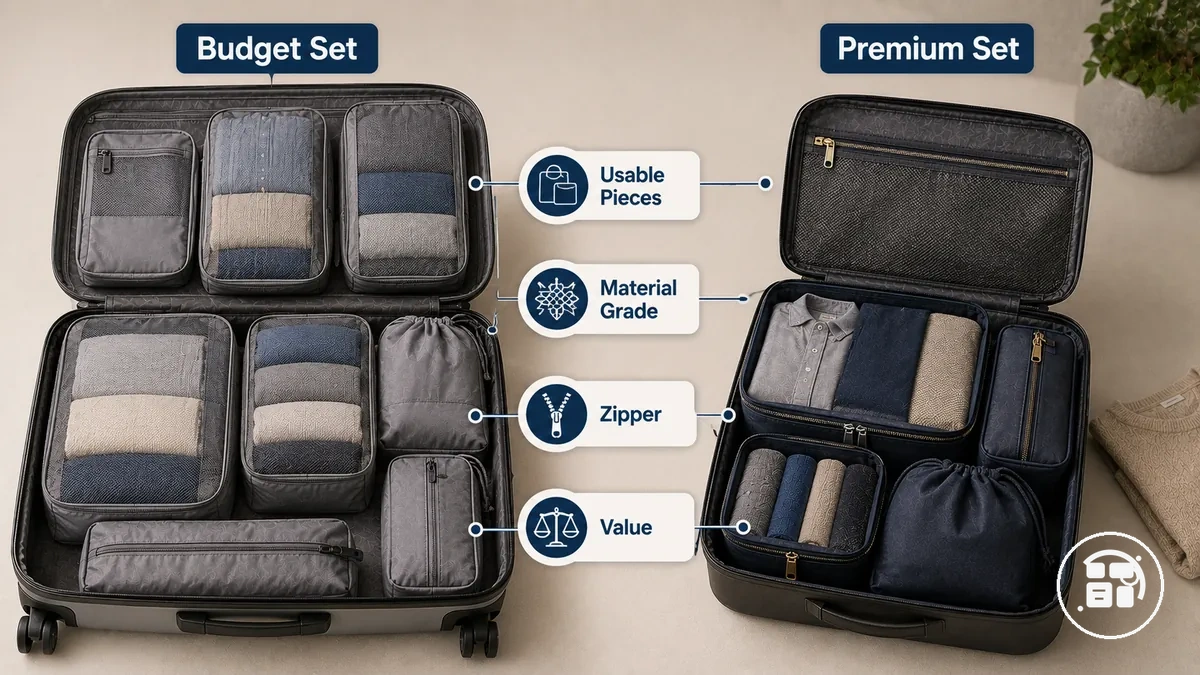
| Value factor | What to check | Why it affects value | Caution |
|---|---|---|---|
| Usable pieces | How many organizers are likely to be used regularly | Unused pieces add less practical value | More pieces do not always mean better value |
| Material grade | Fabric quality and overall construction | May influence expected durability | Higher-grade materials add value only when the use case requires them |
| Zipper reliability | Consistency and build quality of closures | Frequent use can place stress on zippers | Price alone does not confirm zipper quality |
| Protection | How well the organizer supports item separation and handling | Can improve packing organization in suitable situations | Protection level varies by organizer type and use |
| Practical use | Match between included pieces and packing needs | Need fit often drives long-term value | A larger set may offer less value if many pieces remain unused |
Durability signals that justify paying more
Durability signals justify paying more only when stronger construction may reduce likely wear during expected use. An organizer with better construction quality is not automatically a better value, but construction details can matter when repeated travel use creates more stress. The main physical signals are fabric thickness, stitching quality, zipper strength, seam reinforcement, and shape retention.
Weak construction often becomes noticeable when organizers are packed, compressed, and handled repeatedly. Thin fabric may be more vulnerable to tearing under stress, weak stitching may increase seam separation risk, and lower zipper strength may contribute to snagging or closure problems over time. Shape retention can also decline when luggage pressure leads to sagging during repeated use. These construction cues should be considered alongside other features that affect value before comparing cost. Durability signals that justify paying more are easier to evaluate when construction details are checked directly.
Durability signals that justify paying more can often be identified by inspecting visible construction details rather than relying on labels or price alone. The image below highlights the organizer components that may influence durability under repeated travel use and heavier packing conditions.
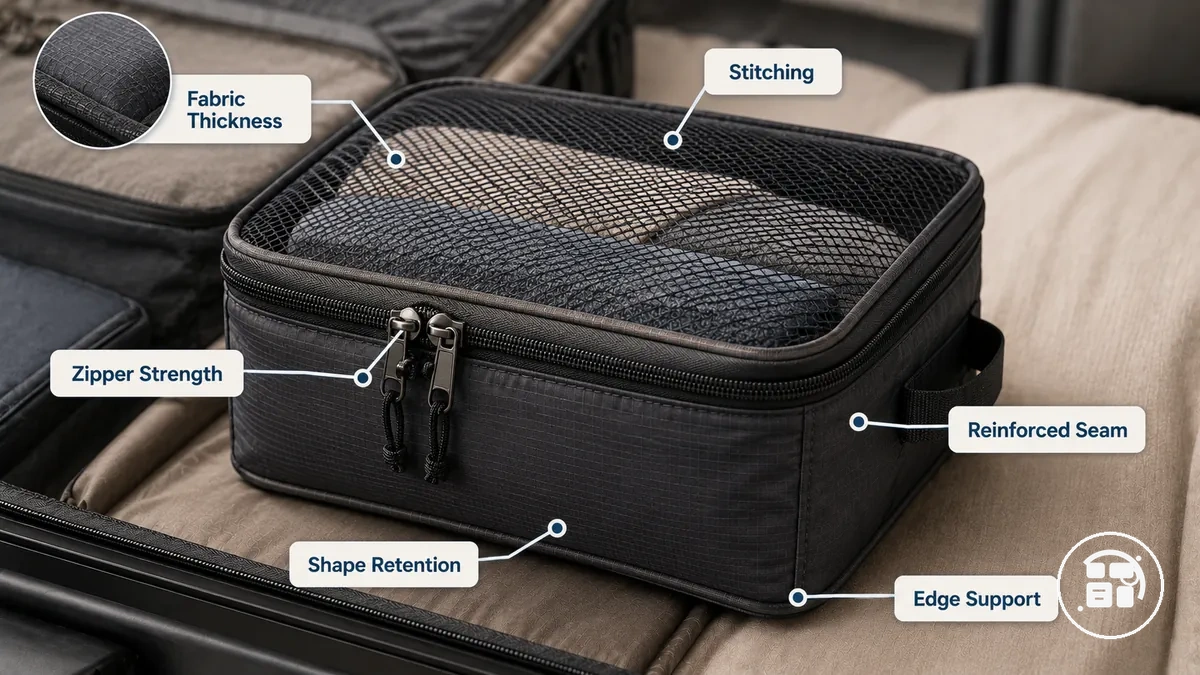
- Fabric thickness: Look for material strength and consistent texture; this may reduce tearing under repeated packing stress.
- Stitching quality: Check for even, secure stitching lines; this may reduce seam separation during use.
- Zipper strength: Inspect zipper construction and pull movement; this may reduce snagging and closure-related failure risk.
- Seam reinforcement: Look for reinforced seams at stress points; this may improve durability when the organizer is heavily packed.
- Shape retention: Check whether the organizer keeps its form under light compression; this may reduce sagging during travel.
- Edge construction: Inspect corners and reinforced edges; this may help limit wear in high-contact areas.
For frequent travel or heavier packing, stronger construction quality may lower replacement risk and support longer useful service. The value of a higher price depends on use frequency and whether these durability signals match the expected travel conditions.
Material strength, stitching, and shape retention
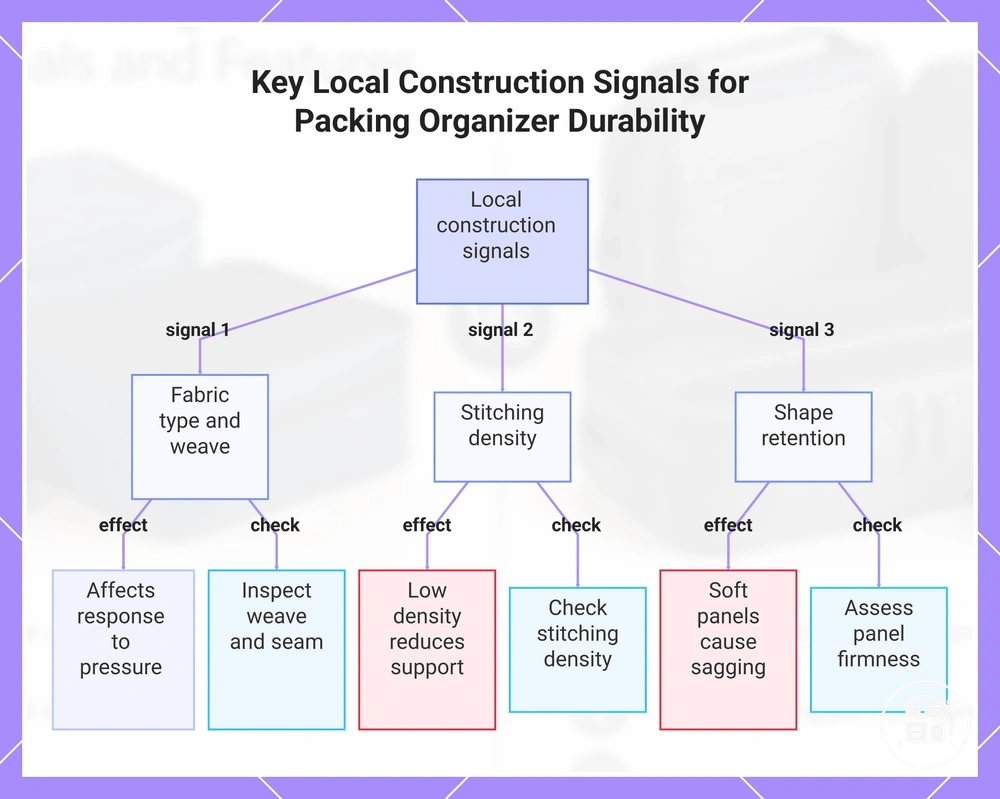
Material strength is the local construction basis for durability because fabric behavior under packing stress can influence how well an organizer maintains its structure. Fabric type and weave may affect how the organizer responds to luggage pressure and repeated handling. The key local signals are fabric type, stitching density, and shape retention.
Weak seams and soft panel structure can affect packing performance when an organizer is compressed inside luggage. A limited seam finish may concentrate stress at connection points, while lower stitching density may provide less structural support under repeated packing stress. Soft panels may also lose shape retention more easily, which can contribute to sagging under luggage pressure. A practical check is to inspect the weave, seam finish, stitching density, and panel firmness before relying on the organizer for repeated use.
When a clothing cube is packed tightly, panel structure and material strength can influence how well the cube keeps its shape. Better shape retention may help maintain packing performance during compression, although results can vary by fabric type, construction, and packing conditions.
This chart shows the three main local construction factors—fabric type, stitching density, and shape retention—along with their effects on packing performance and practical checks.
Zipper quality under repeated packing stress
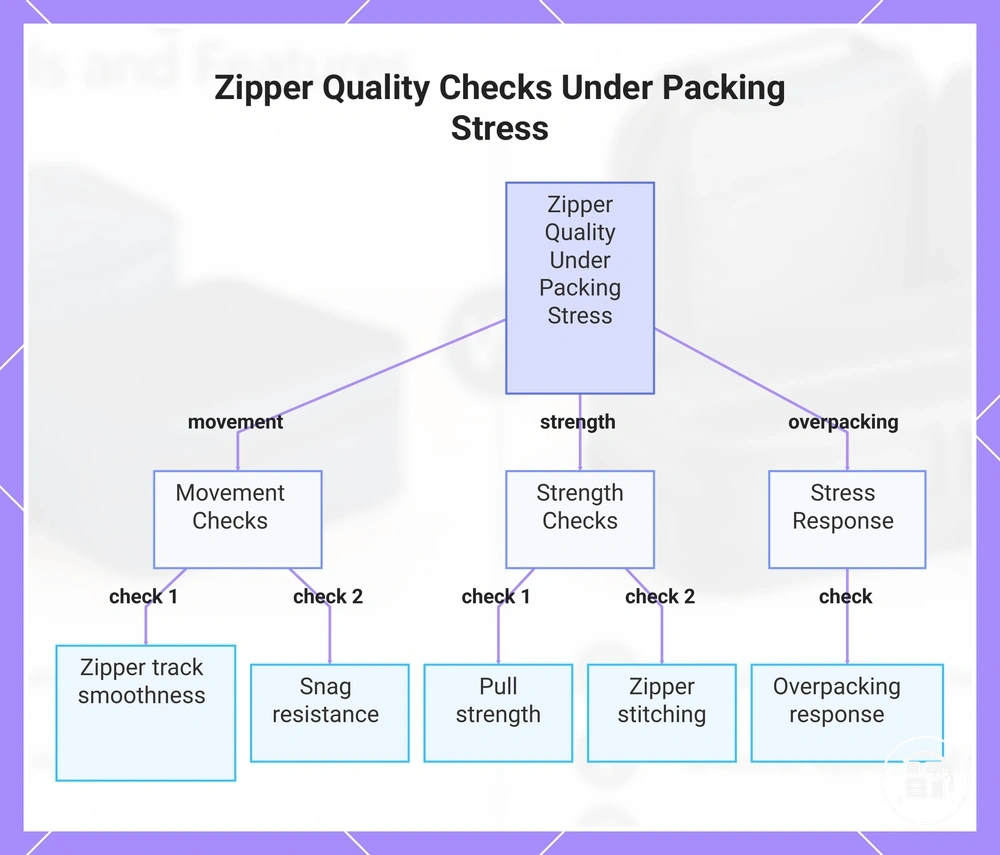
Zipper quality matters most when an organizer is repeatedly compressed, overfilled, opened, and closed during travel use. A zipper may experience higher stress under compression because the closure must manage pressure across the opening while maintaining smooth operation. The main zipper checks are zipper track smoothness, pull strength, zipper stitching, snag resistance, and failure risk under overpacking.
Repeated packing stress can expose weaknesses in zipper quality when the closure is forced through tight curves, compressed contents, or frequent opening cycles. A rough zipper track may increase snagging, a weak pull tab may provide less control during compression, and limited zipper stitching around the seam area may place more stress on a critical connection point. Failure risk may increase when overpacking and repeated compression occur together.
Zipper quality under repeated packing stress can be assessed by checking how the closure responds to common stress conditions. The checklist below organizes the main zipper stress signals.
- Zipper track: A smoother zipper track may improve snag resistance during repeated opening and support more reliable closure movement.
- Pull strength: Stronger pull strength may provide better control when compression or overpacking increases closure stress.
- Zipper stitching: Secure zipper stitching around the seam area may reduce stress concentration at a common wear point.
- Snag resistance: Better snag resistance may help the zipper move more smoothly when fabric edges approach the zip track.
- Overpacking response: When an organizer is overpacked, zipper reliability and closure strength may influence how the zipper handles added packing stress.
This chart organizes the main stress signals to check when assessing zipper quality under repeated packing stress.
Waterproof, washable, and lightweight features as value tradeoffs
Waterproof, washable, and lightweight features add value only when they match a specific travel risk or packing need. A feature that improves moisture protection, cleaning ease, or weight savings in one situation may provide less value in another. The main tradeoff involves balancing water resistance, washability, fabric breathability, and weight.
When wet toiletries or damp items are a concern, waterproof packing cubes or a water-resistant organizer may provide useful moisture protection. When cleaning frequency matters, a washable packing organizer or washable travel pouch may improve cleaning ease and reuse. When reducing luggage weight is the priority, a lightweight luggage organizer may offer weight savings, although lighter construction can depend on thinner materials. The most useful feature depends on the travel condition being addressed.
A common assumption is that every added protective feature increases value. In practice, each convenience feature involves a material tradeoff because water resistance, washability, fabric breathability, and lightness can influence one another depending on material and construction. Waterproof, washable, and lightweight features as value tradeoffs are easier to compare when each feature is matched to its intended use condition. The table below compares feature value by condition.
| Feature | Value condition | Tradeoff | When to prioritize |
|---|---|---|---|
| Water resistance | Moisture protection for wet items or spill-prone packing | May reduce fabric breathability depending on construction | When exposure to moisture is a realistic concern |
| Washability | Cleaning ease after repeated travel use | Material choice may influence breathability or structure | When frequent cleaning is expected |
| Light weight | Weight savings during travel | May depend on thinner materials or simpler construction | When reducing luggage weight is a priority |
| Breathability | Airflow around stored clothing or soft items | May offer less moisture protection than more water-resistant materials | When airflow matters more than moisture control |
When a budget travel organizer set gives enough value
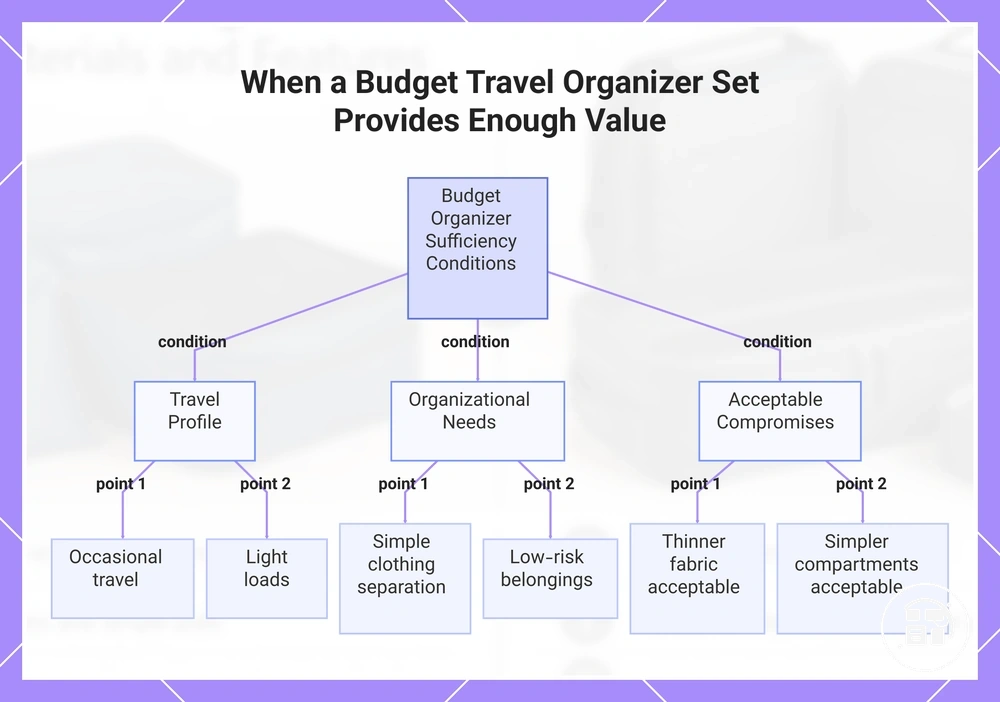
A budget travel organizer set can provide enough value when the travel use involves occasional travel, light loads, simple clothing separation, and low-risk belongings. A lower-cost organizer is often sufficient when the goal is basic packing cube use rather than frequent compression or heavy packing stress. The main selection condition is whether the organizer meets the practical travel need without requiring higher-end construction features.
For occasional trips, an entry-level organizer or basic packing set may perform adequately when clothing, accessories, and other low-risk belongings only need simple organization. Light loads usually place less stress on seams, zippers, and compartments than repeated heavy travel use. In these situations, thinner fabric or simpler compartments may be an acceptable compromise if organization remains the primary goal.
A budget set does not automatically create early failure risk, but acceptable compromises should be separated from conditions that place unusual stress on the organizer. Thinner fabric, simpler compartments, and basic packing cube use may remain reasonable under limited stress, while repeated overpacking or heavier loads may place greater demands on the organizer. When a budget travel organizer set gives enough value, the checklist below helps verify the most common enough-value conditions.
- The travel pattern involves occasional travel rather than frequent packing cycles.
- Light loads are expected, reducing stress on fabric, seams, and closures.
- Simple clothing separation is the main organizational need.
- Low-risk belongings are being stored instead of items that may need additional protection.
- Basic packing cube use is sufficient without requiring complex compartment layouts.
- Thinner fabric is an acceptable compromise for the intended travel conditions.
- Simpler compartments still support the required level of organization.
For broader selection criteria beyond basic sufficiency, see how to choose travel organizers.
This chart shows the key conditions under which a less expensive travel organizer still meets practical needs, based on travel pattern, organizational requirements, and acceptable quality compromises.
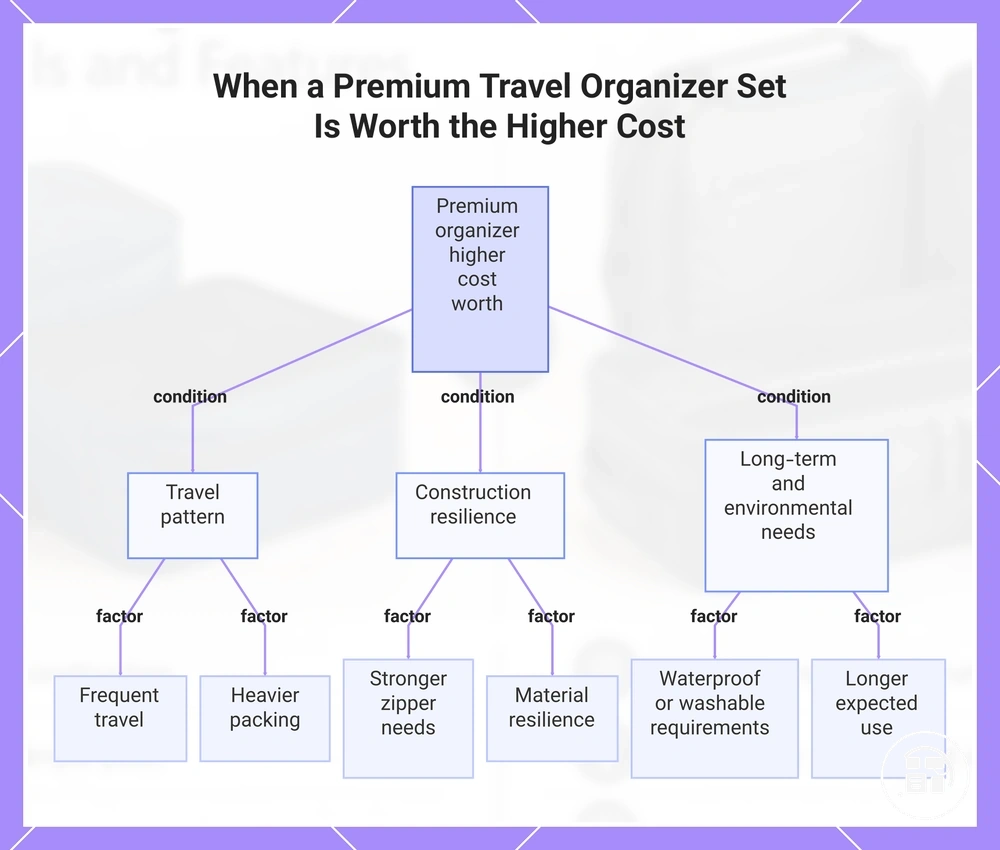
When a premium travel organizer set is worth the higher cost
A premium travel organizer set can be worth the higher cost when the travel pattern involves frequent travel, heavier packing, or stronger protection requirements. Higher cost may be justified when upgraded construction supports repeated use conditions that place greater stress on materials and closures. The key decision factors are repeated use and protection needs.
For travelers who pack often, carry heavier loads, or clean organizers more regularly, stronger zipper needs and material resilience may become more relevant than basic organization alone. Waterproof requirements or washable requirements can also matter when belongings face moisture exposure or repeated cleaning cycles. Protective compartments may add value when stored items need more separation or structure during travel. The main value condition is whether the organizer is expected to handle recurring travel stress over a longer period of use.
A higher-end set does not automatically provide better value, but upgraded construction may reduce packing friction or lower replacement frequency when travel demands are higher. Stronger materials and protective features justify the higher cost only when they address a real travel condition. When a premium travel organizer set is worth the higher cost, the signals below organize the conditions where premium features may matter more.
- Frequent travel may increase the value of upgraded construction by exposing the organizer to more repeated use.
- Heavier packing may justify stronger zipper needs because closures can face greater stress during compression.
- Higher material resilience may support more consistent use when organizers are packed and handled often.
- Waterproof requirements may add value when moisture protection is an important travel concern.
- Washable requirements may justify a stronger organizer when repeated cleaning is expected.
- Protective compartments may help reduce damage risk by improving separation and organization of belongings.
- Longer expected use may make replacement frequency a more important part of the value decision.
This chart shows the key conditions that justify paying a higher cost for a premium travel organizer set.
Cost-value differences by organizer type
Cost-value differences by organizer type depend on which feature attributes affect the organizer's actual travel function. Premium features may matter more in some organizer categories than others because value conditions change with packing stress, protection needs, and access requirements. The comparison below focuses on packing cubes, clothing organizers, toiletry organizers, tech organizers, and document organizers.
Clothing organizers and packing cubes often face compression and zipper load, while toiletry organizers may place more importance on water resistance and cleanability. Tech organizers can depend more on compartment security and protection, whereas document organizers may prioritize secure closure and easy access during travel. Because each organizer type serves a different function, the cost-value judgment changes by organizer category, feature attribute, value condition, and buying implication. Cost-value differences by organizer type are easier to evaluate when value is compared through organizer function rather than price alone.
The table below compares how premium value may shift across organizer types based on common travel conditions.
| Organizer type | Attribute that changes value | Budget may be enough when | Premium may be worth it when |
|---|---|---|---|
| Packing cubes | Compression handling and zipper load | Light packing and basic organization are the main goals | Frequent compression or repeated packing stress is expected |
| Clothing organizers | Material resilience and compartment structure | Simple clothing separation is sufficient | Repeated use or heavier packing may place more stress on the organizer |
| Toiletry organizers | Water resistance and cleanability | Moisture exposure is limited and cleaning needs are minimal | Leak risk, moisture protection, or frequent cleaning are important concerns |
| Tech organizers | Padding, compartment security, and protection | Stored items are low-risk and require basic organization | Protection and secure separation are more important during travel |
| Document organizers | Secure closure and easy access | Documents only need simple storage and retrieval | Travel use requires more secure organization and repeated access |
Packing cubes and clothing organizers
Packing cubes and clothing organizers usually need premium features only when clothing volume creates cube compression stress, zipper load, or repeated shape-retention demands. A lower-cost option may be enough for light clothing separation when mesh visibility, lightweight fabric, and basic organization are the main needs. The key stress condition is whether clothing is loosely separated or tightly compressed.
For simple clothing organization, budget travel cubes may provide enough value when the organizer is not overfilled and washable use is occasional. Premium packing cubes may be more useful when fabric strength, shape retention, and zipper support matter under repeated packing or compression. Mesh visibility can improve convenience in either tier, but stronger materials matter more when clothing volume creates pressure on seams and closures. Local value depends on whether the cube is used for light separation or compression-heavy packing.
Toiletry, tech, and document organizers
Toiletry organizers, tech organizers, and document organizers are more likely to justify premium value when protection or access matters more than simple separation. These organizer types often hold higher-risk belongings, so leak resistance, padding, compartment security, zipper reliability, cleanability, and easy access can change the cost-value decision. The main local risks are moisture exposure for toiletries, impact or cable disorder for tech, and closure or access needs for documents.
When a toiletry pouch may carry wet or spill-prone items, cleanability and leak resistance can matter more than extra pockets alone. When an electronics organizer or cable organizer holds small devices, padding and compartment security may support better protection under travel movement. When a document pouch is used during transit, zipper reliability and easy access may matter because closure quality affects how confidently documents are stored and retrieved. Premium value is more likely when the organizer protects higher-risk belongings, but the value still depends on material, closure quality, and actual travel need.
Toiletry, tech, and document organizers should be compared by the protection and access criteria each one must handle. The block below organizes simple separation against protection-sensitive storage.
| Organizer type | Main risk | Value attribute | Premium worth condition |
|---|---|---|---|
| Toiletry organizers | Moisture risk or messy contents | Leak resistance and cleanability | Premium may be worth it when wet items or frequent cleaning make material quality more important. |
| Tech organizers | Impact, cable tangling, or loose accessories | Padding and compartment security | Premium may be worth it when protection and organized access matter more than basic storage. |
| Document organizers | Loose papers, weak closure, or slow access | Zipper reliability and easy access | Premium may be worth it when travel use requires secure closure and repeated retrieval. |
How travel frequency changes the cheap vs premium decision
Travel frequency changes the cheap vs premium decision by changing organizer wear, replacement risk, and the importance of reliability. A budget organizer may be sufficient when travel use is light, while premium value may increase when repeated use adds packing stress. The main criterion is how often the organizer faces compression, handling, zipper movement, and cleaning.
For occasional trips, light packing usually creates lower stress, so a budget organizer may fit when basic separation is the main goal. For seasonal trips, the decision depends on whether the organizer is stored most of the time or used across several packing cycles. For frequent trips, repeated zipper stress, cleaning cycles, and heavier handling can make reliability more important. Heavy luggage use raises the value of stronger construction when packing stress is likely to repeat.
The replacement-cost tradeoff should be judged without exact lifespan promises because organizer wear depends on material, use frequency, packing weight, and handling. A lower-cost option may lose value if replacement risk becomes likely under repeated use, while a premium option may fit better when reliability reduces packing friction. How travel frequency changes the cheap vs premium decision is clearer when the table compares frequency and packing stress.
| Travel pattern | Stress level | Budget may fit when | Premium may fit when |
|---|---|---|---|
| Occasional trips | Lower stress from limited use | Light packing and simple separation are enough | Protection or stronger closures are still needed for specific belongings |
| Seasonal trips | Moderate stress depending on packing habits | The organizer is used only a few times and not overfilled | Repeated packing, washing, or compression happens during each trip cycle |
| Frequent trips | Higher stress from repeated use | Loads remain light and replacement risk is acceptable | Reliability, repeated zipper stress, and cleaning cycles matter more |
| Heavy packing | High stress from compression and heavy luggage use | The organizer only separates low-risk soft items | Stronger construction may reduce packing friction and replacement risk |
Occasional trips and light packing needs
Occasional trips and light packing needs can keep budget organizers within a safe value range when low packing stress is expected. Budget organizers may be sufficient when the organizer is used for simple clothing separation, light travel, and limited handling rather than repeated compression. The main boundary condition is whether the contents create limited zipper strain and do not require premium waterproofing or reinforced construction.
For short trips with soft clothing, a basic organizer can fit the need when simple clothing separation is the primary goal and low-stress packing is expected. Limited zipper strain usually places fewer demands on closures and seams than repeated heavy packing, so a simple organizer may remain a practical option. The value judgment can change when fragile belongings, wet items, or high-value belongings need added protection that may justify premium waterproofing or reinforced construction.
Frequent travel and heavier luggage use
Frequent travel and heavier luggage use can increase the value of stronger travel organization accessories because the same stress conditions occur repeatedly over time. A stronger organizer may become more useful when repeated compression, heavier loads, and frequent handling place greater demands on materials and closures. The main stress signals are repeated compression, cleaning cycles, zipper strain, seam failure risk, and fabric failure risk.
When a stronger organizer is exposed to frequent use, compression and heavier loads can create more pressure on seams, fabric panels, and zipper paths. Repeated cleaning cycles may also increase the importance of material resilience, while zipper strain can rise when organizers are packed tightly or opened frequently. These conditions do not guarantee seam failure or fabric failure, but they can influence the value outcome when stress repeats. Frequent travel and heavier luggage use are easier to evaluate when the checklist verifies repeated stress conditions.
- Frequent travel with repeated compression may increase stress on fabric structure, which can make a stronger organizer more valuable.
- Heavier loads can place more pressure on seams, so seam failure risk may become a more important decision factor.
- Repeated cleaning cycles may increase the importance of material resilience when a washable organizer is used often.
- Higher zipper strain from frequent opening, closing, or tight packing may increase the value of stronger closure construction.
- Heavy packing combined with repeated use can raise overall stress conditions, which may shift the value outcome toward more durable organizer construction.
Poor-value signals in cheap travel organizers
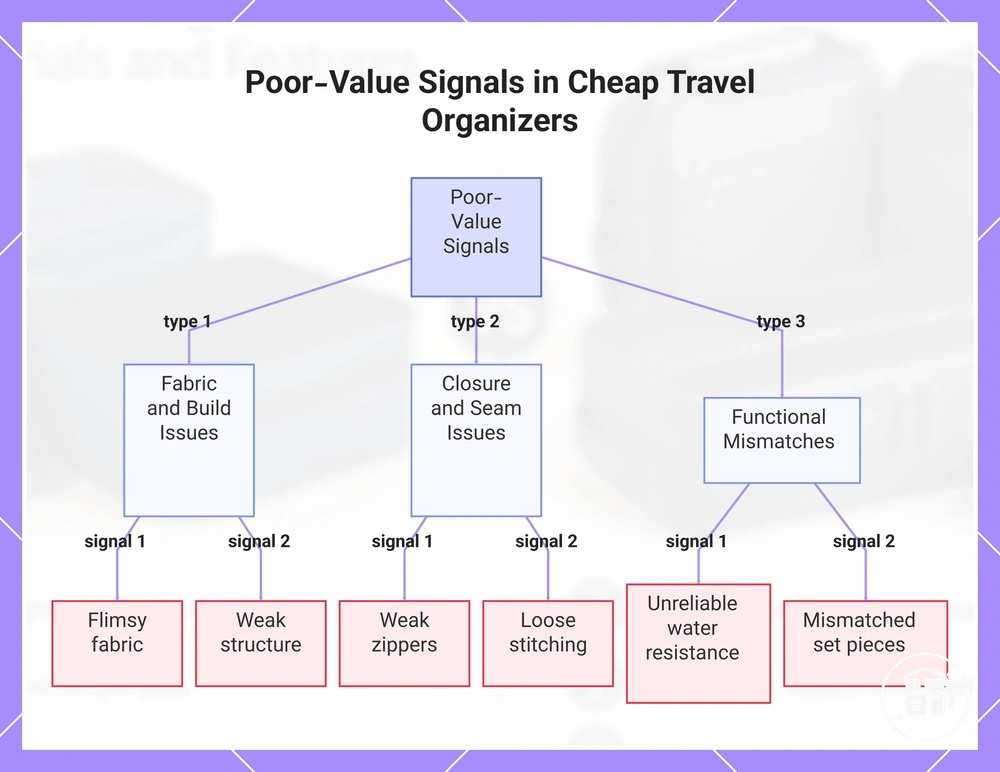
Poor-value signals in cheap travel organizers matter when an attractive price is outweighed by likely performance limits or poor fit for the intended use. Cheap travel organizers can still provide value, but observable red flags should carry more weight than price alone. The key decision frame is identifying poor-value signals before purchase.
Weak zippers, loose stitching, and flimsy fabric can reduce practical value when an organizer faces repeated handling or packing stress. These signs may increase failure risk by affecting closure reliability, seam stability, or overall structure. Poor seam finishing can create similar concerns because stress may concentrate at connection points. Poor-value signals in cheap travel organizers are easier to evaluate when organized into a simple checklist.
- Weak zippers: May affect closure reliability during repeated opening, closing, or packing.
- Loose stitching: May reduce seam stability and increase stress at connection points.
- Flimsy fabric: May provide less support when the organizer is packed or compressed.
- Poor seam finishing: May affect how well the organizer handles repeated use.
- Unreliable water resistance claims: May create a mismatch between expected and actual moisture protection.
- Difficult cleaning: May reduce convenience when regular cleaning is needed.
- Weak structure: May limit shape retention and organization efficiency.
- Mismatched set pieces: May reduce practical value when sizes or functions do not fit the intended packing setup.
When a set includes mismatched set pieces, the organizer may provide less useful storage even if the price appears attractive. Difficult cleaning can become more noticeable during repeated travel use, while water resistance claims may require closer inspection when moisture protection is important. These concerns do not automatically make a budget organizer a low-value organizer, but they can justify additional caution when the intended use depends on those attributes.
A common myth is that every low-cost organizer represents poor value. The more useful approach is to judge cheap travel organizers by observable red flags, fit for purpose, and expected use conditions rather than price alone. A final buying checklist can help confirm whether these failure signals outweigh the attractive price.
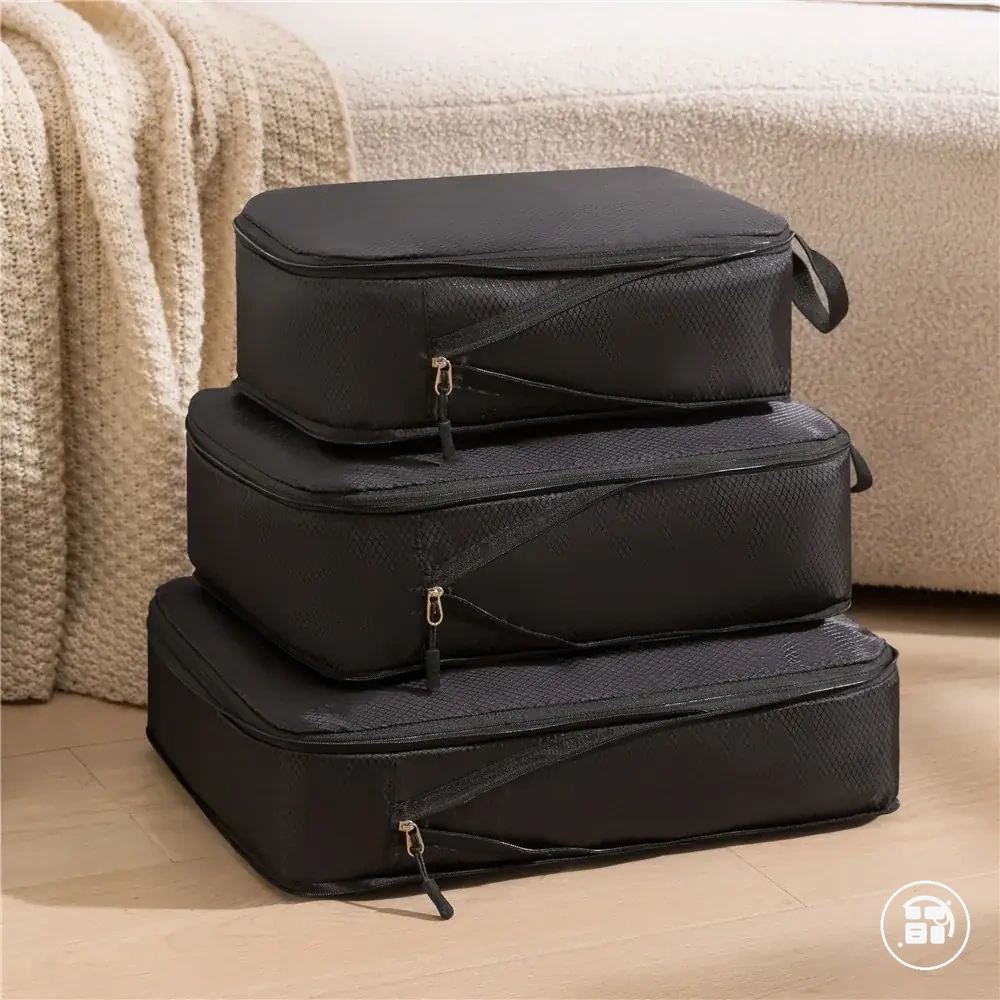
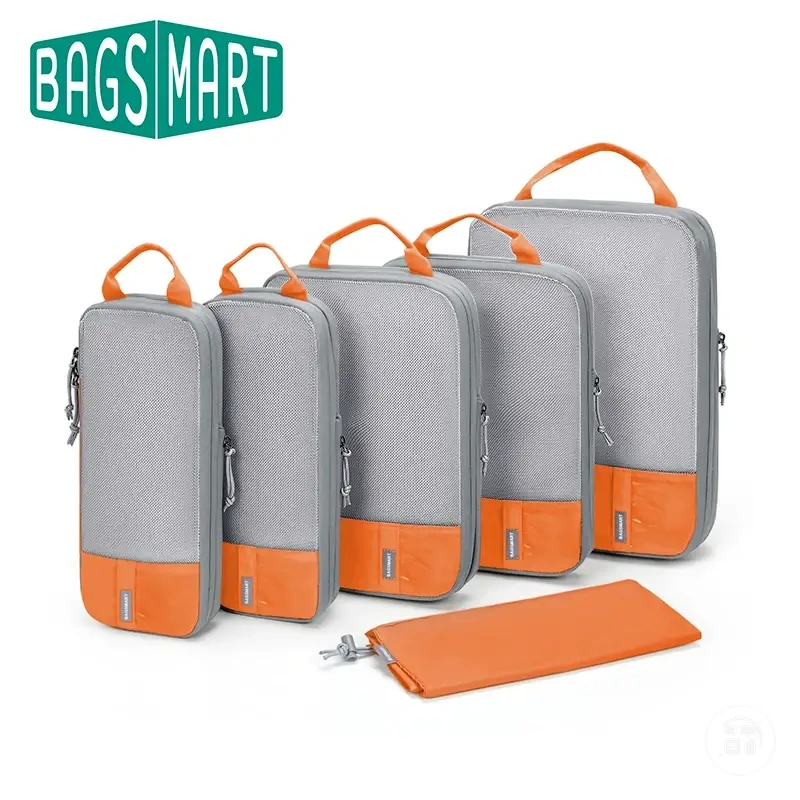
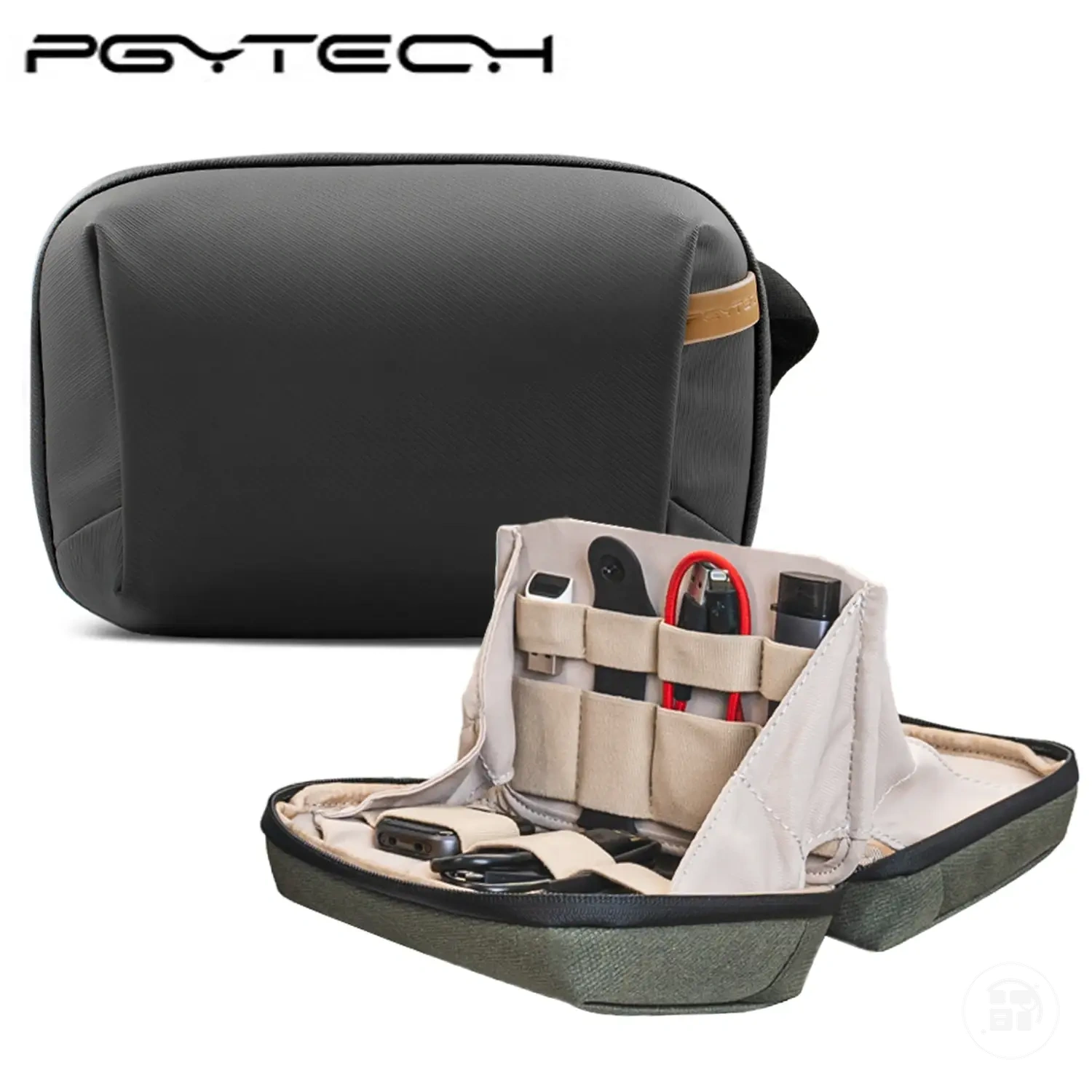
Here are product examples that may make comparison easier. Before buying, always review the compatibility criteria, essential features, and product details.
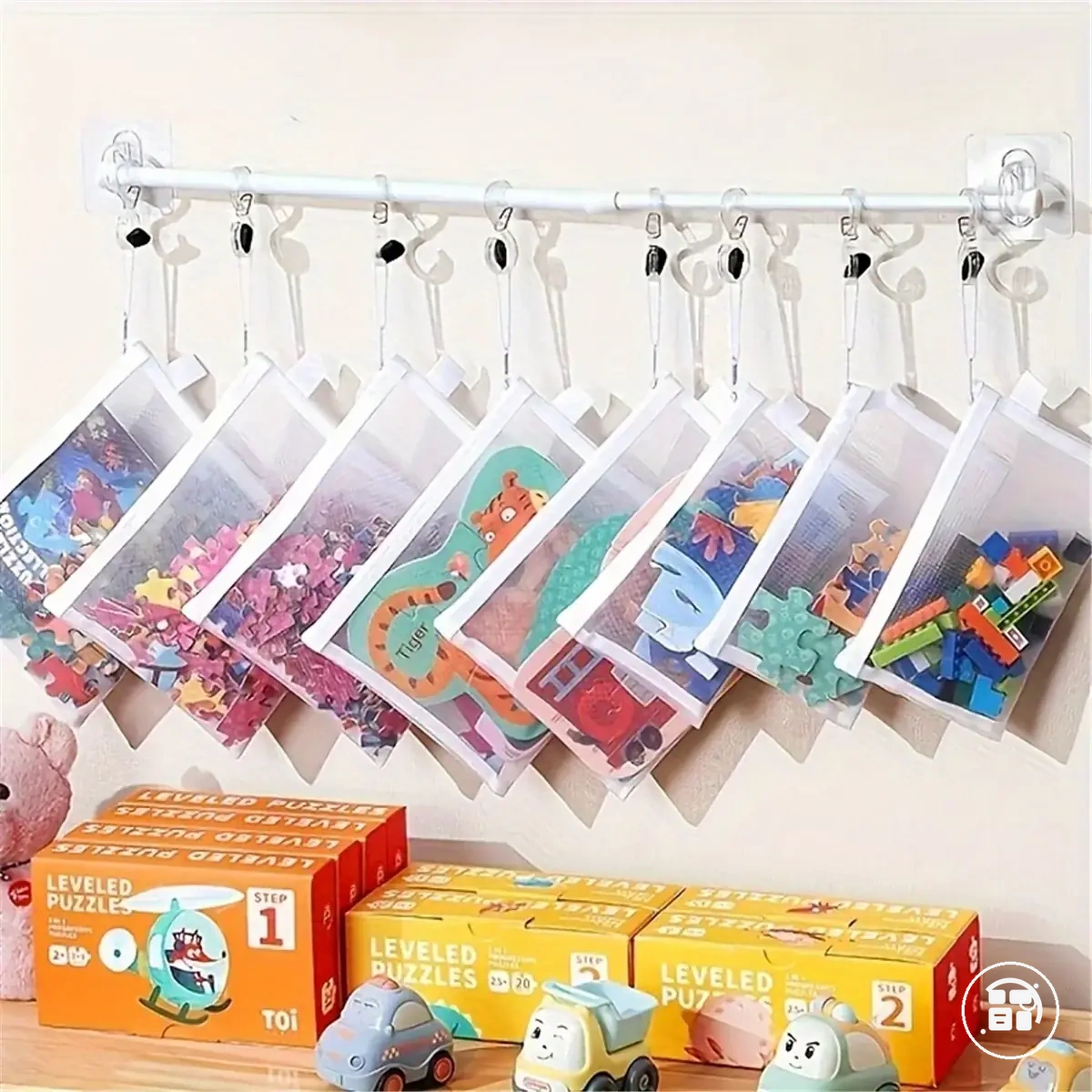
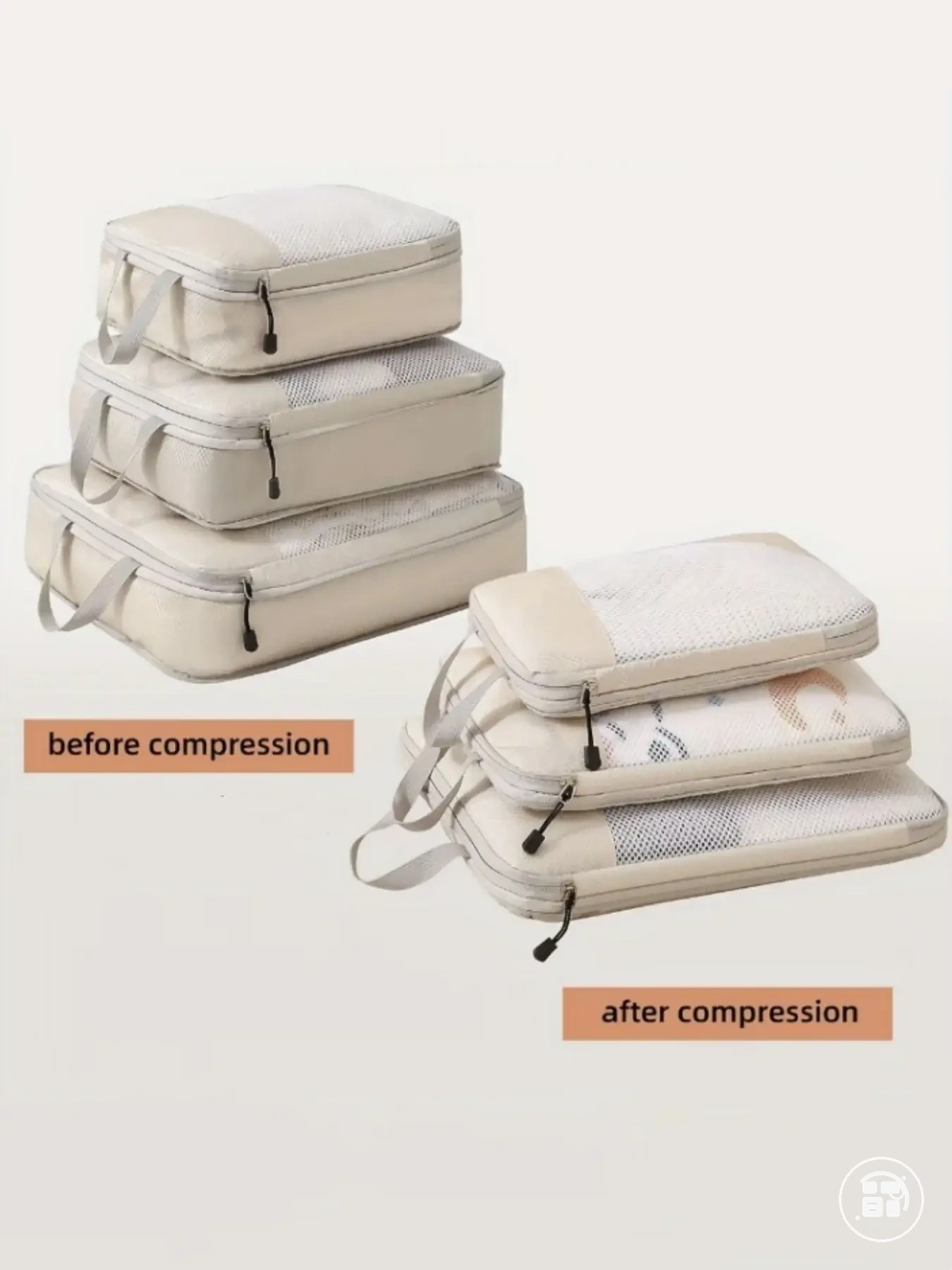
This chart groups common poor-value signals in cheap travel organizers into three categories, helping you identify red flags before purchase.