
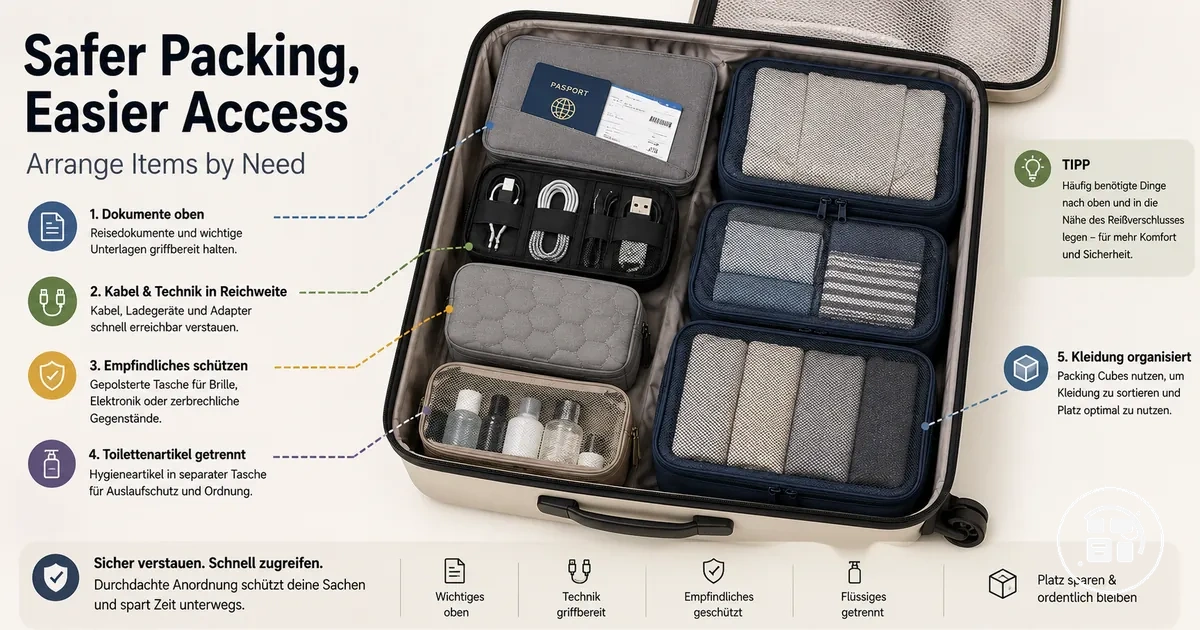
Travel Organization Accessories for Safer, More Accessible Packing
Travel organization accessories are packing accessories that separate, protect, and position belongings so travel items are easier to control inside luggage. They support safer packing and easier access by keeping documents, electronics, toiletries, liquids, and small items from mixing in ways that may increase damage, loss, spills, or delayed access. Organizing for neatness only makes a bag look orderly; organizing for protection and access also considers padding, closure, material, and luggage placement. Protection and access are the main frame for this page.
Loose items can shift, hide, press against fragile items, or leak into the wrong part of a bag. A document organizer may improve passport access and reduce loss risk when it stays visible and reachable. A pouch with a secure closure may help contain liquids when bottle caps or creams create spill risk. An organizer with padding may reduce pressure risk for electronics when placement inside the bag supports that protection. These outcomes still depend on organizer features such as padding, closure quality, material, and placement.
During airport checks, hotel transfers, train rides, or daily movement, safer packing often depends on which items must stay reachable and which items need deeper protection. Documents and cards may need faster access, electronics may need cushioning and separation, and toiletries may need containment away from clothing or devices. Travel pouches, protective organizers, and other organizer features can help when they match the travel stage and the condition of the items being packed. The next section grounds this safety-and-access frame by defining what protection and access mean in travel organization accessories.
What Protection and Access Mean in Travel Organization Accessories
Protection and access in travel organization accessories is the combination of reducing common packing risks while keeping important items easier to find and reach. Protection relates to limiting damage risk through organizer features such as padding, closure, and placement. Access refers to visibility, reachability, and access speed during different travel situations.
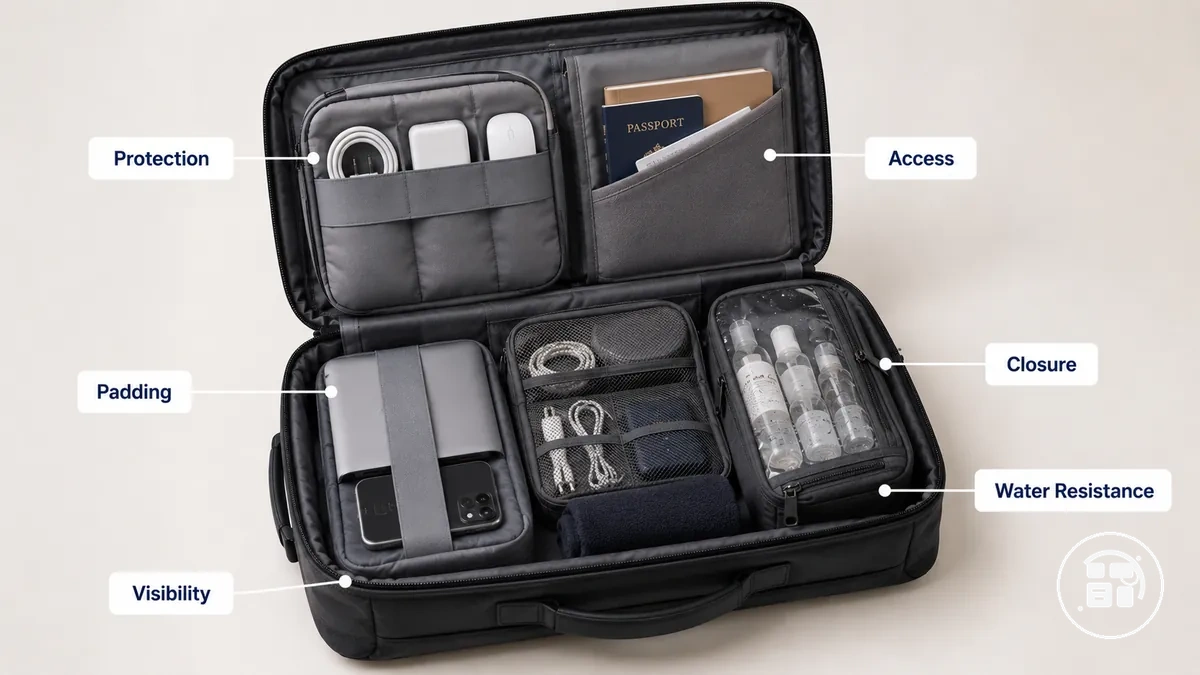
Protection and access depend on both organizer design and travel conditions. The travel organization accessories hub reflects how padding may help reduce damage risk when fragile items are positioned appropriately and closure systems help separate contents when liquid exposure is possible. Visibility and placement can improve reachability and access speed when documents, electronics, or toiletries need to be located quickly. Water resistance may help limit exposure in certain conditions, but its effect depends on the organizer feature, use case, and level of exposure.
A common misconception is that protective organization creates complete security in every travel condition. The more accurate view is that travel organization accessories can reduce common packing risks when used appropriately. They may lower risk, but they do not guarantee theft prevention, waterproofing, or impact protection in every condition.
Travel Essentials That Need Protective Organization
Travel essentials that usually benefit most from protective organization include documents, passports, cards, electronics, cables, chargers, toiletries, liquids, and valuables. These belongings often face a higher risk of loss, damage, spills, or delayed access during travel. Protective organization helps separate item types according to their risk.
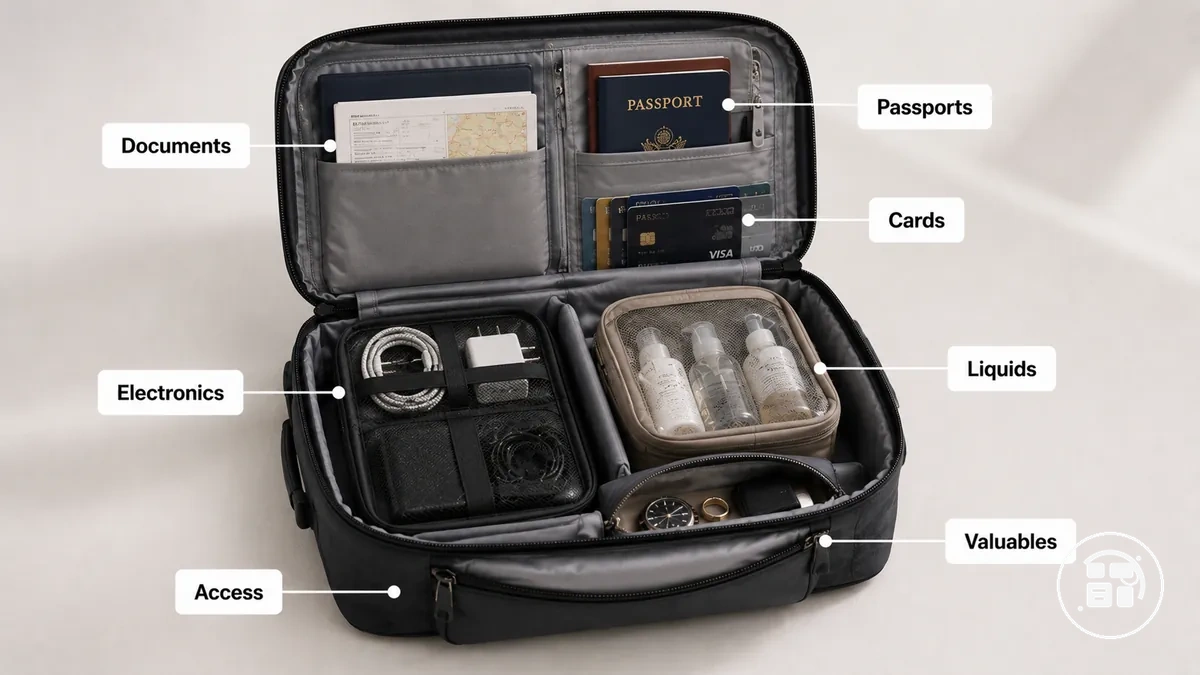
Documents, passports, cards, and valuables are often affected by loss risk and access risk rather than physical damage alone. When travel papers and small valuables are mixed with other belongings, they may become harder to locate during security checks, transit changes, or hotel movement. Dedicated placement can improve visibility and access when quick retrieval is needed. Protective organization helps keep these items grouped according to travel stage and condition.
- Documents, passports, cards: loss risk and access risk → visible placement and separation → easier retrieval.
- Electronics, cables, chargers: damage risk and tangle risk → cushioning and organization → reduced movement and better item control.
- Toiletries, liquids: spill risk and contamination risk → containment and separation → lower exposure to surrounding belongings.
- Valuables: placement-related risk → controlled storage → improved visibility and reachability.
Electronics, cables, chargers, and toiletries face different risks that may require different organizer conditions. Tech items may benefit from cushioning and separation when movement, pressure, or tangling could affect them. Leak-prone items may benefit from containment when liquids are carried near clothing, documents, or devices. Examples of organizers for documents and devices show how separation can support both protection and access.
During airport checks, hotel transfers, or travel days involving wet items, risk conditions can change quickly. Placement that works in one travel stage may require different access priorities in another. The value of protective organization depends on the belongings carried, the travel context, and the type of risk involved.
Passports, Documents, Cards, and Travel Papers
Passports, documents, cards, and travel papers benefit from separation and controlled access because they are often needed quickly and may be difficult to recover if misplaced. Keeping these items visible and grouped can reduce loss risk during travel. Organized access can also help when travel documents must be presented repeatedly.
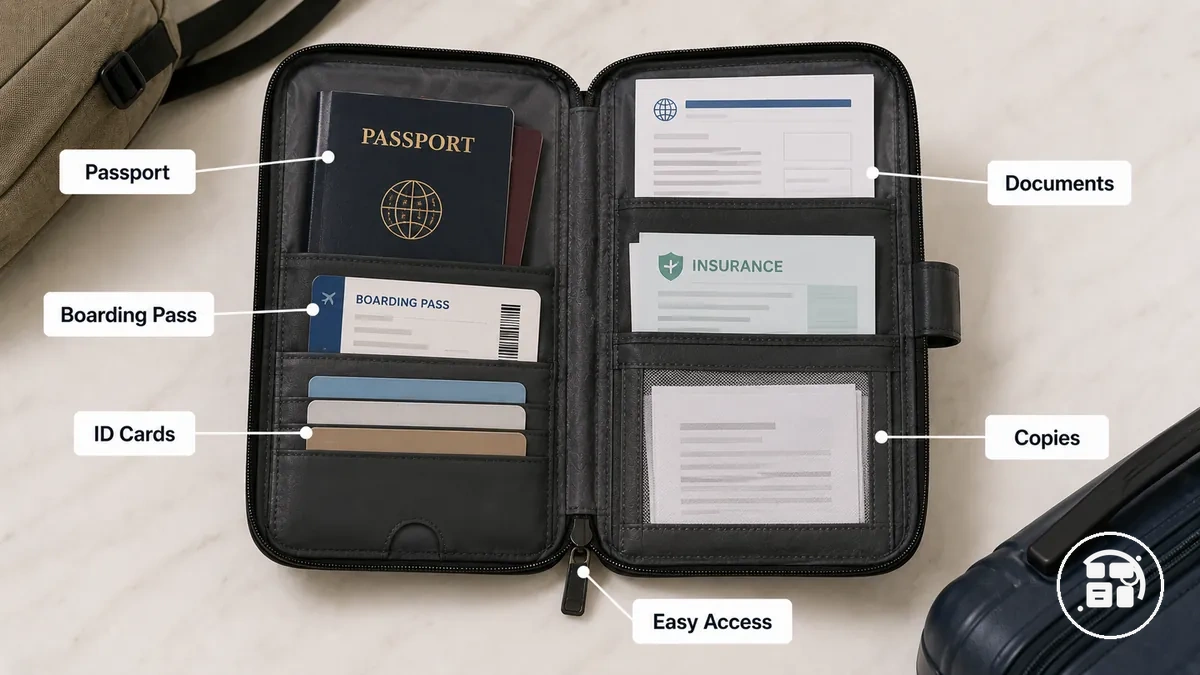
Document grouping matters because different travel papers have different access needs and loss risks.
- Passport: frequent access during check-in and identity verification → visible placement in a passport holder or document organizer can support faster access.
- Boarding pass: repeated access during transit stages → separation from less-used papers can improve visibility.
- ID and cards: regular access and loss risk → dedicated slots can help maintain separation and visibility.
- Insurance papers: less frequent access but important when needed → organized placement with related documents can improve retrieval.
- Copies: if carried, they may be easier to locate when separated from originals according to travel conditions.
During airport check-in or accommodation check-in, access priorities can change quickly. A document organizer can support visibility and controlled access, but it does not guarantee protection against loss, theft, or document misuse.
Electronics, Chargers, Cables, and Small Tech Items
Electronics, chargers, cables, and small tech items benefit from cushioning, separation, and tangle control because they can be affected by movement and pressure inside luggage. Protective organization helps keep related items together while reducing the chance of scratches, bends, or tangles. The level of protection depends on item type, placement, and organizer features.
Tech protection depends on fragility, cable movement, and pressure inside luggage. The table below shows how different electronics and accessories can be organized according to their condition and risk.
| Entity/Part | Attribute/Condition | Organizer Feature | Effect/Risk |
|---|---|---|---|
| Device | Fragile surfaces or edges | Cushioning or padded compartment | May reduce scratches and pressure-related contact |
| Cable | Loose movement during travel | Loop or elastic hold | May reduce tangles and improve retrieval |
| Charger | Mixed with other items | Dedicated compartment | May improve organization and visibility |
| Adapter | Small size and irregular shape | Separate pouch or compartment | May reduce loss risk |
| Power bank | Carry-on condition may vary by travel situation | Accessible compartment | May improve retrieval when needed |
| Small tech items | Easy to misplace | Organized compartments | May improve item control |
Loose packing can allow electronics, chargers, and cables to shift against each other, while organized containment can improve separation and access. A travel pouch with compartments, loops, or light cushioning may help in many cases, but outcomes still depend on packing pressure, item shape, and travel conditions.
Toiletries, Liquids, and Leak-Prone Accessories
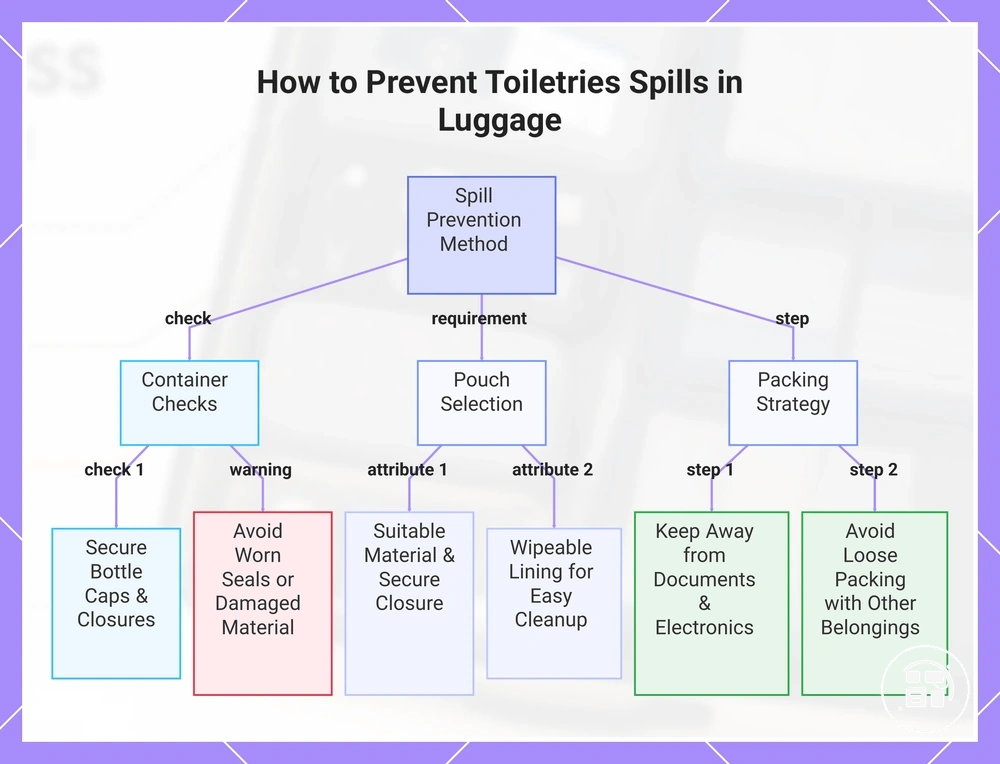
Toiletries, liquids, and leak-prone accessories require containment and separation because spills can affect documents, clothing, and electronics stored nearby. A travel pouch with suitable pouch material, a secure closure, and a wipeable lining may help limit spill risk when a bottle, cream, gel, razor, or damp accessory is carried in luggage. The result depends on the seal condition, pouch construction, and packing arrangement.
Spill risk often increases when liquid bottles, creams, gels, or wet accessories are packed loosely with other belongings. A secure seal and closure may help reduce leakage risk, while a wipeable lining can make cleanup easier if a spill occurs. Separation inside a travel pouch can help keep leak-prone accessories away from sensitive items and reduce contamination risk. A loose cap, worn seal, or damaged pouch material may still allow leakage, even when containment features are present.
- Seal: Check that bottle caps and closures are fully secured.
- Pouch material: Use a pouch designed to manage minor moisture exposure and containment needs.
- Wipeable lining: May simplify cleanup if liquids or damp items leak.
- Separation: Keep toiletries and liquids away from documents, clothing, and electronics when practical.
Containment features can help manage leak-prone accessories, but spill control depends on container condition, closure quality, pouch construction, and travel conditions.
This chart shows the key steps to prevent spills from toiletries, liquids, and leak-prone accessories: container checks, pouch selection, and packing strategy.
Protective Features That Reduce Damage, Loss, and Spills
Protective features are the organizer attributes that help reduce damage, loss, and spill exposure rather than simply keeping items tidy. The value of a feature depends on the item being carried, the travel condition, and the type of risk involved. Protective features should be matched to item fragility, access frequency, and spill exposure rather than treated as a fixed requirement.
Without the right feature, an organizer may improve order while offering limited protection against pressure, moisture, or misplaced items. Padding can help when fragile items face contact pressure, while compartments and clean separation can help when liquids, documents, and electronics need to remain apart. Visibility and closures can improve retrieval and item control when access is frequent. Water resistance may help limit moisture exposure in certain conditions, but its effect depends on material, construction, and exposure level.
Protective features reduce different risks under different conditions. The table below organizes each feature by the condition where it may matter most and the effect or limitation associated with its use.
| Feature | Condition | Protection Effect or Limitation |
|---|---|---|
| Padding | Fragile or pressure-sensitive items | May reduce contact pressure and surface damage risk |
| Structure | Items that shift during travel | May help maintain shape and item positioning |
| Water resistance | Moisture exposure or damp conditions | May help limit moisture contact; effectiveness varies by construction |
| Compartments | Mixed item types | May improve separation and item control |
| Closures | Frequent movement and access | May help contain contents; closure quality remains a limitation |
| Visibility | Frequent retrieval needs | May improve access and reduce misplaced-item risk |
| RFID blocking | Specific document or card-carrying situations | May provide an additional feature, but relevance depends on travel needs |
| Clean separation | Liquids, documents, electronics, and clothing packed together | May reduce spill and contamination exposure between item groups |
Criteria-based selection is often more useful than choosing every available feature. Travelers carrying fragile items may prioritize padding and structure, while travelers carrying liquids may focus on clean separation, closures, and water resistance. More detail about protective organizer features can help match feature strength to travel conditions, access needs, and practical limitations.
Padding, Structure, and Shock Protection
Padding, structure, and shock protection are protective attributes that help reduce pressure, scratches, and minor bump exposure during travel. Their value depends on item fragility, luggage pressure, and organizer placement. A fragile item may benefit from more cushioning and support than an item that is already durable.
Padding and structure work together when belongings are exposed to movement inside a bag. A padded sleeve may help reduce surface contact and scratch risk, while a rigid pouch can help maintain shape when surrounding items create pressure. A compartment wall may improve separation between fragile and heavier items, reducing direct contact in certain packing conditions. Shock protection is influenced by padding thickness, structural stiffness, and placement rather than by any single feature alone.
Padding, structure, and shock protection affect protection differently depending on the item and travel condition. The comparison below highlights where each feature may help and where limitations remain.
| Entity/Part | Attribute/Condition | Effect/Risk/Decision |
|---|---|---|
| Electronics organizer | Light padding with moderate pressure exposure | May reduce scratches and minor contact pressure |
| Rigid pouch | Structured shape under packed conditions | May help limit compression; protection varies by construction |
| Padded sleeve | Fragile item with surface-contact risk | May reduce scratch risk and minor bump exposure |
| Compartment wall | Mixed items packed together | May improve separation and reduce direct contact between items |
Higher levels of padding or structure do not automatically create complete shock protection. The outcome depends on item fragility, packing density, luggage pressure, and how the organizer is positioned during travel.
Water Resistance, Leak Control, and Clean Separation
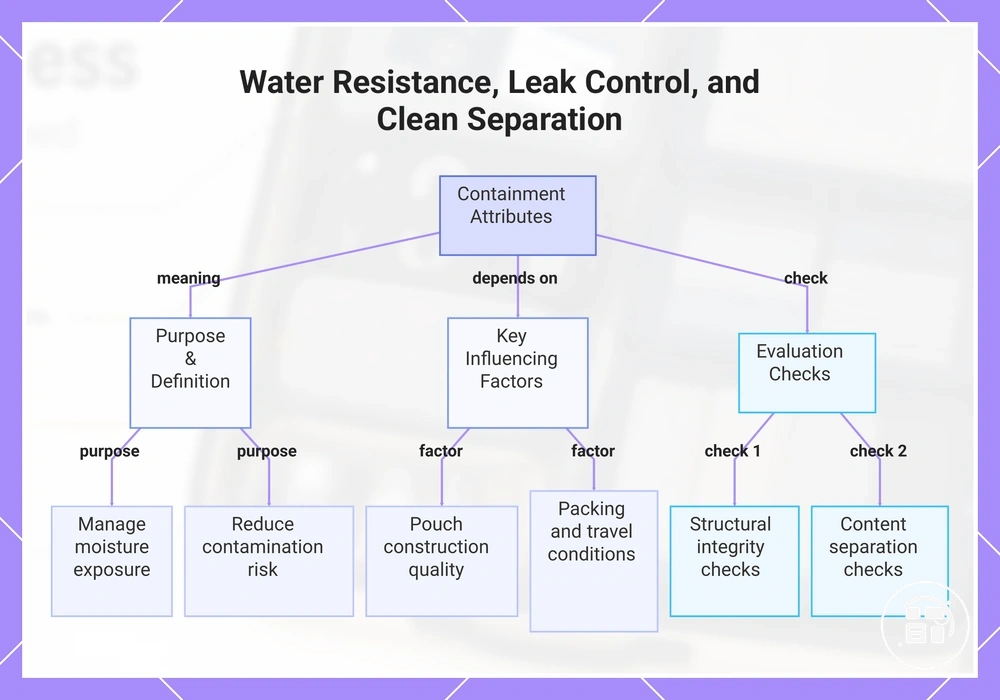
Water resistance, leak control, and clean separation are containment attributes that help manage moisture exposure and reduce contamination risk inside travel organization accessories. Water resistance refers to limiting moisture penetration under certain conditions, while leak control and clean separation focus on containing liquid items and keeping them apart from other belongings. Their effectiveness depends on pouch material, lining, seams, closures, and packing conditions.
Liquid exposure can affect nearby documents, electronics, or clothing when containers loosen, leak, or shift during travel. A travel pouch with suitable pouch material, a wipeable lining, and adequate zipper coverage may help contain minor moisture exposure and reduce the spread of liquids. Clean separation keeps liquid items apart from sensitive belongings, while leak control depends on containment conditions rather than a universal outcome. Seams, closure quality, and bottle separation can influence how effectively moisture remains confined within an organizer.
When evaluating water resistance, leak control, and clean separation, these containment conditions are often useful to check:
- Seams: Well-finished seams may help reduce moisture migration through stitched areas.
- Zipper coverage: Covered closures may help limit moisture entry in certain conditions.
- Lining: A wipeable lining may make cleanup easier after minor liquid exposure.
- Bottle separation: Keeping liquid containers apart from documents, electronics, and clothing supports containment and clean separation.
Water resistance and leak control can help reduce wetness and contamination risk when containment features match the travel condition. Results depend on closure integrity, liquid volume, pouch construction, and how items are packed.
This chart explains the meaning, influencing factors, and evaluation checks for containment attributes in travel organizers.
Secure Closures, Visibility, and RFID Blocking
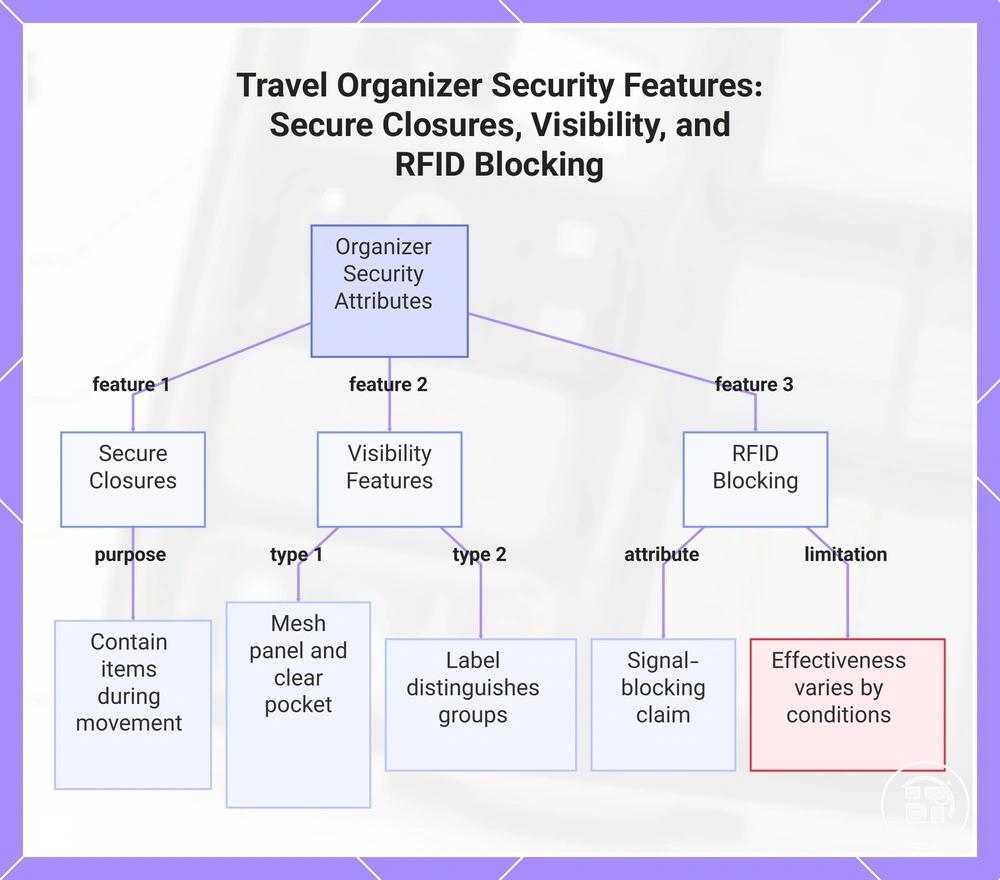
Secure closures, visibility, and RFID blocking are organizer attributes that support access control and item confidence during travel. Secure closures help keep items contained, visibility features make belongings easier to identify, and RFID blocking may add a layer of protection in certain card- or document-carrying situations. Each feature serves a different purpose and should not be treated as a single security solution.
Items can be misplaced, overlooked, or difficult to retrieve when an organizer lacks clear access control or visual identification. A zipper, snap, or elastic loop helps keep contents contained, while a mesh panel, clear pocket, or label can improve visibility and reduce search time. These features support faster identification when access is needed and may lower the risk of overlooking small items. RFID blocking differs from physical closures and visibility features because it focuses on signal-blocking claims rather than item organization or containment.
- Zipper, snap, and elastic loop: Support access control by helping keep contents contained during movement.
- Mesh panel and clear pocket: Improve visibility by making stored items easier to identify without opening every compartment.
- Label: Helps distinguish item groups and may reduce retrieval time when multiple organizers are carried.
- RFID layer: May provide signal-blocking functionality in certain situations, but effectiveness depends on material, implementation, and use conditions.
Secure closures and visibility features directly support organization and retrieval, while RFID blocking should be viewed as a limited feature with results that can vary by design and travel context.
This chart explains the three main security-related attributes of travel organizers – secure closures, visibility features, and RFID blocking – and their distinct purposes and limitations.
Access Design for Items Needed During the Trip
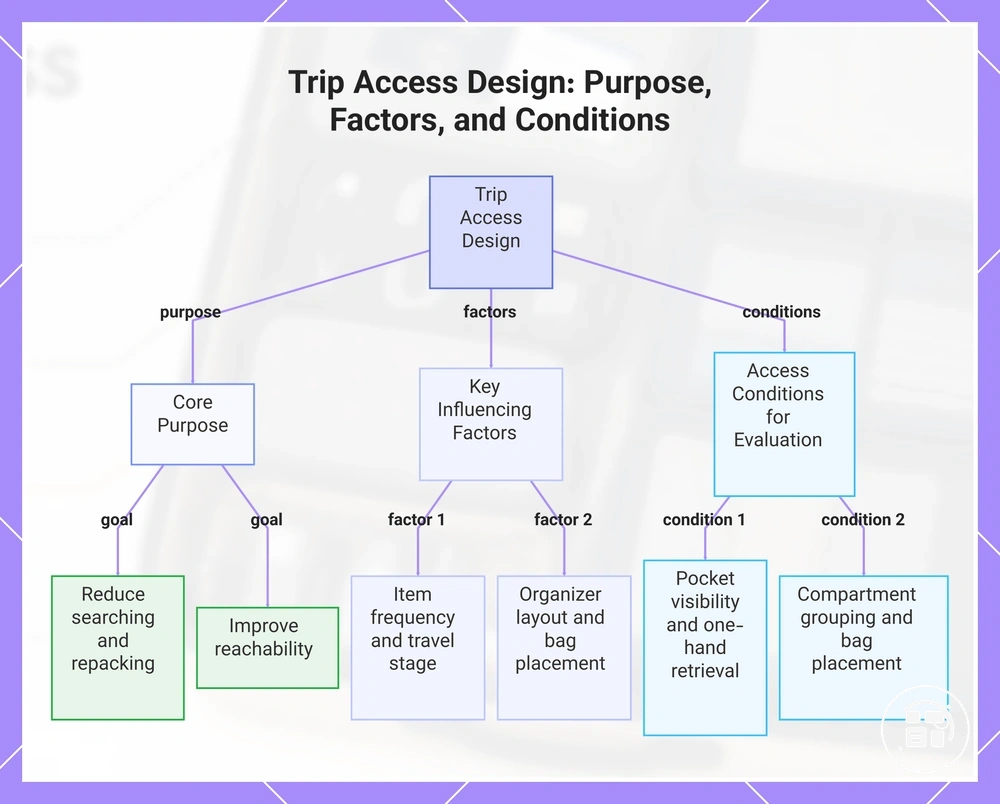
Access design improves reachability by placing frequently used items where retrieval is easier during different travel stages. The purpose is to reduce unnecessary searching and repacking when documents, cards, devices, or daily-use belongings are needed. Effective access design depends on item frequency, organizer layout, and bag placement.
Access problems often occur when frequently used items are stored with belongings that are rarely needed. Access design and organizer layout can improve retrieval when pocket visibility and compartment grouping reflect actual usage patterns. Reachability may improve when high-frequency items remain in accessible locations instead of being buried beneath lower-priority items. The outcome depends on placement, item volume, and travel behavior.
Travel stage can change access priorities and influence organizer layout decisions. During an airport check, identification or travel documents may require greater reachability than items intended for later use. During hotel stays, train transfers, car travel, or daily movement, different belongings may become the frequently used items. Bag placement can help support these changing access needs when access design reflects the situation.
Access design for frequently used items is easier to evaluate when access conditions are reviewed together:
- Pocket visibility: Visible storage areas may reduce search time for commonly used items.
- One-hand retrieval: Accessible compartments can improve retrieval when movement limits both-hand access.
- Compartment grouping: Related items stored together may reduce repeated searching.
- Bag placement: Organizer position inside the bag can affect reachability during different travel stages.
Access design works best when item frequency, travel stage, and reachability are considered together. Faster retrieval and less repacking may be possible when organizer layout matches how belongings are used throughout the trip.
This chart explains the core purpose, key influencing factors, and access conditions for designing reachable storage of trip items.
Frequently Used Items That Should Stay Reachable
Frequently used items should remain easy to reach because repeated retrieval can increase searching and interrupt travel flow. An easy access pouch can help keep high-frequency items available when they are needed during different travel stages. The most suitable position depends on luggage type, travel conditions, and personal needs.
Access delays often happen when frequently used items are stored with belongings that are rarely needed. A passport, ticket, wallet, keys, phone cable, medication, sanitizer, or small toiletries may benefit from an organizer position that supports easier retrieval. When these items are grouped by use frequency, an organizer can reduce repeated searching and unnecessary repacking. The result depends on organizer layout, item volume, and how the items are used throughout the trip.
- Travel access items: passport, ticket, wallet, and keys → frequent retrieval needs → may benefit from an easy access pouch.
- Daily-use essentials: phone cable, sanitizer, and small toiletries → repeated use during travel → may be easier to retrieve when grouped together.
- Personal-use items: medication and similar essentials → access needs vary by traveler and travel stage → position depends on individual requirements.
Frequently used items are easier to manage when use frequency guides organizer position. The most practical location can vary according to the travel stage, bag design, security requirements, and personal access priorities.
Clear Pockets, Labels, and Compartment Visibility
Clear pockets, labels, and compartment visibility improve item identification and support easier retrieval during travel. Their purpose is to reduce searching by making item locations easier to recognize without requiring every organizer to be transparent. Visibility features function as access aids when items need to be found quickly.
Searching becomes more difficult when compartments look similar or when item locations change frequently. Clear pockets support direct identification, while mesh panels can provide visibility without fully exposing contents. Labels, color coding, and dedicated pockets help associate specific item groups with consistent locations, making identification easier during retrieval. Faster retrieval and lower misplacement risk may depend on item grouping, labeling consistency, and travel behavior.
- Clear pockets: support direct identification of stored items.
- Mesh: provides partial visibility while maintaining some privacy.
- Labels: help identify item categories without opening every compartment.
- Color coding: can distinguish item groups through visual recognition.
- Dedicated pockets: assign a consistent location to frequently carried items.
Greater compartment visibility is not always the preferred choice. Privacy needs, item type, and travel conditions may influence whether clear pockets, mesh, labels, color coding, or dedicated pockets provide the most practical balance between identification and concealment.
Carry-On and Checked-Luggage Safety Boundaries
Carry-on and checked luggage safety boundaries depend on value, fragility, access need, and travel rules. Valuables, documents, medication, electronics, and fragile accessories often benefit from staying closer to the traveler, while lower-risk spare items may be packed deeper when protected. The purpose of these safety boundaries is to support safer placement decisions rather than create fixed packing rules.
Placement becomes more important when an item is difficult to replace, frequently needed, or vulnerable to damage. A carry-on may provide easier access and greater personal control for documents, medication, valuables, and certain electronics. Checked luggage may be suitable for protected spare items, extra toiletries, or belongings with lower access needs when appropriate protection is used. The most suitable placement depends on the travel context, item type, handling conditions, and applicable travel requirements.
These carry-on and checked luggage safety boundaries organize placement decisions according to item condition and risk.
| Entity/Part | Attribute/Criterion | Value/Condition | Effect/Risk/Decision |
|---|---|---|---|
| Valuables | High value | Loss or control concerns | May benefit from carry-on placement |
| Documents | Frequent access need | Identification or travel checks | Often easier to manage in a carry-on |
| Medication | Personal access requirement | Need may vary during travel | Placement depends on travel circumstances and requirements |
| Electronics | Fragility and access need | Damage risk or frequent use | May benefit from carry-on placement with a protective organizer |
| Fragile accessories | Breakage sensitivity | Pressure or handling exposure | Placement depends on protection level and travel conditions |
| Toiletries | Lower access frequency | Contained and protected condition | May be suitable for checked luggage when appropriate |
| Spare items | Infrequent use | Protected storage | Can often be packed deeper inside checked luggage |
A protective organizer can help cushion or separate belongings inside luggage, but protection within luggage is different from control over loss, theft, inspection, delays, or baggage handling. Carry-on and checked luggage decisions should remain conditional because travel rules, airport procedures, item types, and route requirements may vary.
Valuables and Documents That Should Stay With You
Valuables and documents often benefit from personal control rather than deep luggage storage because identity needs, access requirements, and replacement difficulty can be higher. A carry-on, passport holder, or travel pouch may help keep important items closer to the traveler when access is needed. The purpose is to reduce the risk of delays caused by inaccessible or misplaced essentials.
Problems can arise when high-value or identity-critical items are packed where retrieval becomes difficult during travel. Documents, cards, cash, medication, and essential electronics may require quicker access or closer personal control than other belongings. Keeping these items in a carry-on or organizer can support retrieval when travel conditions change or access needs increase. The benefit depends on item value, identity importance, access frequency, replacement difficulty, security requirements, and personal travel needs.
- Documents and cards: identity and payment functions → may benefit from closer personal control.
- Cash: value-related consideration → carry position depends on travel context and individual preference.
- Medication: access needs may vary during a trip → placement depends on personal requirements.
- Essential electronics: frequent use or replacement difficulty → may be easier to manage in a carry-on.
A passport holder or document organizer can help keep important items grouped together, but the most suitable carry position may vary according to travel rules, security procedures, and individual circumstances.
Fragile Items That Need Deeper Cushioning
Fragile items may be placed deeper when deeper cushioning, separation, and pressure control are adequate. Deeper placement can reduce exposure to frequent handling, but it can also increase pressure risk from surrounding contents. The purpose is to balance fragility, placement, and protection rather than assume deeper packing is safer in every situation.
Problems can occur when fragile items are packed beneath heavier belongings without enough cushioning or separation. Glasses, small devices, chargers, breakable containers, and delicate accessories may be exposed to compression, shifting, or direct contact during travel. A protective organizer or travel pouch can help improve pressure control when fragile items are surrounded by other packed belongings. The placement outcome depends on fragility level, cushioning condition, access needs, and the amount of pressure the packed area may experience.
Fragile items that need deeper cushioning should be evaluated according to pressure risk and protective conditions.
| Entity/Part | Attribute/Criterion | Value/Condition | Effect/Risk/Decision |
|---|---|---|---|
| Glasses | High surface and frame sensitivity | Cushioned and separated storage | May tolerate deeper placement when pressure control is adequate |
| Small devices | Fragility varies by construction | Protected from direct compression | Placement depends on cushioning and surrounding weight |
| Chargers | Moderate impact and pressure exposure | Organized in a pouch or compartment | May benefit from separation from fragile items |
| Breakable containers | Crack or leak risk | Cushioned with limited movement | May be better protected when pressure is controlled |
| Delicate accessories | Shape or material sensitivity | Separated from rigid or heavy items | Placement depends on protection level and access needs |
A pair of glasses inside a cushioned case may handle deeper placement better than glasses stored loose among packed items. The most suitable placement still depends on pressure control, separation, fragility, and retrieval needs during the trip.
When a Protective Organizer Is Better Than a Basic Pouch
A protective organizer may be a better choice than a basic pouch when item risk, trip complexity, and access frequency increase. Protection is often more valuable when belongings need padding, structure, separation, or controlled access. The decision depends on the items being carried and the conditions of the trip.
A basic pouch may be suitable for low-risk items that need simple storage. Challenges can arise when fragile items, important documents, liquids, or frequently used accessories are stored together without enough separation. A protective organizer can help improve padding, closure quality, and visibility when item risk increases or when multiple item types need organized storage. The benefit depends on item type, fragility, liquid risk, and access requirements.
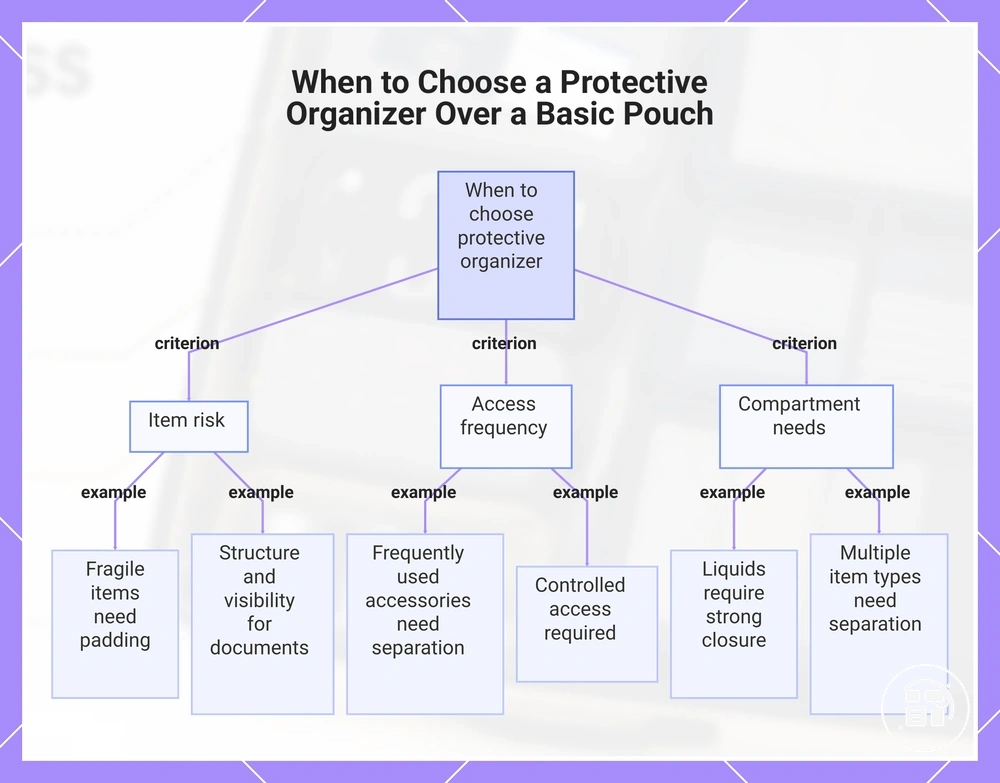
The following criteria can help guide the choice between a basic pouch and a protective organizer. Fragile items may justify added padding, while important documents may benefit from greater structure and visibility. Liquids and toiletries may require stronger closure quality and compartment separation. Travelers dealing with packing problems that need protection may find that item risk, access frequency, and compartment needs are useful decision criteria.
A protective organizer often adds structure, separation, and access control, while a basic pouch may remain sufficient for simpler packing situations. The trade-off is usually between added protection and simpler storage. Padded electronics organizers, travel document organizers, waterproof pouches, and protective toiletry bags can each suit different conditions depending on item type, risk level, and retrieval needs.
The products below are useful examples for comparing available options. Before buying, check that the compatibility criteria, key features, and product details match your needs.
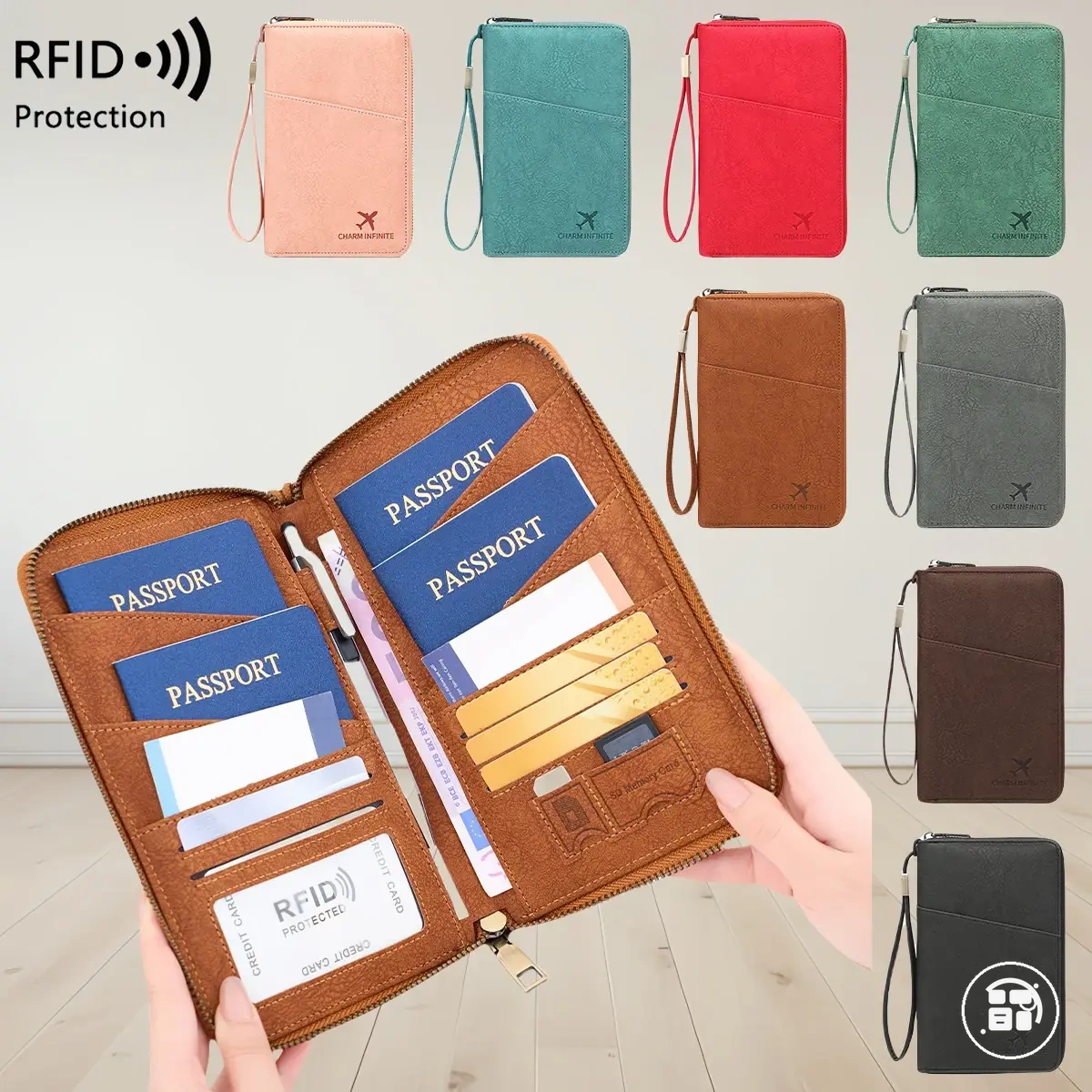
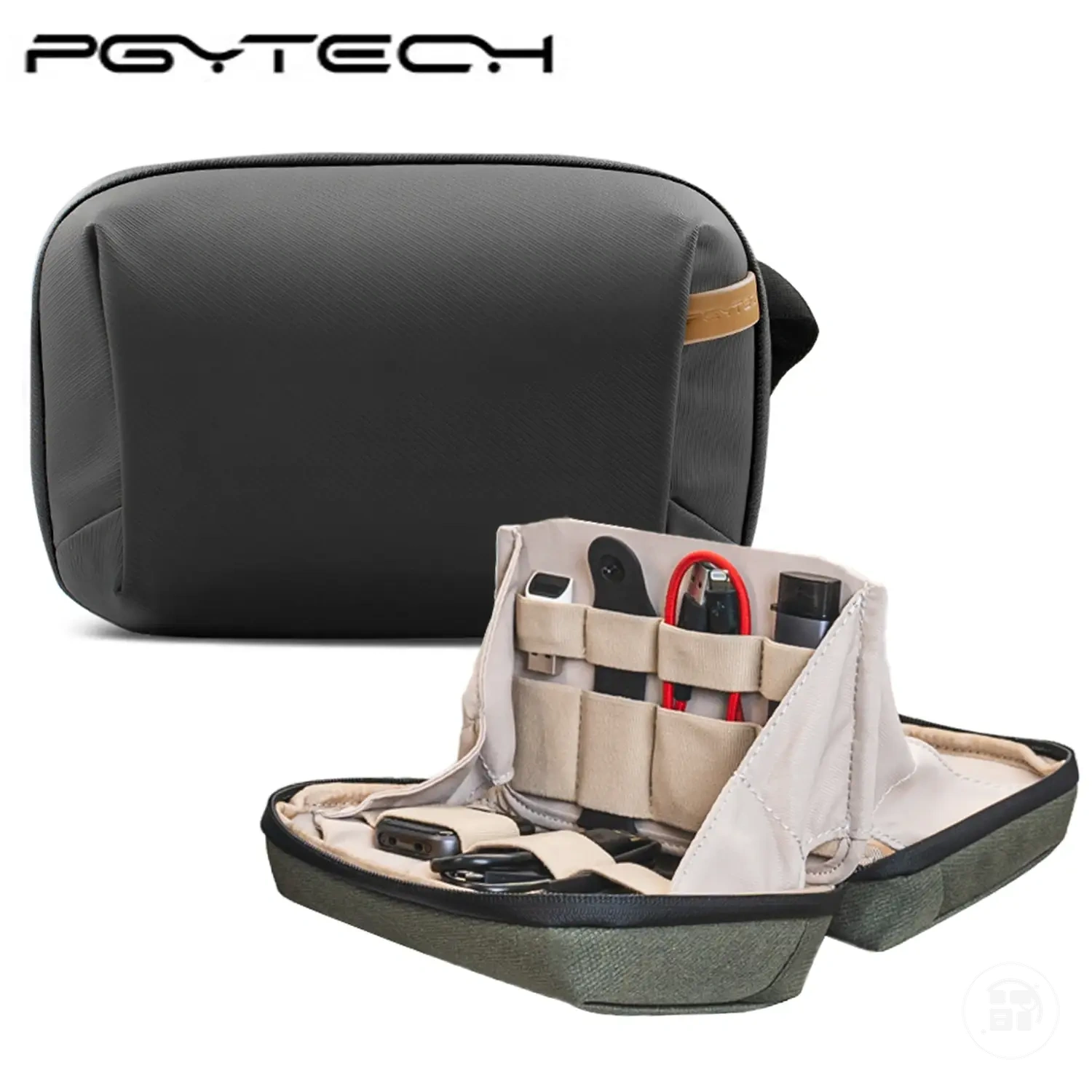
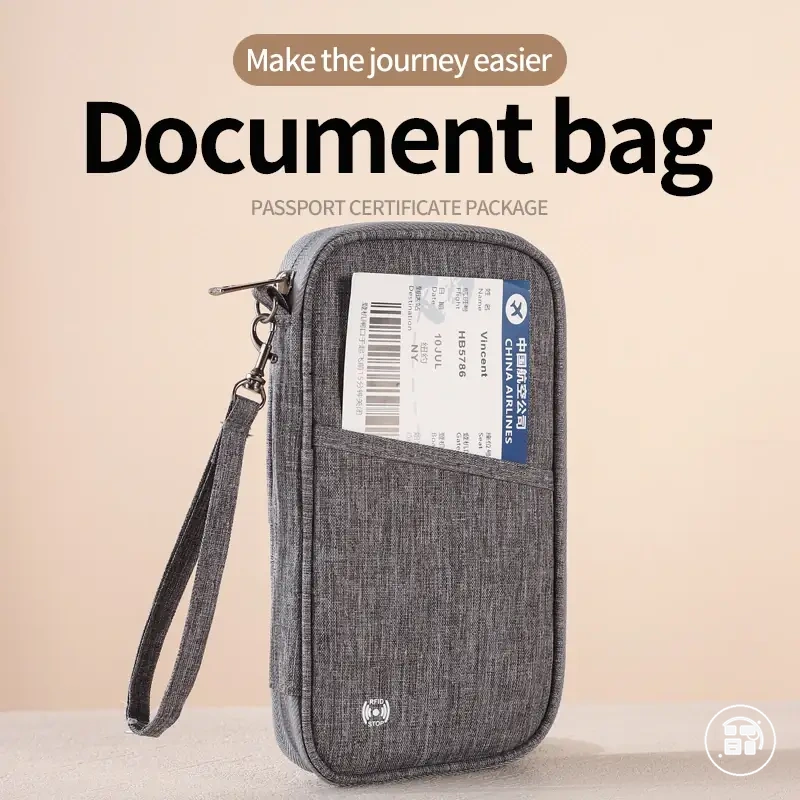
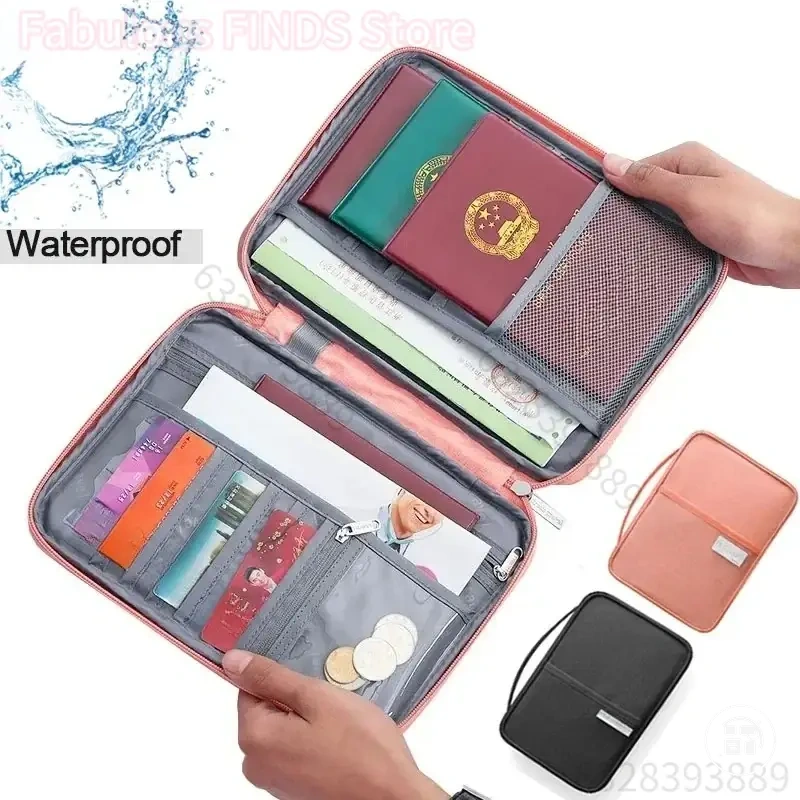
This chart shows the key decision criteria for choosing between a protective organizer and a basic pouch based on item risk, access frequency, and compartment needs.
Packing Mistakes That Weaken Protection and Access
When weak protection or access problems occur, packing mistakes are often the cause rather than the organizer itself. Poor matching, overstuffing, weak closure, wrong placement, and mixed-risk items can increase risk and reduce usability. A correction usually starts by identifying which condition is limiting protection or access.
Overstuffing can reduce space for padding and make a weak closure more likely to strain during travel. An overfilled pouch may compress fragile items, tangle loose cables, or make retrieval slower. The likely cause is storing more items than the organizer can separate effectively. A safer correction is to reduce item volume or use a protective organizer with enough compartments and structure for the contents.
Mixed-risk items can create protection problems when liquids, papers, electronics, or fragile belongings share the same space without separation. Liquids beside papers may increase contamination risk if leakage occurs, while fragile items without cushioning may face pressure from surrounding contents. Wrong placement can also create access problems, such as a buried passport that requires repeated unpacking. A safer correction is to separate item types according to risk, fragility, and access need.
Packing mistakes that weaken protection and access can often be reviewed through mistakes that reduce access and protection before choosing a correction.
| Mistake | Likely Cause | Risk Effect | Safer Correction |
|---|---|---|---|
| Overstuffing | Too many items in one pouch | Reduced protection and slower retrieval | Reduce volume or improve separation |
| Weak closure | Overloaded or poorly secured organizer | Higher chance of contents shifting | Check closure quality and packing load |
| Liquids beside papers | Mixed-risk items stored together | Possible contamination or damage | Separate liquids from documents |
| Loose cables | Lack of organization | Tangling and slower access | Use dedicated compartments or loops |
| Buried passport | Wrong placement | Delayed retrieval | Store in an accessible location |
| Fragile items without cushioning | Missing padding or separation | Higher pressure or contact risk | Add cushioning or separate from heavier items |
Prevention depends on consistent separation, appropriate placement, and avoiding conditions that create unnecessary pressure or access delays. A protective organizer may help when item risk and trip complexity increase, but the outcome still depends on how the organizer is packed and used.
The products below are useful examples for comparing available options. Before buying, check that the compatibility criteria, key features, and product details match your needs.